 Add to Chrome
 Add to Firefox
 Add to Edge
Global Optimization and Inference-Time Region Grafting for Agentic Workflows
Aug 03, 2026
Recent advances in agentic workflow optimization automate workflow design through task-specific workflow search or input-conditioned architecture selection. However, they determine the workflow before execution and cannot adapt failed workflow regions using execution-time label-free quality signals. Naively enabling such inference-time adaptation through whole-workflow re-optimization would be computationally prohibitive. To tackle this challenge, we introduce GRAFT, which preserves a globally optimized workflow while locally replacing only selected regions for each input. Without parameter training, GRAFT evaluates region-level alternatives using label-free execution-quality signals and accepts only replacements that improve local quality while preserving workflow-level consistency, thereby enabling instance-wise adaptation without whole-workflow re-optimization. GRAFT applies without modification across a range of tasks spanning mathematical reasoning, code generation, and multi-hop and knowledge-intensive question answering. Under matched optimizer and executor settings, it improves over the strongest prior workflow-optimization method, MaAS, by 3.85 points on average. Replacing only the executor with a stronger model yields further gains without re-optimizing the global workflow. This suggests that an optimized workflow is not merely a static optimization artifact, but an adaptable execution policy that can evolve with inference-time feedback and stronger executors.

ScholarBench: A Bilingual Benchmark for Abstraction, Comprehension, and Reasoning Evaluation in Academic Contexts
May 22, 2025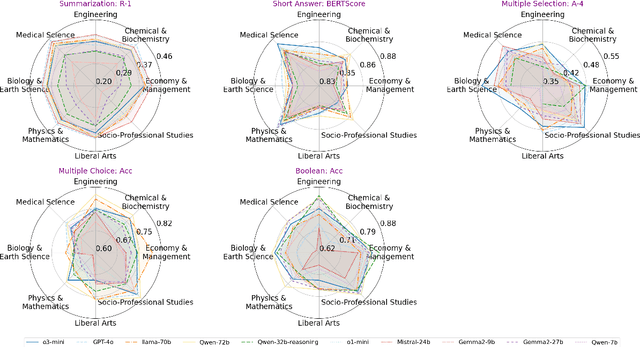
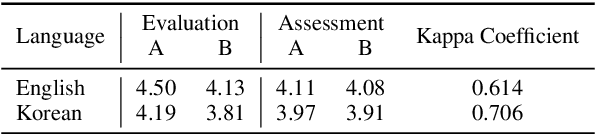
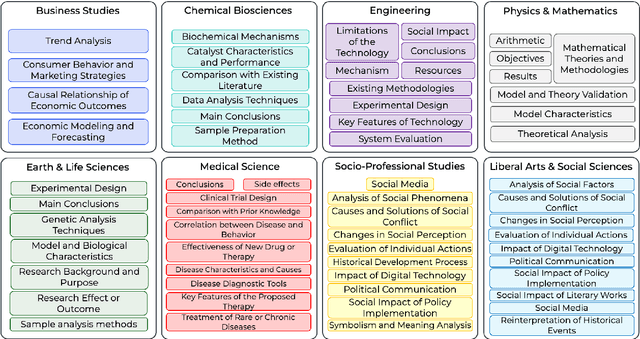
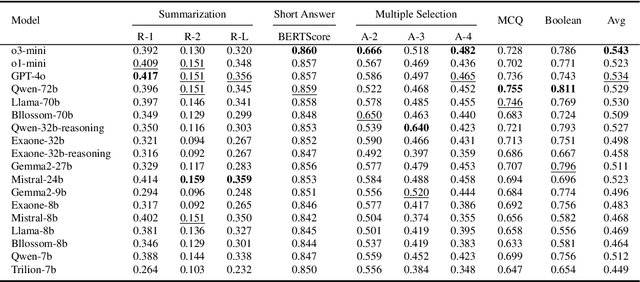
Prior benchmarks for evaluating the domain-specific knowledge of large language models (LLMs) lack the scalability to handle complex academic tasks. To address this, we introduce \texttt{ScholarBench}, a benchmark centered on deep expert knowledge and complex academic problem-solving, which evaluates the academic reasoning ability of LLMs and is constructed through a three-step process. \texttt{ScholarBench} targets more specialized and logically complex contexts derived from academic literature, encompassing five distinct problem types. Unlike prior benchmarks, \texttt{ScholarBench} evaluates the abstraction, comprehension, and reasoning capabilities of LLMs across eight distinct research domains. To ensure high-quality evaluation data, we define category-specific example attributes and design questions that are aligned with the characteristic research methodologies and discourse structures of each domain. Additionally, this benchmark operates as an English-Korean bilingual dataset, facilitating simultaneous evaluation for linguistic capabilities of LLMs in both languages. The benchmark comprises 5,031 examples in Korean and 5,309 in English, with even state-of-the-art models like o3-mini achieving an average evaluation score of only 0.543, demonstrating the challenging nature of this benchmark.