 Add to Chrome
 Add to Firefox
 Add to Edge
PENet+: A Lightweight Residual Transformer Framework for Efficient Image Steganalysis
Jun 09, 2026
Image steganalysis, the detection of hidden information embedded in digital images, is a core component of modern cybersecurity and digital forensics. Recent residual Transformer architectures, such as the Pixel-Difference-Convolution and Enhanced-Transformer-Network (PENet) [1], achieve strong detection accuracy, but their computational and memory demands hinder deployment in resource-constrained settings. We present PENet+, a lightweight steganalysis framework that preserves PENet's discriminative structure while substantially improving efficiency. Rather than redesigning or compressing the attention blocks, we retain PENet's self-attention topology for reproducibility and add a classifier-streamlining stage that progressively narrows the SPP-to-FC1 input channels (SPP: spatial pyramid pooling; FC1: first fully connected layer), yielding large reductions in parameters and FLOPs with negligible accuracy loss. We further refine the high-pass-filter (HPF) stem with an activation-aware mechanism that aggregates HPF responses early and selects a balanced SRM-Gabor top-K subset, and we replace PENet's backbone with a MobileNetV2-style inverted residual network. A balanced configuration with K=31 filters (16 Gabor + 15 SRM) matches or surpasses heavier settings at lower compute. Finally, we motivate PReLU from a steganalysis standpoint, arguing that preserving negative responses helps capture weak stego cues that ReLU suppresses. On a disjoint ALASKA2 JPEG QF90 protocol at 512x512 resolution (5,000 cover images for training, validation, and internal testing; a separate 19,000-cover evaluation set), PENet+ achieves up to 45.5% fewer parameters and about 97% fewer FLOPs than the re-evaluated PENet baseline, offering a computationally efficient direction for resource-constrained steganalysis. Device-level latency and power measurements remain future work.

VLR-Bench: Multilingual Benchmark Dataset for Vision-Language Retrieval Augmented Generation
Dec 13, 2024



We propose the VLR-Bench, a visual question answering (VQA) benchmark for evaluating vision language models (VLMs) based on retrieval augmented generation (RAG). Unlike existing evaluation datasets for external knowledge-based VQA, the proposed VLR-Bench includes five input passages. This allows testing of the ability to determine which passage is useful for answering a given query, a capability lacking in previous research. In this context, we constructed a dataset of 32,000 automatically generated instruction-following examples, which we denote as VLR-IF. This dataset is specifically designed to enhance the RAG capabilities of VLMs by enabling them to learn how to generate appropriate answers based on input passages. We evaluated the validity of the proposed benchmark and training data and verified its performance using the state-of-the-art Llama3-based VLM, the Llava-Llama-3 model. The proposed VLR-Bench and VLR-IF datasets are publicly available online.
Advancing Cross-Domain Generalizability in Face Anti-Spoofing: Insights, Design, and Metrics
Jun 18, 2024
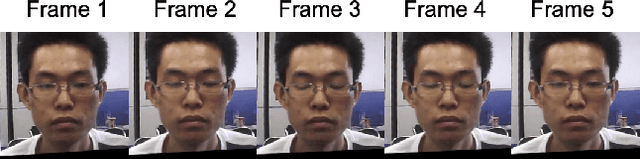
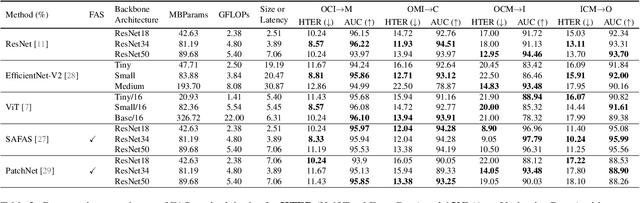
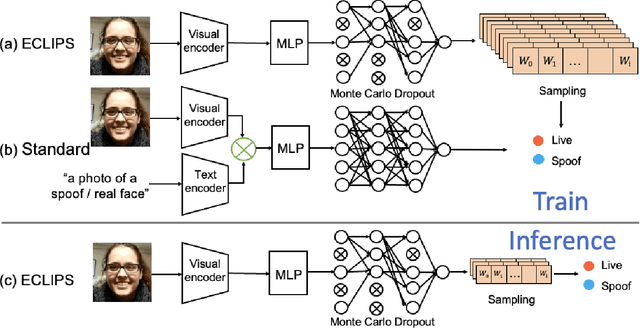
This paper presents a novel perspective for enhancing anti-spoofing performance in zero-shot data domain generalization. Unlike traditional image classification tasks, face anti-spoofing datasets display unique generalization characteristics, necessitating novel zero-shot data domain generalization. One step forward to the previous frame-wise spoofing prediction, we introduce a nuanced metric calculation that aggregates frame-level probabilities for a video-wise prediction, to tackle the gap between the reported frame-wise accuracy and instability in real-world use-case. This approach enables the quantification of bias and variance in model predictions, offering a more refined analysis of model generalization. Our investigation reveals that simply scaling up the backbone of models does not inherently improve the mentioned instability, leading us to propose an ensembled backbone method from a Bayesian perspective. The probabilistically ensembled backbone both improves model robustness measured from the proposed metric and spoofing accuracy, and also leverages the advantages of measuring uncertainty, allowing for enhanced sampling during training that contributes to model generalization across new datasets. We evaluate the proposed method from the benchmark OMIC dataset and also the public CelebA-Spoof and SiW-Mv2. Our final model outperforms existing state-of-the-art methods across the datasets, showcasing advancements in Bias, Variance, HTER, and AUC metrics.
BOK-VQA: Bilingual Outside Knowledge-based Visual Question Answering via Graph Representation Pretraining
Jan 12, 2024

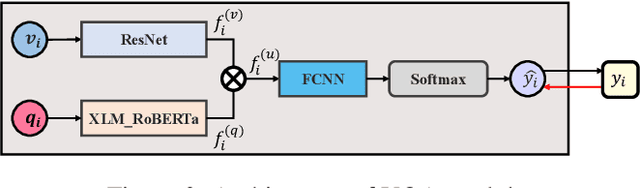

The current research direction in generative models, such as the recently developed GPT4, aims to find relevant knowledge information for multimodal and multilingual inputs to provide answers. Under these research circumstances, the demand for multilingual evaluation of visual question answering (VQA) tasks, a representative task of multimodal systems, has increased. Accordingly, we propose a bilingual outside-knowledge VQA (BOK-VQA) dataset in this study that can be extended to multilingualism. The proposed data include 17K images, 17K question-answer pairs for both Korean and English and 280K instances of knowledge information related to question-answer content. We also present a framework that can effectively inject knowledge information into a VQA system by pretraining the knowledge information of BOK-VQA data in the form of graph embeddings. Finally, through in-depth analysis, we demonstrated the actual effect of the knowledge information contained in the constructed training data on VQA.