 Add to Chrome
 Add to Firefox
 Add to Edge
Robustness and User-Perceived Value of Popularity Calibration in Music Recommendation: A User Study
Aug 05, 2026
Popularity calibration in recommender systems has been studied both as a form of user-centered personalization and as an indicator of popularity bias. Most existing work evaluates calibration through offline metrics, often assuming that users prefer recommendation lists whose popularity distribution matches their historical consumption profile. However, user studies on calibration remain limited, and existing findings suggest that calibrated recommendations do not necessarily have a strong effect on user experience. Moreover, although prior work has shown that calibration metrics can correlate with users' perceptions of recommendation lists, the robustness of this relation remains unclear under different levels of item familiarity and incomplete user-history information. In this work, we study the perceived value and measurement reliability of popularity calibration in music recommendation. We construct personalized track lists from users' recent listening histories and use a controlled naive recommender to create lists with different popularity compositions: highpop-heavy, lowpop-heavy, and calibrated. We investigate whether users perceive differences between these lists, whether calibrated lists are preferred, how robust JSD-based popularity calibration is under different familiarity and history-availability conditions, and how computational popularity labels align with users' own popularity judgments. Our results show that users perceive differences in popularity composition, but do not clearly prefer calibrated lists. We further find that the relation between JSD and perceived popularity depends on item familiarity, list composition, and available user history, while computational and user-judged popularity labels only weakly align. These findings contribute to a more critical understanding of popularity calibration as both an offline metric and a user-facing construct.

From Skill Extraction to Multistakeholder Recommendation: A Two-Stage Framework for Bias Governance in Skills-Based Job Matching
Jul 17, 2026AI-based labor-market systems or platforms can affect access to job opportunities prior to organizational candidate rankings or hiring decisions. Such applications warrant caution, as biases in skill extraction, profile formation, and candidate-job matching may contribute to unfair treatment of candidates. In this paper, we propose a two-stage framework for detecting and governing bias in skills-based job matching. Stage 1, skill extraction and profile formation, addresses how candidates provide skills and preferences to the system, how the system extracts and structures this information, and the bias risks this entails, with a focus on chatbot-based elicitation. Stage 2, multistakeholder candidate-job recommendation, would embed this information in a recommender system in which candidate, company, and regulatory objectives are represented by separate agents, each producing an independent candidate-job ranking; these rankings would be combined through social choice-based aggregation into a single, auditable recommendation. The two stages are connected by a shared distinction between hard constraints, which require correction before processing continues, and soft constraints, which are logged to inform later decisions. Following an AI Act-aligned assessment methodology (based on the Fraunhofer AI Assessment Catalog), we propose using distributional auditing and counterfactual testing to produce a Stage 1 bias inventory sorted into hard and soft constraints, with the latter informing fairness thresholds for Stage 2. The same logic would apply to Stage 2: fairness metrics crossing predefined thresholds would trigger an adapted recommendation process, while smaller deviations would be logged as bias reports and persistent fairness states.
Fair Agents: Balancing Multistakeholder Alignment in Multi-Agent Personalization Systems
May 04, 2026LLM agents are increasingly used for personalization due to their ability to communicate directly with users in natural language, integrate external knowledge bases, and negotiate with other (possibly human) agents. Especially in multistakeholder AI systems with multiple distinct objectives, LLM agents are used to independently optimize for each stakeholder's goals. Here, stakeholder alignment is essential to identify and map these goals to provide LLM agents with quantifiable objectives. Plus, the way in which the outputs of the LLM agents are aggregated is fundamental to ensuring fair outcomes for all agents and, therefore, stakeholders. In this work, we identify open research challenges and propose a conceptual framework for designing fair multi-agent multistakeholder personalization systems that balance competing stakeholder objectives. Our framework integrates (i) methods to align stakeholder objectives and LLM agents, (ii) aggregation strategies, e.g., based on social choice theory, to form fair collective decisions, and (iii) stakeholder-centric evaluation procedures for both individual and collective agent behavior. We showcase our framework through a tourism use case and discuss possible applications in other domains, such as education and healthcare. Finally, we discuss domain-specific fairness tensions and review datasets for evaluating multistakeholder fairness and multi-agent personalization systems.
What Do Humanities Scholars Need? A User Model for Recommendation in Digital Archives
Apr 02, 2026User models for recommender systems (RecSys) typically assume stable preferences, similarity-based relevance, and session-bounded interactions -- assumptions derived from high-volume consumer contexts. This paper investigates these assumptions for humanities scholars working with digital archives. Following a human-centered design approach, we conducted focus groups and analyzed interview data from 18 researchers. Our analysis identifies four dimensions where scholarly information-seeking diverges from common RecSys user modeling: (1) context volatility -- preferences shift with research tasks and domain expertise; (2) epistemic trust -- relevance depends on verifiable provenance; (3) contrastive seeking -- researchers seek items that challenge their current direction; and (4) strand continuity -- research spans long-term threads rather than discrete sessions. We discuss implications for user modeling and outline how these dimensions relate to collaborative filtering, content-based, and session-based recommendation. We propose these dimensions as a diagnostic framework applicable beyond archives to similar application domains where typical user modeling assumptions may not hold.
Private and Fair Machine Learning: Revisiting the Disparate Impact of Differentially Private SGD
Oct 02, 2025Differential privacy (DP) is a prominent method for protecting information about individuals during data analysis. Training neural networks with differentially private stochastic gradient descent (DPSGD) influences the model's learning dynamics and, consequently, its output. This can affect the model's performance and fairness. While the majority of studies on the topic report a negative impact on fairness, it has recently been suggested that fairness levels comparable to non-private models can be achieved by optimizing hyperparameters for performance directly on differentially private models (rather than re-using hyperparameters from non-private models, as is common practice). In this work, we analyze the generalizability of this claim by 1) comparing the disparate impact of DPSGD on different performance metrics, and 2) analyzing it over a wide range of hyperparameter settings. We highlight that a disparate impact on one metric does not necessarily imply a disparate impact on another. Most importantly, we show that while optimizing hyperparameters directly on differentially private models does not mitigate the disparate impact of DPSGD reliably, it can still lead to improved utility-fairness trade-offs compared to re-using hyperparameters from non-private models. We stress, however, that any form of hyperparameter tuning entails additional privacy leakage, calling for careful considerations of how to balance privacy, utility and fairness. Finally, we extend our analyses to DPSGD-Global-Adapt, a variant of DPSGD designed to mitigate the disparate impact on accuracy, and conclude that this alternative may not be a robust solution with respect to hyperparameter choice.
Impacts of Mainstream-Driven Algorithms on Recommendations for Children Across Domains: A Reproducibility Study
Jul 09, 2025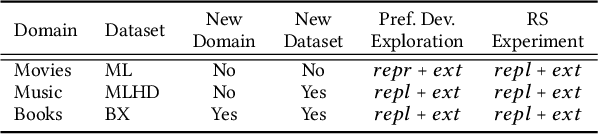
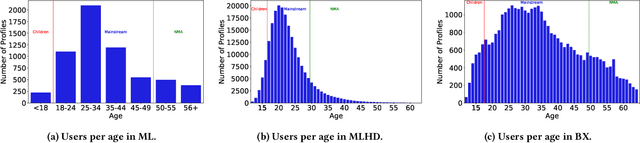

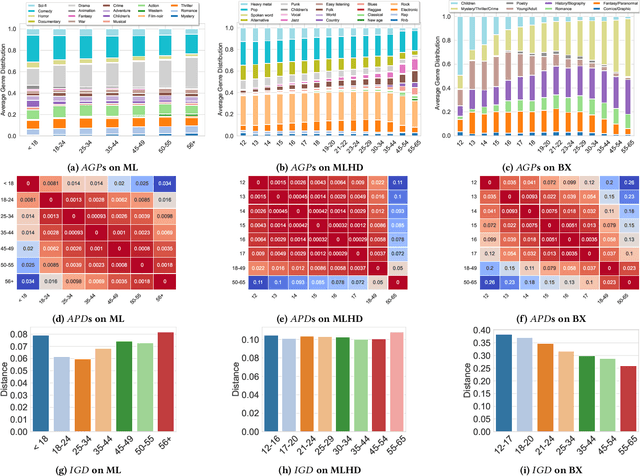
Children are often exposed to items curated by recommendation algorithms. Yet, research seldom considers children as a user group, and when it does, it is anchored on datasets where children are underrepresented, risking overlooking their interests, favoring those of the majority, i.e., mainstream users. Recently, Ungruh et al. demonstrated that children's consumption patterns and preferences differ from those of mainstream users, resulting in inconsistent recommendation algorithm performance and behavior for this user group. These findings, however, are based on two datasets with a limited child user sample. We reproduce and replicate this study on a wider range of datasets in the movie, music, and book domains, uncovering interaction patterns and aspects of child-recommender interactions consistent across domains, as well as those specific to some user samples in the data. We also extend insights from the original study with popularity bias metrics, given the interpretation of results from the original study. With this reproduction and extension, we uncover consumption patterns and differences between age groups stemming from intrinsic differences between children and others, and those unique to specific datasets or domains.
Hybrid Personalization Using Declarative and Procedural Memory Modules of the Cognitive Architecture ACT-R
May 08, 2025Recommender systems often rely on sub-symbolic machine learning approaches that operate as opaque black boxes. These approaches typically fail to account for the cognitive processes that shape user preferences and decision-making. In this vision paper, we propose a hybrid user modeling framework based on the cognitive architecture ACT-R that integrates symbolic and sub-symbolic representations of human memory. Our goal is to combine ACT-R's declarative memory, which is responsible for storing symbolic chunks along sub-symbolic activations, with its procedural memory, which contains symbolic production rules. This integration will help simulate how users retrieve past experiences and apply decision-making strategies. With this approach, we aim to provide more transparent recommendations, enable rule-based explanations, and facilitate the modeling of cognitive biases. We argue that our approach has the potential to inform the design of a new generation of human-centered, psychology-informed recommender systems.
Investigating Popularity Bias Amplification in Recommender Systems Employed in the Entertainment Domain
Apr 07, 2025
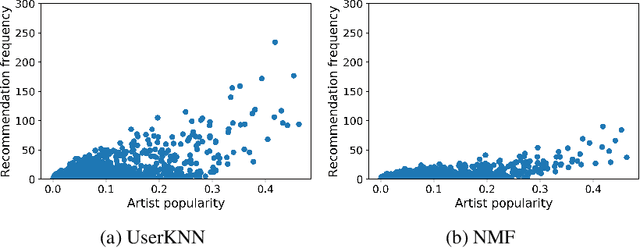
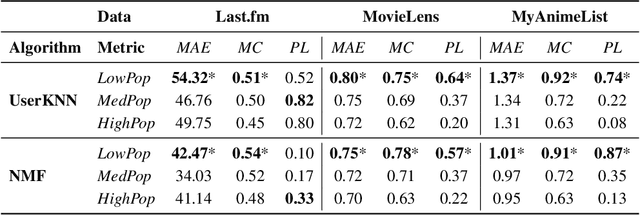
Recommender systems have become an integral part of our daily online experience by analyzing past user behavior to suggest relevant content in entertainment domains such as music, movies, and books. Today, they are among the most widely used applications of AI and machine learning. Consequently, regulations and guidelines for trustworthy AI, such as the European AI Act, which addresses issues like bias and fairness, are highly relevant to the design, development, and evaluation of recommender systems. One particularly important type of bias in this context is popularity bias, which results in the unfair underrepresentation of less popular content in recommendation lists. This work summarizes our research on investigating the amplification of popularity bias in recommender systems within the entertainment sector. Analyzing datasets from three entertainment domains, music, movies, and anime, we demonstrate that an item's recommendation frequency is positively correlated with its popularity. As a result, user groups with little interest in popular content receive less accurate recommendations compared to those who prefer widely popular items. Furthermore, we aim to better understand the connection between recommendation accuracy, calibration quality of algorithms, and popularity bias amplification.
De-centering the (Traditional) User: Multistakeholder Evaluation of Recommender Systems
Jan 09, 2025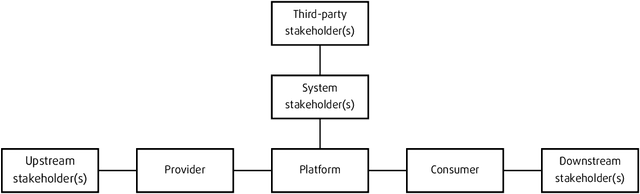
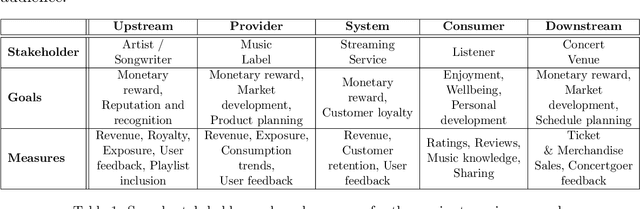
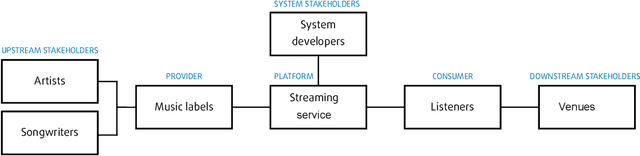
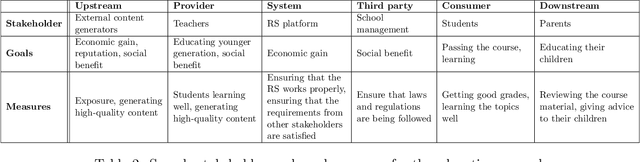
Multistakeholder recommender systems are those that account for the impacts and preferences of multiple groups of individuals, not just the end users receiving recommendations. Due to their complexity, evaluating these systems cannot be restricted to the overall utility of a single stakeholder, as is often the case of more mainstream recommender system applications. In this article, we focus our discussion on the intricacies of the evaluation of multistakeholder recommender systems. We bring attention to the different aspects involved in the evaluation of multistakeholder recommender systems - from the range of stakeholders involved (including but not limited to producers and consumers) to the values and specific goals of each relevant stakeholder. Additionally, we discuss how to move from theoretical principles to practical implementation, providing specific use case examples. Finally, we outline open research directions for the RecSys community to explore. We aim to provide guidance to researchers and practitioners about how to think about these complex and domain-dependent issues of evaluation in the course of designing, developing, and researching applications with multistakeholder aspects.
Establishing and Evaluating Trustworthy AI: Overview and Research Challenges
Nov 15, 2024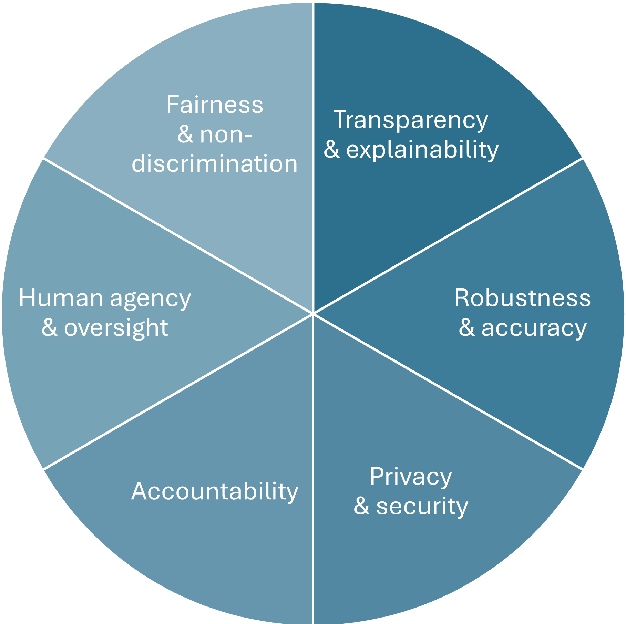


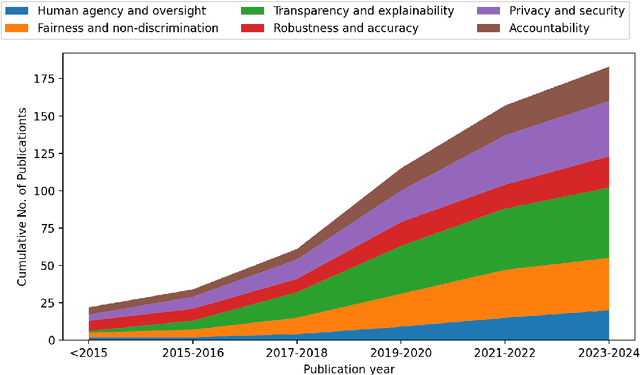
Artificial intelligence (AI) technologies (re-)shape modern life, driving innovation in a wide range of sectors. However, some AI systems have yielded unexpected or undesirable outcomes or have been used in questionable manners. As a result, there has been a surge in public and academic discussions about aspects that AI systems must fulfill to be considered trustworthy. In this paper, we synthesize existing conceptualizations of trustworthy AI along six requirements: 1) human agency and oversight, 2) fairness and non-discrimination, 3) transparency and explainability, 4) robustness and accuracy, 5) privacy and security, and 6) accountability. For each one, we provide a definition, describe how it can be established and evaluated, and discuss requirement-specific research challenges. Finally, we conclude this analysis by identifying overarching research challenges across the requirements with respect to 1) interdisciplinary research, 2) conceptual clarity, 3) context-dependency, 4) dynamics in evolving systems, and 5) investigations in real-world contexts. Thus, this paper synthesizes and consolidates a wide-ranging and active discussion currently taking place in various academic sub-communities and public forums. It aims to serve as a reference for a broad audience and as a basis for future research directions.