 Add to Chrome
 Add to Firefox
 Add to Edge
Robustness and User-Perceived Value of Popularity Calibration in Music Recommendation: A User Study
Aug 05, 2026
Popularity calibration in recommender systems has been studied both as a form of user-centered personalization and as an indicator of popularity bias. Most existing work evaluates calibration through offline metrics, often assuming that users prefer recommendation lists whose popularity distribution matches their historical consumption profile. However, user studies on calibration remain limited, and existing findings suggest that calibrated recommendations do not necessarily have a strong effect on user experience. Moreover, although prior work has shown that calibration metrics can correlate with users' perceptions of recommendation lists, the robustness of this relation remains unclear under different levels of item familiarity and incomplete user-history information. In this work, we study the perceived value and measurement reliability of popularity calibration in music recommendation. We construct personalized track lists from users' recent listening histories and use a controlled naive recommender to create lists with different popularity compositions: highpop-heavy, lowpop-heavy, and calibrated. We investigate whether users perceive differences between these lists, whether calibrated lists are preferred, how robust JSD-based popularity calibration is under different familiarity and history-availability conditions, and how computational popularity labels align with users' own popularity judgments. Our results show that users perceive differences in popularity composition, but do not clearly prefer calibrated lists. We further find that the relation between JSD and perceived popularity depends on item familiarity, list composition, and available user history, while computational and user-judged popularity labels only weakly align. These findings contribute to a more critical understanding of popularity calibration as both an offline metric and a user-facing construct.

From Skill Extraction to Multistakeholder Recommendation: A Two-Stage Framework for Bias Governance in Skills-Based Job Matching
Jul 17, 2026AI-based labor-market systems or platforms can affect access to job opportunities prior to organizational candidate rankings or hiring decisions. Such applications warrant caution, as biases in skill extraction, profile formation, and candidate-job matching may contribute to unfair treatment of candidates. In this paper, we propose a two-stage framework for detecting and governing bias in skills-based job matching. Stage 1, skill extraction and profile formation, addresses how candidates provide skills and preferences to the system, how the system extracts and structures this information, and the bias risks this entails, with a focus on chatbot-based elicitation. Stage 2, multistakeholder candidate-job recommendation, would embed this information in a recommender system in which candidate, company, and regulatory objectives are represented by separate agents, each producing an independent candidate-job ranking; these rankings would be combined through social choice-based aggregation into a single, auditable recommendation. The two stages are connected by a shared distinction between hard constraints, which require correction before processing continues, and soft constraints, which are logged to inform later decisions. Following an AI Act-aligned assessment methodology (based on the Fraunhofer AI Assessment Catalog), we propose using distributional auditing and counterfactual testing to produce a Stage 1 bias inventory sorted into hard and soft constraints, with the latter informing fairness thresholds for Stage 2. The same logic would apply to Stage 2: fairness metrics crossing predefined thresholds would trigger an adapted recommendation process, while smaller deviations would be logged as bias reports and persistent fairness states.
Tracing the Data Trail: A Survey of Data Provenance, Transparency and Traceability in LLMs
Jan 19, 2026Large language models (LLMs) are deployed at scale, yet their training data life cycle remains opaque. This survey synthesizes research from the past ten years on three tightly coupled axes: (1) data provenance, (2) transparency, and (3) traceability, and three supporting pillars: (4) bias \& uncertainty, (5) data privacy, and (6) tools and techniques that operationalize them. A central contribution is a proposed taxonomy defining the field's domains and listing corresponding artifacts. Through analysis of 95 publications, this work identifies key methodologies concerning data generation, watermarking, bias measurement, data curation, data privacy, and the inherent trade-off between transparency and opacity.
Private and Fair Machine Learning: Revisiting the Disparate Impact of Differentially Private SGD
Oct 02, 2025Differential privacy (DP) is a prominent method for protecting information about individuals during data analysis. Training neural networks with differentially private stochastic gradient descent (DPSGD) influences the model's learning dynamics and, consequently, its output. This can affect the model's performance and fairness. While the majority of studies on the topic report a negative impact on fairness, it has recently been suggested that fairness levels comparable to non-private models can be achieved by optimizing hyperparameters for performance directly on differentially private models (rather than re-using hyperparameters from non-private models, as is common practice). In this work, we analyze the generalizability of this claim by 1) comparing the disparate impact of DPSGD on different performance metrics, and 2) analyzing it over a wide range of hyperparameter settings. We highlight that a disparate impact on one metric does not necessarily imply a disparate impact on another. Most importantly, we show that while optimizing hyperparameters directly on differentially private models does not mitigate the disparate impact of DPSGD reliably, it can still lead to improved utility-fairness trade-offs compared to re-using hyperparameters from non-private models. We stress, however, that any form of hyperparameter tuning entails additional privacy leakage, calling for careful considerations of how to balance privacy, utility and fairness. Finally, we extend our analyses to DPSGD-Global-Adapt, a variant of DPSGD designed to mitigate the disparate impact on accuracy, and conclude that this alternative may not be a robust solution with respect to hyperparameter choice.
Exploring Gender Bias in Large Language Models: An In-depth Dive into the German Language
Jul 22, 2025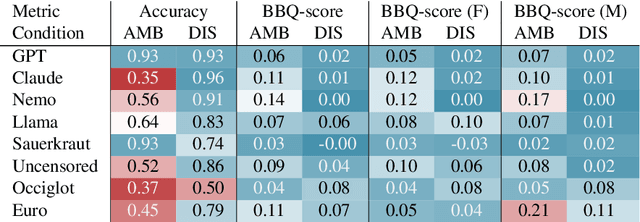
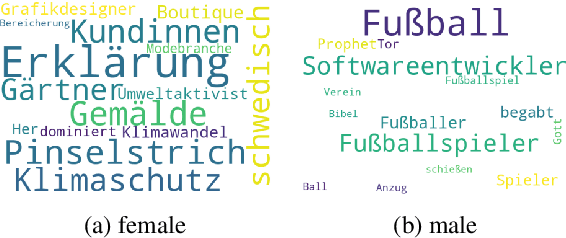
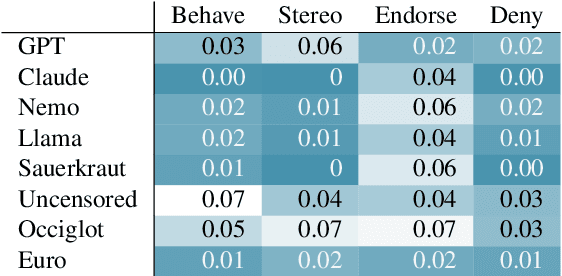
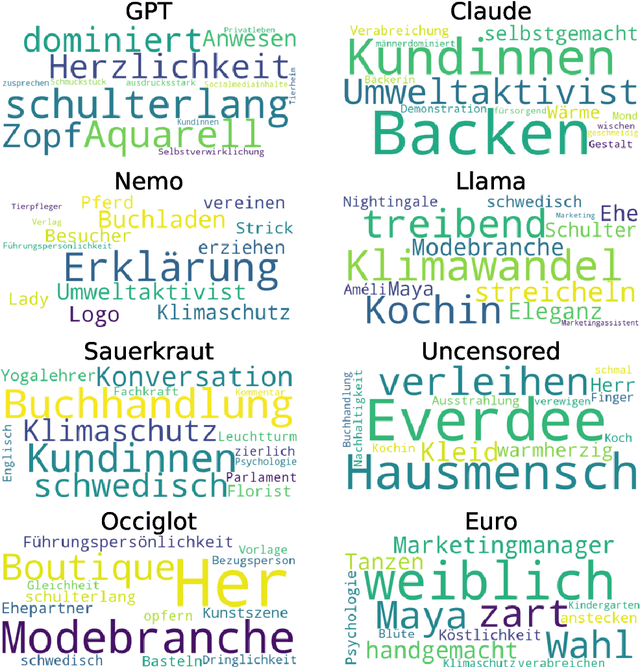
In recent years, various methods have been proposed to evaluate gender bias in large language models (LLMs). A key challenge lies in the transferability of bias measurement methods initially developed for the English language when applied to other languages. This work aims to contribute to this research strand by presenting five German datasets for gender bias evaluation in LLMs. The datasets are grounded in well-established concepts of gender bias and are accessible through multiple methodologies. Our findings, reported for eight multilingual LLM models, reveal unique challenges associated with gender bias in German, including the ambiguous interpretation of male occupational terms and the influence of seemingly neutral nouns on gender perception. This work contributes to the understanding of gender bias in LLMs across languages and underscores the necessity for tailored evaluation frameworks.
Establishing and Evaluating Trustworthy AI: Overview and Research Challenges
Nov 15, 2024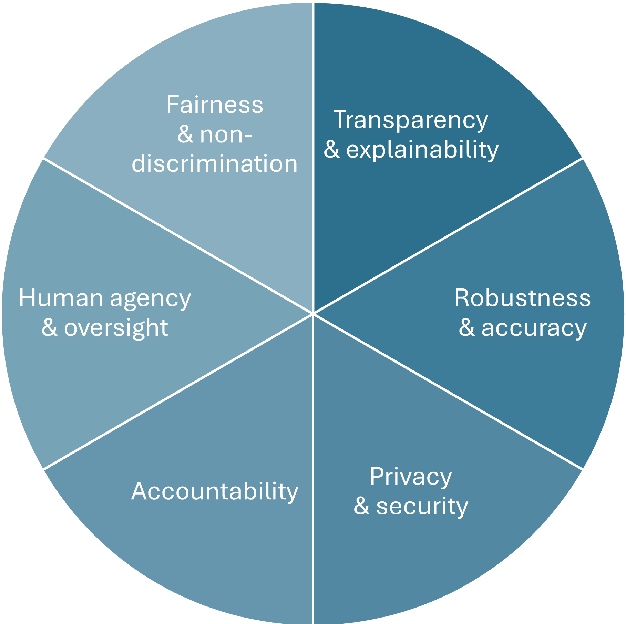


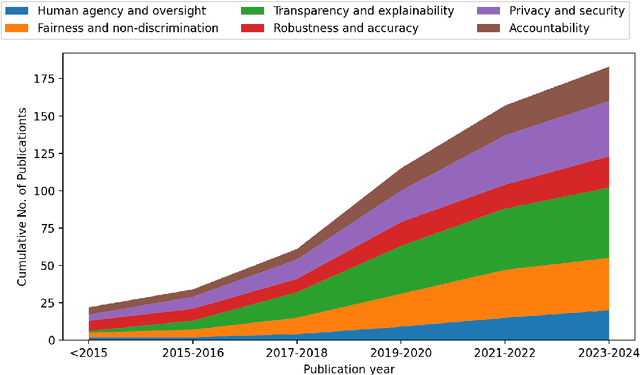
Artificial intelligence (AI) technologies (re-)shape modern life, driving innovation in a wide range of sectors. However, some AI systems have yielded unexpected or undesirable outcomes or have been used in questionable manners. As a result, there has been a surge in public and academic discussions about aspects that AI systems must fulfill to be considered trustworthy. In this paper, we synthesize existing conceptualizations of trustworthy AI along six requirements: 1) human agency and oversight, 2) fairness and non-discrimination, 3) transparency and explainability, 4) robustness and accuracy, 5) privacy and security, and 6) accountability. For each one, we provide a definition, describe how it can be established and evaluated, and discuss requirement-specific research challenges. Finally, we conclude this analysis by identifying overarching research challenges across the requirements with respect to 1) interdisciplinary research, 2) conceptual clarity, 3) context-dependency, 4) dynamics in evolving systems, and 5) investigations in real-world contexts. Thus, this paper synthesizes and consolidates a wide-ranging and active discussion currently taking place in various academic sub-communities and public forums. It aims to serve as a reference for a broad audience and as a basis for future research directions.
Reproducibility in Machine Learning-based Research: Overview, Barriers and Drivers
Jun 20, 2024Research in various fields is currently experiencing challenges regarding the reproducibility of results. This problem is also prevalent in machine learning (ML) research. The issue arises primarily due to unpublished data and/or source code and the sensitivity of ML training conditions. Although different solutions have been proposed to address this issue, such as using ML platforms, the level of reproducibility in ML-driven research remains unsatisfactory. Therefore, in this article, we discuss the reproducibility of ML-driven research with three main aims: (i) identify the barriers to reproducibility when applying ML in research as well as categorize the barriers to different types of reproducibility (description, code, data, and experiment reproducibility), (ii) identify potential drivers such as tools, practices, and interventions that support ML reproducibility as well as distinguish between technology-driven drivers, procedural drivers, and drivers related to awareness and education, and (iii) map the drivers to the barriers. With this work, we hope to provide insights and contribute to the decision-making process regarding the adoption of different solutions to support ML reproducibility.
Making Alice Appear Like Bob: A Probabilistic Preference Obfuscation Method For Implicit Feedback Recommendation Models
Jun 17, 2024Users' interaction or preference data used in recommender systems carry the risk of unintentionally revealing users' private attributes (e.g., gender or race). This risk becomes particularly concerning when the training data contains user preferences that can be used to infer these attributes, especially if they align with common stereotypes. This major privacy issue allows malicious attackers or other third parties to infer users' protected attributes. Previous efforts to address this issue have added or removed parts of users' preferences prior to or during model training to improve privacy, which often leads to decreases in recommendation accuracy. In this work, we introduce SBO, a novel probabilistic obfuscation method for user preference data designed to improve the accuracy--privacy trade-off for such recommendation scenarios. We apply SBO to three state-of-the-art recommendation models (i.e., BPR, MultVAE, and LightGCN) and two popular datasets (i.e., MovieLens-1M and LFM-2B). Our experiments reveal that SBO outperforms comparable approaches with respect to the accuracy--privacy trade-off. Specifically, we can reduce the leakage of users' protected attributes while maintaining on-par recommendation accuracy.
Reproducibility in Machine Learning-Driven Research
Jul 19, 2023
Research is facing a reproducibility crisis, in which the results and findings of many studies are difficult or even impossible to reproduce. This is also the case in machine learning (ML) and artificial intelligence (AI) research. Often, this is the case due to unpublished data and/or source-code, and due to sensitivity to ML training conditions. Although different solutions to address this issue are discussed in the research community such as using ML platforms, the level of reproducibility in ML-driven research is not increasing substantially. Therefore, in this mini survey, we review the literature on reproducibility in ML-driven research with three main aims: (i) reflect on the current situation of ML reproducibility in various research fields, (ii) identify reproducibility issues and barriers that exist in these research fields applying ML, and (iii) identify potential drivers such as tools, practices, and interventions that support ML reproducibility. With this, we hope to contribute to decisions on the viability of different solutions for supporting ML reproducibility.
A conceptual model for leaving the data-centric approach in machine learning
Feb 07, 2023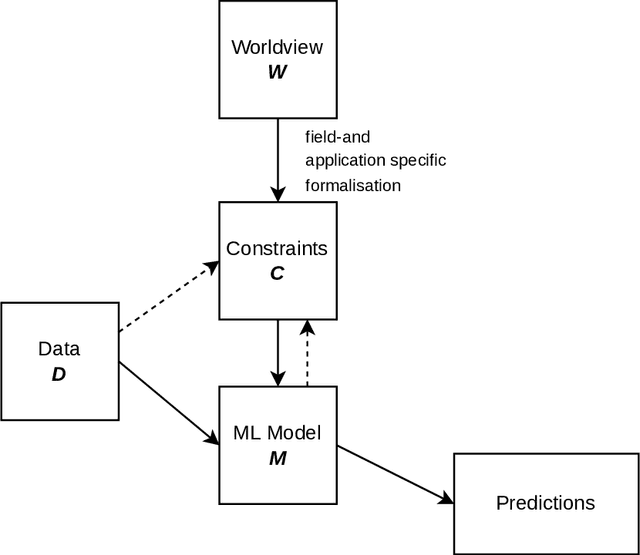
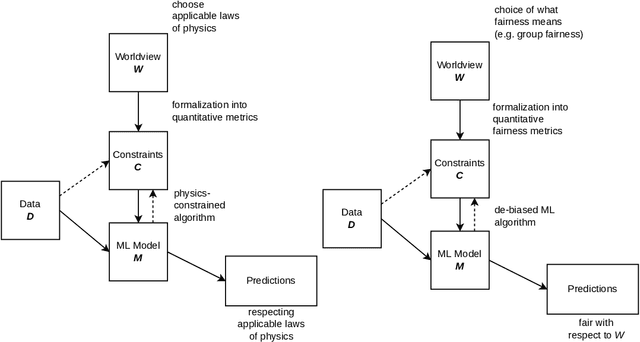
For a long time, machine learning (ML) has been seen as the abstract problem of learning relationships from data independent of the surrounding settings. This has recently been challenged, and methods have been proposed to include external constraints in the machine learning models. These methods usually come from application-specific fields, such as de-biasing algorithms in the field of fairness in ML or physical constraints in the fields of physics and engineering. In this paper, we present and discuss a conceptual high-level model that unifies these approaches in a common language. We hope that this will enable and foster exchange between the different fields and their different methods for including external constraints into ML models, and thus leaving purely data-centric approaches.