 Add to Chrome
 Add to Firefox
 Add to Edge
Scaling Generative Foundation Models for Chest Radiography with Rectified Flow Transformers
Jun 17, 2026
We introduce the first generative foundation model for chest radiograph synthesis trained from scratch at the billion-parameter scale. Existing radiographic AI models often suffer from poor generalisation across patient subpopulations, institutions, and acquisition settings, resulting in limited real-world clinical utility. Controlled, high-fidelity synthesis of chest radiographs is a promising path toward diversifying clinical datasets and evaluating the robustness of diagnostic models. Therefore, we present the largest specialist generative foundation model for chest radiographs to date, with over 1.3B parameters, trained for 1.6T tokens on a curated, heterogeneous dataset comprising 1.2M radiographs and clinical expert-guided metadata. Our model supports controllable radiograph generation and editing across multiple demographic subgroups, acquisition views, and a dozen pathologies. Moreover, we significantly advance the state of the art in radiograph synthesis fidelity, producing images that are indistinguishable from real radiographs to clinical experts.

Multi-site, Multi-domain Airway Tree Modeling : A Public Benchmark for Pulmonary Airway Segmentation
Mar 10, 2023

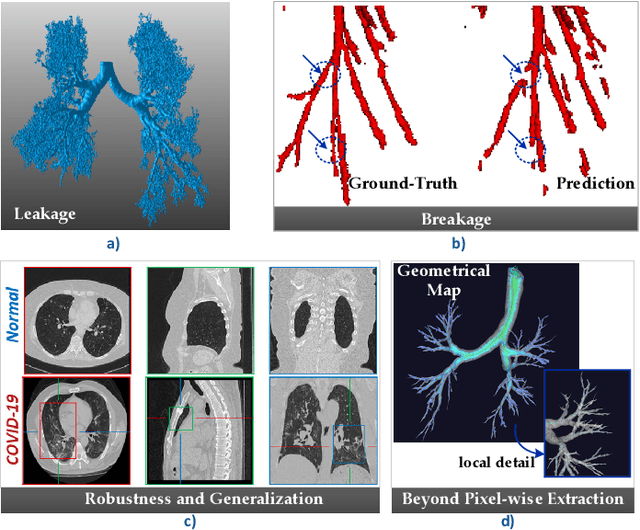

Open international challenges are becoming the de facto standard for assessing computer vision and image analysis algorithms. In recent years, new methods have extended the reach of pulmonary airway segmentation that is closer to the limit of image resolution. Since EXACT'09 pulmonary airway segmentation, limited effort has been directed to quantitative comparison of newly emerged algorithms driven by the maturity of deep learning based approaches and clinical drive for resolving finer details of distal airways for early intervention of pulmonary diseases. Thus far, public annotated datasets are extremely limited, hindering the development of data-driven methods and detailed performance evaluation of new algorithms. To provide a benchmark for the medical imaging community, we organized the Multi-site, Multi-domain Airway Tree Modeling (ATM'22), which was held as an official challenge event during the MICCAI 2022 conference. ATM'22 provides large-scale CT scans with detailed pulmonary airway annotation, including 500 CT scans (300 for training, 50 for validation, and 150 for testing). The dataset was collected from different sites and it further included a portion of noisy COVID-19 CTs with ground-glass opacity and consolidation. Twenty-three teams participated in the entire phase of the challenge and the algorithms for the top ten teams are reviewed in this paper. Quantitative and qualitative results revealed that deep learning models embedded with the topological continuity enhancement achieved superior performance in general. ATM'22 challenge holds as an open-call design, the training data and the gold standard evaluation are available upon successful registration via its homepage.