 Add to Chrome
 Add to Firefox
 Add to Edge
Seeing Through Experts Eyes A Foundational Vision Language Model Trained on Radiologists Gaze and Reasoning
Apr 15, 2026
Large scale vision language models have shown promise in automating chest Xray interpretation, yet their clinical utility remains limited by a gap between model outputs and radiologist reasoning. Most systems optimize for semantic information without emulating how experts visually examine medical images, often overlooking critical findings or diverging from established diagnostic workflows. Radiologists follow structured protocols (e.g., the ABCDEF approach) that ensure all clinically relevant regions are systematically examined, reducing missed findings and supporting reliable diagnostic reasoning. We introduce GazeX, a vision language model that leverages radiologists' eye tracking data as a behavioral prior to model expert diagnostic reasoning. By incorporating gaze trajectories and fixation patterns into pretraining, GazeX learns to follow the spatial and temporal structure of radiologist attention and integrates observations in a clinically meaningful sequence. Using a curated dataset of over 30,000 gaze key frames from five radiologists, we demonstrate that GazeX produces more accurate, interpretable, and expert consistent outputs across radiology report generation, disease grounding, and visual question answering, utilizing 231,835 radiographic studies, 780,014 question answer pairs, and 1,162 image sentence pairs with bounding boxes. Unlike autonomous reporting systems, GazeX produces verifiable evidence artifacts, including inspection trajectories and finding linked localized regions, enabling efficient human verification and safe human AI collaboration. Learning through expert eyes provides a practical route toward more trustworthy, explainable, and diagnostically robust AI systems for radiology and beyond.

GEMA-Score: Granular Explainable Multi-Agent Score for Radiology Report Evaluation
Mar 07, 2025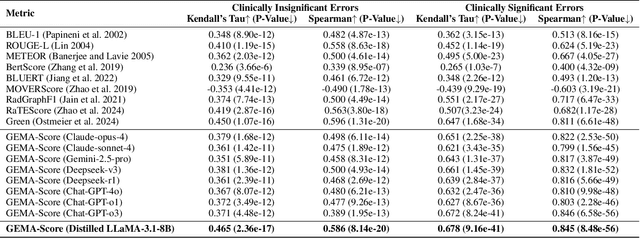
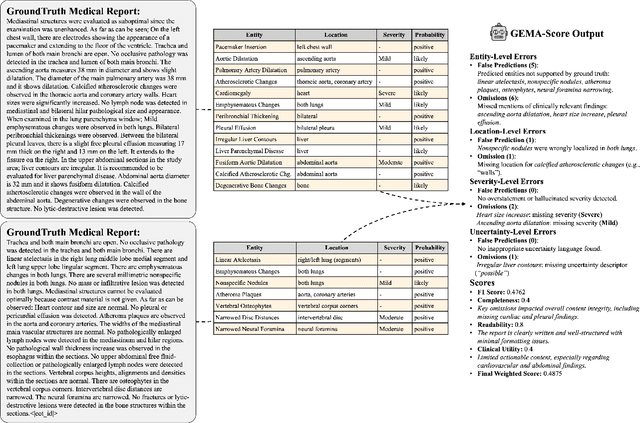
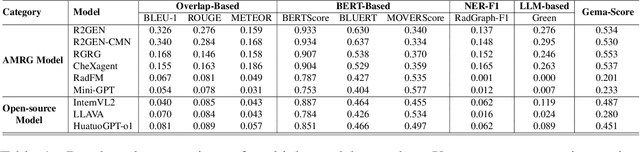
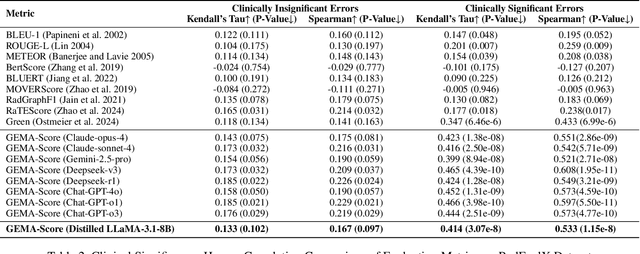
Automatic medical report generation supports clinical diagnosis, reduces the workload of radiologists, and holds the promise of improving diagnosis consistency. However, existing evaluation metrics primarily assess the accuracy of key medical information coverage in generated reports compared to human-written reports, while overlooking crucial details such as the location and certainty of reported abnormalities. These limitations hinder the comprehensive assessment of the reliability of generated reports and pose risks in their selection for clinical use. Therefore, we propose a Granular Explainable Multi-Agent Score (GEMA-Score) in this paper, which conducts both objective quantification and subjective evaluation through a large language model-based multi-agent workflow. Our GEMA-Score parses structured reports and employs NER-F1 calculations through interactive exchanges of information among agents to assess disease diagnosis, location, severity, and uncertainty. Additionally, an LLM-based scoring agent evaluates completeness, readability, and clinical terminology while providing explanatory feedback. Extensive experiments validate that GEMA-Score achieves the highest correlation with human expert evaluations on a public dataset, demonstrating its effectiveness in clinical scoring (Kendall coefficient = 0.70 for Rexval dataset and Kendall coefficient = 0.54 for RadEvalX dataset). The anonymous project demo is available at: https://github.com/Zhenxuan-Zhang/GEMA_score.