 Add to Chrome
 Add to Firefox
 Add to Edge
Redefining Maritime Anomaly Detection via Equation-Grounded Synthetic Anomalies
Jun 29, 2026
Maritime anomaly detection is essential for ensuring maritime safety, security, and efficient traffic management at sea, with Automatic Identification System (AIS) data serving as a primary data source. Despite its importance, most publicly available AIS datasets lack predefined anomaly labels, forcing prior studies to rely on either distribution-based rarity or domain rule/expert-assisted labeling. These approaches, however, face fundamental limitations: statistical rarity often fails to reflect practically critical events, while expert-based labeling is costly, subjective, and difficult to scale. Moreover, both paradigms tend to overlook interaction-driven hazards such as near-miss approaches between vessels. To address these challenges, we propose an equation-grounded anomaly taxonomy that is implementable under a limited AIS observation schema and extensible to other AIS datasets. Specifically, the taxonomy defines three anomaly types: unexpected AIS activity (A1), route deviation (A2), and close approach (A3), covering both single-vessel and inter-vessel anomalies. Building on this taxonomy, we introduce a unified score-synthesize-label pipeline that produces LLM-guided plausibility scores, uses them to synthesize anomalies, and assigns timestamp-level labels. To rigorously assess detection performance, we further design benchmark evaluation settings that account for variations in temporal-window length and anomaly-type composition, and evaluate a broad range of time-series models and anomaly detection models. Together, these contributions provide a systematic basis for evaluating maritime anomaly detection methods across different anomaly types. Our code is available at https://github.com/snudial/open-maritime-anomaly-detection.

Spatio-Temporal Graphs Beyond Grids: Benchmark for Maritime Anomaly Detection
Dec 23, 2025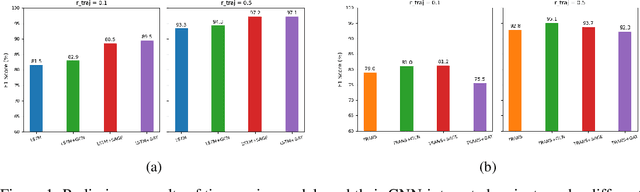
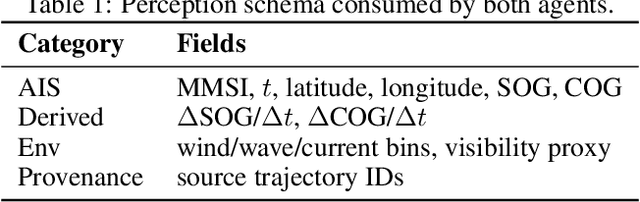
Spatio-temporal graph neural networks (ST-GNNs) have achieved notable success in structured domains such as road traffic and public transportation, where spatial entities can be naturally represented as fixed nodes. In contrast, many real-world systems including maritime traffic lack such fixed anchors, making the construction of spatio-temporal graphs a fundamental challenge. Anomaly detection in these non-grid environments is particularly difficult due to the absence of canonical reference points, the sparsity and irregularity of trajectories, and the fact that anomalies may manifest at multiple granularities. In this work, we introduce a novel benchmark dataset for anomaly detection in the maritime domain, extending the Open Maritime Traffic Analysis Dataset (OMTAD) into a benchmark tailored for graph-based anomaly detection. Our dataset enables systematic evaluation across three different granularities: node-level, edge-level, and graph-level anomalies. We plan to employ two specialized LLM-based agents: \emph{Trajectory Synthesizer} and \emph{Anomaly Injector} to construct richer interaction contexts and generate semantically meaningful anomalies. We expect this benchmark to promote reproducibility and to foster methodological advances in anomaly detection for non-grid spatio-temporal systems.
Adaptive Sparsified Graph Learning Framework for Vessel Behavior Anomalies
Feb 20, 2025Graph neural networks have emerged as a powerful tool for learning spatiotemporal interactions. However, conventional approaches often rely on predefined graphs, which may obscure the precise relationships being modeled. Additionally, existing methods typically define nodes based on fixed spatial locations, a strategy that is ill-suited for dynamic environments like maritime environments. Our method introduces an innovative graph representation where timestamps are modeled as distinct nodes, allowing temporal dependencies to be explicitly captured through graph edges. This setup is extended to construct a multi-ship graph that effectively captures spatial interactions while preserving graph sparsity. The graph is processed using Graph Convolutional Network layers to capture spatiotemporal patterns, with a forecasting layer for feature prediction and a Variational Graph Autoencoder for reconstruction, enabling robust anomaly detection.