 Add to Chrome
 Add to Firefox
 Add to Edge
DecoVAE: a Lightweight Interpretable Trend-Seasonal VAE Framework for Efficient Probabilistic Time Series Forecasting
Aug 20, 2026
Probabilistic time series forecasting remains challenging, largely because modeling distinct trend and seasonal dynamics requires specialized approaches. Existing methods often fail to capture the unique inner properties of these components, lack interpretability, or suffer from heavy memory and runtime overhead. To address these limitations, we propose DecoVAE, a lightweight interpretable trend-seasonal VAE framework that explicitly decomposes time series into trend and seasonal components by applying domain-specific inductive biases. The trend stream enforces structural smoothness using a differential regularizer on the latent trajectory, analogous to the Hodrick-Prescott filter. Concurrently, the seasonal stream operates in the frequency domain via a complex Gaussian VAE, natively capturing the amplitude and phase of periodic patterns. Extensive evaluations across seven real-world benchmarks show that DecoVAE consistently outperforms strong baselines. It achieves reductions of up to 14.96\% in CRPS and 23.30\% in NMAE for short-term forecasting, and up to 52.68\% and 26.51\% for long-term horizons. Crucially, DecoVAE yields these accuracy gains while remaining highly efficient, reducing model weight by up to 93\% and accelerating speed by up to 74\% compared to the second-best method.

CLaST: Context-aware Contrastive VAE for Probabilistic Time Series Forecasting
Aug 20, 2026Probabilistic forecasting models are widely used for time series forecasting in domains such as energy systems, finance, medicine, and transportation. In recent years, deep generative models have shown strong results on probabilistic forecasting, yet many conventional approaches struggle to capture internal temporal dependencies, leading to latent representations with limited expressive power. To address this limitation, we propose \textit{CLaST}, a VAE framework for probabilistic multivariate time series forecasting. Unlike existing generative models, CLaST learns embeddings that preserve contextual similarity between observations through our contrastive loss function. Experiments across nine widely adopted benchmarks demonstrate that CLaST consistently surpasses strong baseline methods. In short-term forecasting tasks, our approach achieves improvements of up to $16.4\%$ in CRPS and $14.4\%$ in NMAE over the second-best method. Furthermore, in long-term prediction CLaST attains superior overall performance, exceeding the second-best method by up to $48.6\%$ and $25.1\%$ in CRPS and NMAE, respectively.
SplitLight: An Exploratory Toolkit for Recommender Systems Datasets and Splits
Feb 22, 2026Offline evaluation of recommender systems is often affected by hidden, under-documented choices in data preparation. Seemingly minor decisions in filtering, handling repeats, cold-start treatment, and splitting strategy design can substantially reorder model rankings and undermine reproducibility and cross-paper comparability. In this paper, we introduce SplitLight, an open-source exploratory toolkit that enables researchers and practitioners designing preprocessing and splitting pipelines or reviewing external artifacts to make these decisions measurable, comparable, and reportable. Given an interaction log and derived split subsets, SplitLight analyzes core and temporal dataset statistics, characterizes repeat consumption patterns and timestamp anomalies, and diagnoses split validity, including temporal leakage, cold-user/item exposure, and distribution shifts. SplitLight further allows side-by-side comparison of alternative splitting strategies through comprehensive aggregated summaries and interactive visualizations. Delivered as both a Python toolkit and an interactive no-code interface, SplitLight produces audit summaries that justify evaluation protocols and support transparent, reliable, and comparable experimentation in recommender systems research and industry.
Concealed Adversarial attacks on neural networks for sequential data
Feb 28, 2025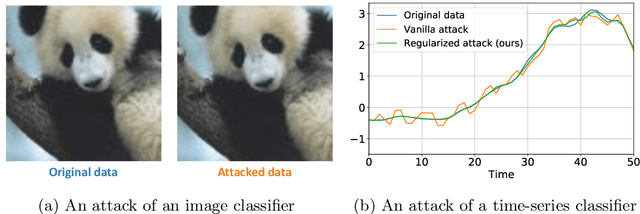
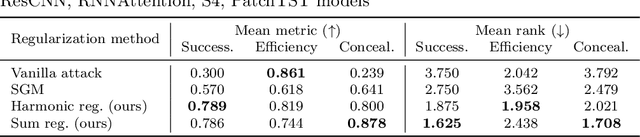
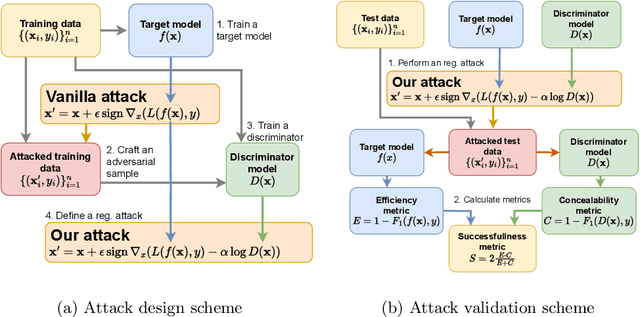
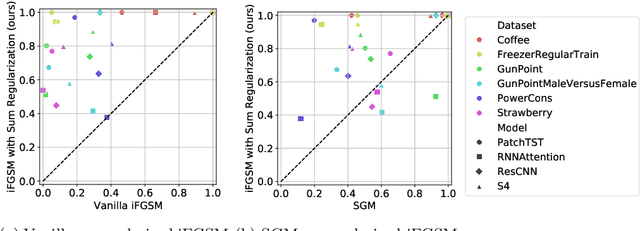
The emergence of deep learning led to the broad usage of neural networks in the time series domain for various applications, including finance and medicine. While powerful, these models are prone to adversarial attacks: a benign targeted perturbation of input data leads to significant changes in a classifier's output. However, formally small attacks in the time series domain become easily detected by the human eye or a simple detector model. We develop a concealed adversarial attack for different time-series models: it provides more realistic perturbations, being hard to detect by a human or model discriminator. To achieve this goal, the proposed adversarial attack maximizes an aggregation of a classifier and a trained discriminator loss. To make the attack stronger, we also propose a training procedure for a discriminator that provides broader coverage of possible attacks. Extensive benchmarking on six UCR time series datasets across four diverse architectures - including recurrent, convolutional, state-space, and transformer-based models - demonstrates the superiority of our attack for a concealability-efficiency trade-off. Our findings highlight the growing challenge of designing robust time series models, emphasizing the need for improved defenses against realistic and effective attacks.