 Add to Chrome
 Add to Firefox
 Add to Edge
CLaST: Context-aware Contrastive VAE for Probabilistic Time Series Forecasting
Aug 20, 2026
Probabilistic forecasting models are widely used for time series forecasting in domains such as energy systems, finance, medicine, and transportation. In recent years, deep generative models have shown strong results on probabilistic forecasting, yet many conventional approaches struggle to capture internal temporal dependencies, leading to latent representations with limited expressive power. To address this limitation, we propose \textit{CLaST}, a VAE framework for probabilistic multivariate time series forecasting. Unlike existing generative models, CLaST learns embeddings that preserve contextual similarity between observations through our contrastive loss function. Experiments across nine widely adopted benchmarks demonstrate that CLaST consistently surpasses strong baseline methods. In short-term forecasting tasks, our approach achieves improvements of up to $16.4\%$ in CRPS and $14.4\%$ in NMAE over the second-best method. Furthermore, in long-term prediction CLaST attains superior overall performance, exceeding the second-best method by up to $48.6\%$ and $25.1\%$ in CRPS and NMAE, respectively.

GENADA: efficient generative time series adversarial attack framework
Aug 12, 2026Deep learning models are widely used for time series analysis in domains such as healthcare, finance, energy systems, and environmental monitoring. However, these models remain vulnerable to adversarial attacks, where small input perturbations cause severe degradation in predictive performance. Commonly used gradient-based attacks, iterative first-order methods, are computationally burdensome, as they repeatedly backpropagate through the victim model to compute input gradients during a number of iterative refinement steps. We propose a GENerative ADversarial Attack (GENADA) that learns a generative model to produce deceptive perturbations directly in a single forward pass and a procedure to train it. Variants include single-step and iterative generative attack schemes. The validation considers attacks on several neural models and datasets in the time-series domain, a controlled, low-dimensional setting. Empirically, GENADA achieves comparable attack quality to strong baselines while requiring less time to generate perturbations during inference.
Concealed Adversarial attacks on neural networks for sequential data
Feb 28, 2025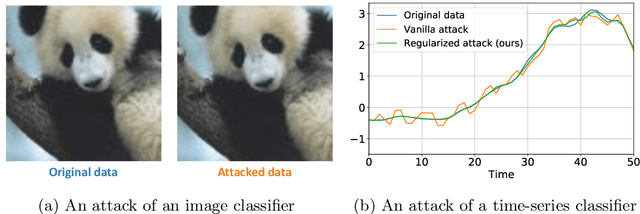
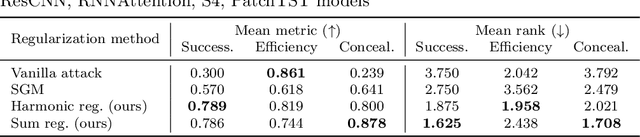
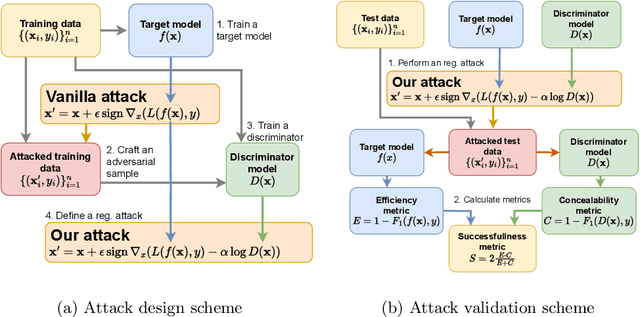
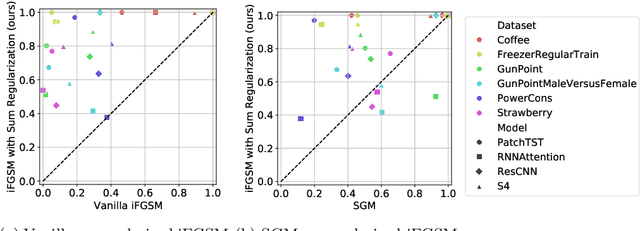
The emergence of deep learning led to the broad usage of neural networks in the time series domain for various applications, including finance and medicine. While powerful, these models are prone to adversarial attacks: a benign targeted perturbation of input data leads to significant changes in a classifier's output. However, formally small attacks in the time series domain become easily detected by the human eye or a simple detector model. We develop a concealed adversarial attack for different time-series models: it provides more realistic perturbations, being hard to detect by a human or model discriminator. To achieve this goal, the proposed adversarial attack maximizes an aggregation of a classifier and a trained discriminator loss. To make the attack stronger, we also propose a training procedure for a discriminator that provides broader coverage of possible attacks. Extensive benchmarking on six UCR time series datasets across four diverse architectures - including recurrent, convolutional, state-space, and transformer-based models - demonstrates the superiority of our attack for a concealability-efficiency trade-off. Our findings highlight the growing challenge of designing robust time series models, emphasizing the need for improved defenses against realistic and effective attacks.
Portfolio Selection via Topological Data Analysis
Aug 15, 2023Portfolio management is an essential part of investment decision-making. However, traditional methods often fail to deliver reasonable performance. This problem stems from the inability of these methods to account for the unique characteristics of multivariate time series data from stock markets. We present a two-stage method for constructing an investment portfolio of common stocks. The method involves the generation of time series representations followed by their subsequent clustering. Our approach utilizes features based on Topological Data Analysis (TDA) for the generation of representations, allowing us to elucidate the topological structure within the data. Experimental results show that our proposed system outperforms other methods. This superior performance is consistent over different time frames, suggesting the viability of TDA as a powerful tool for portfolio selection.