 Add to Chrome
 Add to Firefox
 Add to Edge
Pessimism's Paradox: Conservative Offline Training Amplifies Reward Hacking During Online Adaptation in Reasoning Models
Jun 29, 2026
Conservative offline training is widely advocated as a safe foundation for subsequent online adaptation: if a policy stays close to well-supported behaviour, the argument goes, it is less likely to exploit imperfections in a learned reward model. We challenge this intuition empirically and mechanistically. We train a Qwen3-14B policy under Direct Preference Optimisation (DPO) with three levels of conservatism ($β\in \{β_{\mathrm{lo}}, β_{\mathrm{mid}}, β_{\mathrm{hi}}\}$ derived from empirical log-ratio percentiles), then adapt each checkpoint online against a learned reward ensemble (3\,$\times$\,Qwen3-1.7B) while measuring true performance on GSM8K exact-answer accuracy. We find that \emph{higher offline conservatism monotonically increases reward-hacking damage}, measured by the Goodhart gap and its area under the curve (AUGC), with Spearman $ρ= 1.0$ across all three conditions. Mechanistic analysis reveals a three-link causal chain: (i) high-$β$ DPO compresses policy entropy, (ii) Low-entropy policies generate responses with reduced diversity, concentrating in a narrow region of the reward model's training distribution (lower pairwise cosine distance), and (iii) despite this proximity, ensemble disagreement (epistemic uncertainty) increases with $β$ and is exploited faster during online optimisation. We further fit a power-law curve to the $(β, \augc)$ data and identify a practical optimal conservatism level $β^{\star}$ that balances alignment fidelity against hacking vulnerability. Our results suggest that the field needs \emph{calibrated}, not \emph{maximal}, conservatism.

Linear Probes Detect Task Format, Not Reasoning Mode in Language Model Hidden States
Jun 03, 2026Linear probing of large language model (LLM) hidden states is widely used to claim that models learn distinct representations for different reasoning types. We test this by probing Qwen3-14B on three benchmarks spanning the classical trichotomy: LogiQA 2.0 (deductive), ARC-Challenge (inductive), and $α$NLI (abductive). At layer 32 of 40, linear probes achieve 100\% cross-validated accuracy with well-separated geometry (intrinsic dimensionalities: 20.6, 28.5, 33.6; convex hull contamination $\leq$1.5\%). However, this separation is entirely driven by format confounds. Residualizing source identity, option count, and response length reduces accuracy to chance. Trace-anchor similarity indicates largely shared reasoning across tasks (42.5\% agreement vs.\ 33.3\% chance), and causal steering with random controls ($n=20$) shows no functional link between geometry and reasoning mode ($p=0.286$). Thus, high probe accuracy reflects task format rather than computational structure, motivating routine format deconfounding in mechanistic interpretability.
The Reasoning Trap -- Logical Reasoning as a Mechanistic Pathway to Situational Awareness
Mar 10, 2026Situational awareness, the capacity of an AI system to recognize its own nature, understand its training and deployment context, and reason strategically about its circumstances, is widely considered among the most dangerous emergent capabilities in advanced AI systems. Separately, a growing research effort seeks to improve the logical reasoning capabilities of large language models (LLMs) across deduction, induction, and abduction. In this paper, we argue that these two research trajectories are on a collision course. We introduce the RAISE framework (Reasoning Advancing Into Self Examination), which identifies three mechanistic pathways through which improvements in logical reasoning enable progressively deeper levels of situational awareness: deductive self inference, inductive context recognition, and abductive self modeling. We formalize each pathway, construct an escalation ladder from basic self recognition to strategic deception, and demonstrate that every major research topic in LLM logical reasoning maps directly onto a specific amplifier of situational awareness. We further analyze why current safety measures are insufficient to prevent this escalation. We conclude by proposing concrete safeguards, including a "Mirror Test" benchmark and a Reasoning Safety Parity Principle, and pose an uncomfortable but necessary question to the logical reasoning community about its responsibility in this trajectory.
When Shallow Wins: Silent Failures and the Depth-Accuracy Paradox in Latent Reasoning
Mar 03, 2026Mathematical reasoning models are widely deployed in education, automated tutoring, and decision support systems despite exhibiting fundamental computational instabilities. We demonstrate that state-of-the-art models (Qwen2.5-Math-7B) achieve 61% accuracy through a mixture of reliable and unreliable reasoning pathways: 18.4% of correct predictions employ stable, faithful reasoning while 81.6% emerge through computationally inconsistent pathways. Additionally, 8.8% of all predictions are silent failures -- confident yet incorrect outputs. Through comprehensive analysis using novel faithfulness metrics, we reveal: (1) reasoning quality shows weak negative correlation with correctness (r=-0.21, p=0.002), reflecting a binary classification threshold artifact rather than a monotonic inverse relationship; (2) scaling from 1.5B to 7B parameters (4.7x increase) provides zero accuracy benefit on our evaluated subset (6% of GSM8K), requiring validation on the complete benchmark; and (3) latent reasoning employs diverse computational strategies, with ~20% sharing CoT-like patterns. These findings highlight that benchmark accuracy can mask computational unreliability, demanding evaluation reforms measuring stability beyond single-sample metrics.
I Can't Believe It's Not Robust: Catastrophic Collapse of Safety Classifiers under Embedding Drift
Mar 01, 2026Instruction tuned reasoning models are increasingly deployed with safety classifiers trained on frozen embeddings, assuming representation stability across model updates. We systematically investigate this assumption and find it fails: normalized perturbations of magnitude $σ=0.02$ (corresponding to $\approx 1^\circ$ angular drift on the embedding sphere) reduce classifier performance from $85\%$ to $50\%$ ROC-AUC. Critically, mean confidence only drops $14\%$, producing dangerous silent failures where $72\%$ of misclassifications occur with high confidence, defeating standard monitoring. We further show that instruction-tuned models exhibit 20$\%$ worse class separability than base models, making aligned systems paradoxically harder to safeguard. Our findings expose a fundamental fragility in production AI safety architectures and challenge the assumption that safety mechanisms transfer across model versions.
Leveraging Geolocation in Clinical Records to Improve Alzheimer's Disease Diagnosis Using DMV Framework
Feb 06, 2025
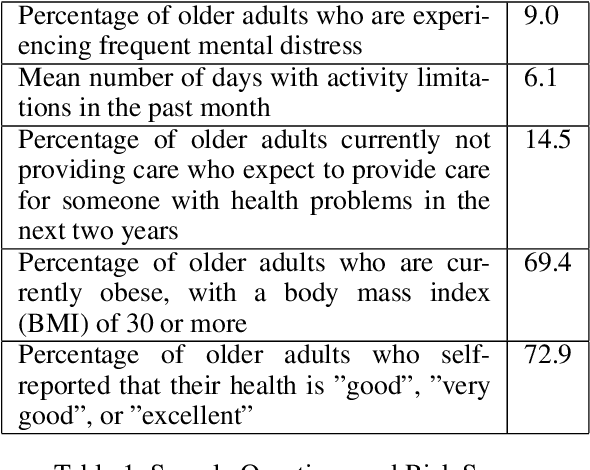
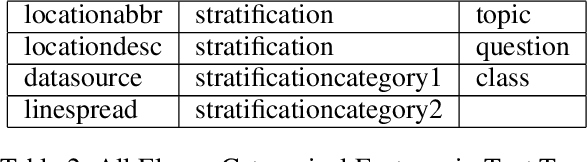
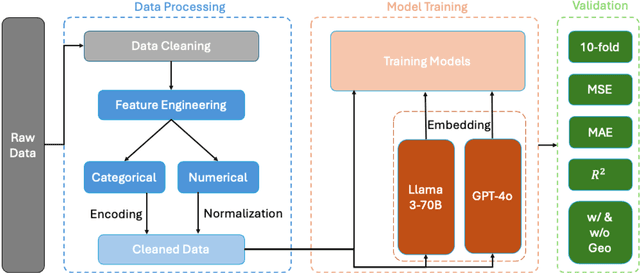
Alzheimer's Disease (AD) early detection is critical for enabling timely intervention and improving patient outcomes. This paper presents a DMV framework using Llama3-70B and GPT-4o as embedding models to analyze clinical notes and predict a continuous risk score associated with early AD onset. Framing the task as a regression problem, we model the relationship between linguistic features in clinical notes (inputs) and a target variable (data value) that answers specific questions related to AD risk within certain topic categories. By leveraging a multi-faceted feature set that includes geolocation data, we capture additional environmental context potentially linked to AD. Our results demonstrate that the integration of the geolocation information significantly decreases the error of predicting early AD risk scores over prior models by 28.57% (Llama3-70B) and 33.47% (GPT4-o). Our findings suggest that this combined approach can enhance the predictive accuracy of AD risk assessment, supporting early diagnosis and intervention in clinical settings. Additionally, the framework's ability to incorporate geolocation data provides a more comprehensive risk assessment model that could help healthcare providers better understand and address environmental factors contributing to AD development.
SKETCH: Structured Knowledge Enhanced Text Comprehension for Holistic Retrieval
Dec 19, 2024


Retrieval-Augmented Generation (RAG) systems have become pivotal in leveraging vast corpora to generate informed and contextually relevant responses, notably reducing hallucinations in Large Language Models. Despite significant advancements, these systems struggle to efficiently process and retrieve information from large datasets while maintaining a comprehensive understanding of the context. This paper introduces SKETCH, a novel methodology that enhances the RAG retrieval process by integrating semantic text retrieval with knowledge graphs, thereby merging structured and unstructured data for a more holistic comprehension. SKETCH, demonstrates substantial improvements in retrieval performance and maintains superior context integrity compared to traditional methods. Evaluated across four diverse datasets: QuALITY, QASPER, NarrativeQA, and Italian Cuisine-SKETCH consistently outperforms baseline approaches on key RAGAS metrics such as answer_relevancy, faithfulness, context_precision and context_recall. Notably, on the Italian Cuisine dataset, SKETCH achieved an answer relevancy of 0.94 and a context precision of 0.99, representing the highest performance across all evaluated metrics. These results highlight SKETCH's capability in delivering more accurate and contextually relevant responses, setting new benchmarks for future retrieval systems.
* 16 pages, 8 figures, Workshop on Generative AI and Knowledge Graphs (GenAIK) at The 31st International Conference on Computational Linguistics (COLING 2025)
Northeastern Uni at Multilingual Counterspeech Generation: Enhancing Counter Speech Generation with LLM Alignment through Direct Preference Optimization
Dec 19, 2024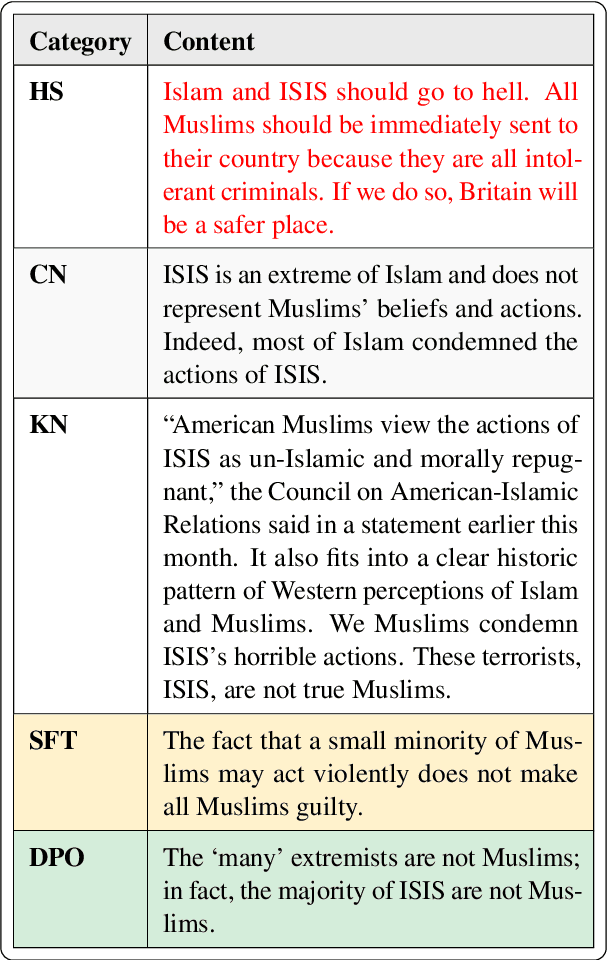
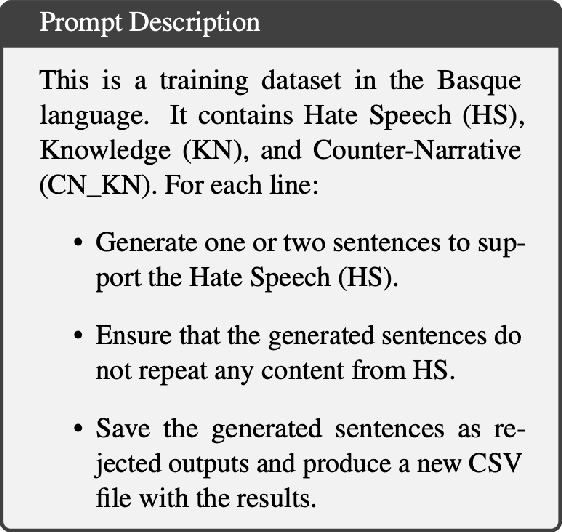
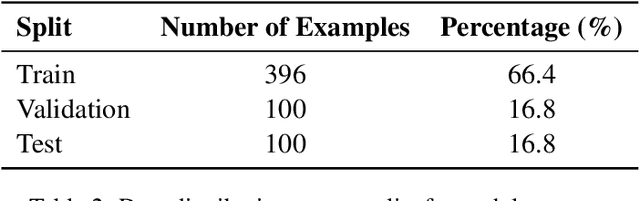
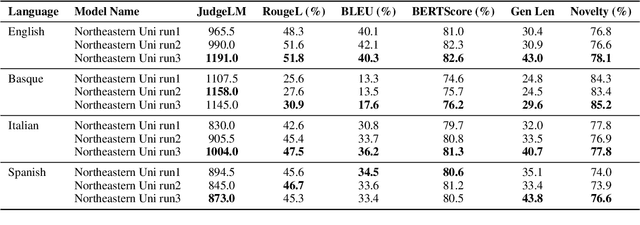
The automatic generation of counter-speech (CS) is a critical strategy for addressing hate speech by providing constructive and informed responses. However, existing methods often fail to generate high-quality, impactful, and scalable CS, particularly across diverse linguistic contexts. In this paper, we propose a novel methodology to enhance CS generation by aligning Large Language Models (LLMs) using Supervised Fine-Tuning (SFT) and Direct Preference Optimization (DPO). Our approach leverages DPO to align LLM outputs with human preferences, ensuring contextually appropriate and linguistically adaptable responses. Additionally, we incorporate knowledge grounding to enhance the factual accuracy and relevance of generated CS. Experimental results demonstrate that DPO-aligned models significantly outperform SFT baselines on CS benchmarks while scaling effectively to multiple languages. These findings highlight the potential of preference-based alignment techniques to advance CS generation across varied linguistic settings. The model supervision and alignment is done in English and the same model is used for reporting metrics across other languages like Basque, Italian, and Spanish.
* 10 pages, 6 tables, 1 figure, The First Workshop on Multilingual Counterspeech Generation (MCG) at The 31st International Conference on Computational Linguistics (COLING 2025)
WADER at SemEval-2023 Task 9: A Weak-labelling framework for Data augmentation in tExt Regression Tasks
Mar 05, 2023


Intimacy is an essential element of human relationships and language is a crucial means of conveying it. Textual intimacy analysis can reveal social norms in different contexts and serve as a benchmark for testing computational models' ability to understand social information. In this paper, we propose a novel weak-labeling strategy for data augmentation in text regression tasks called WADER. WADER uses data augmentation to address the problems of data imbalance and data scarcity and provides a method for data augmentation in cross-lingual, zero-shot tasks. We benchmark the performance of State-of-the-Art pre-trained multilingual language models using WADER and analyze the use of sampling techniques to mitigate bias in data and optimally select augmentation candidates. Our results show that WADER outperforms the baseline model and provides a direction for mitigating data imbalance and scarcity in text regression tasks.