 Add to Chrome
 Add to Firefox
 Add to Edge
DFIC: Towards a balanced facial image dataset for automatic ICAO compliance verification
Feb 11, 2026
Ensuring compliance with ISO/IEC and ICAO standards for facial images in machine-readable travel documents (MRTDs) is essential for reliable identity verification, but current manual inspection methods are inefficient in high-demand environments. This paper introduces the DFIC dataset, a novel comprehensive facial image dataset comprising around 58,000 annotated images and 2706 videos of more than 1000 subjects, that cover a broad range of non-compliant conditions, in addition to compliant portraits. Our dataset provides a more balanced demographic distribution than the existing public datasets, with one partition that is nearly uniformly distributed, facilitating the development of automated ICAO compliance verification methods. Using DFIC, we fine-tuned a novel method that heavily relies on spatial attention mechanisms for the automatic validation of ICAO compliance requirements, and we have compared it with the state-of-the-art aimed at ICAO compliance verification, demonstrating improved results. DFIC dataset is now made public (https://github.com/visteam-isr-uc/DFIC) for the training and validation of new models, offering an unprecedented diversity of faces, that will improve both robustness and adaptability to the intrinsically diverse combinations of faces and props that can be presented to the validation system. These results emphasize the potential of DFIC to enhance automated ICAO compliance methods but it can also be used in many other applications that aim to improve the security, privacy, and fairness of facial recognition systems.

Second Competition on Presentation Attack Detection on ID Card
Jul 27, 2025This work summarises and reports the results of the second Presentation Attack Detection competition on ID cards. This new version includes new elements compared to the previous one. (1) An automatic evaluation platform was enabled for automatic benchmarking; (2) Two tracks were proposed in order to evaluate algorithms and datasets, respectively; and (3) A new ID card dataset was shared with Track 1 teams to serve as the baseline dataset for the training and optimisation. The Hochschule Darmstadt, Fraunhofer-IGD, and Facephi company jointly organised this challenge. 20 teams were registered, and 74 submitted models were evaluated. For Track 1, the "Dragons" team reached first place with an Average Ranking and Equal Error rate (EER) of AV-Rank of 40.48% and 11.44% EER, respectively. For the more challenging approach in Track 2, the "Incode" team reached the best results with an AV-Rank of 14.76% and 6.36% EER, improving on the results of the first edition of 74.30% and 21.87% EER, respectively. These results suggest that PAD on ID cards is improving, but it is still a challenging problem related to the number of images, especially of bona fide images.
EFaR 2023: Efficient Face Recognition Competition
Aug 08, 2023
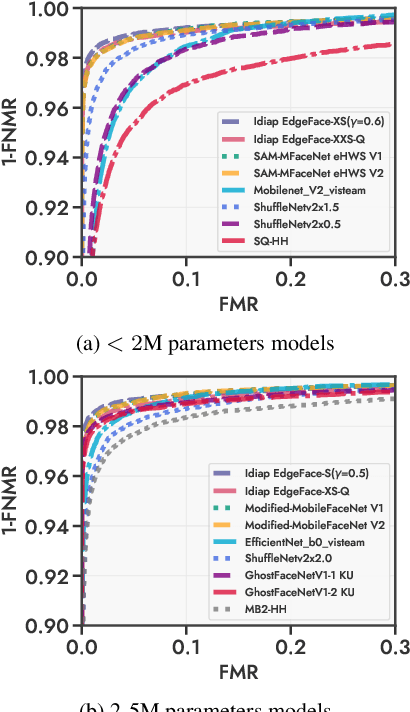
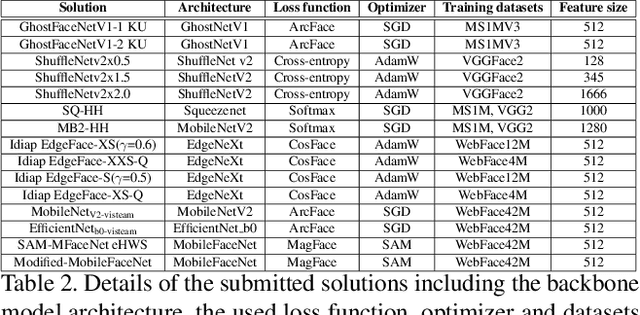
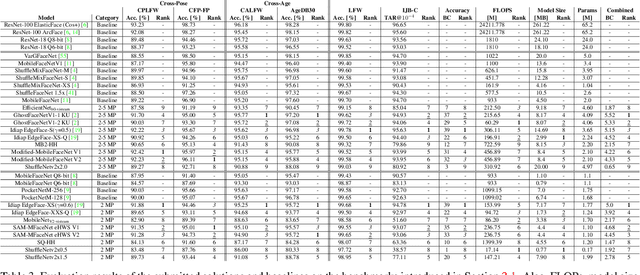
This paper presents the summary of the Efficient Face Recognition Competition (EFaR) held at the 2023 International Joint Conference on Biometrics (IJCB 2023). The competition received 17 submissions from 6 different teams. To drive further development of efficient face recognition models, the submitted solutions are ranked based on a weighted score of the achieved verification accuracies on a diverse set of benchmarks, as well as the deployability given by the number of floating-point operations and model size. The evaluation of submissions is extended to bias, cross-quality, and large-scale recognition benchmarks. Overall, the paper gives an overview of the achieved performance values of the submitted solutions as well as a diverse set of baselines. The submitted solutions use small, efficient network architectures to reduce the computational cost, some solutions apply model quantization. An outlook on possible techniques that are underrepresented in current solutions is given as well.