 Add to Chrome
 Add to Firefox
 Add to Edge
One Model, Two Minds: Task-Conditioned Reasoning for Unified Image Quality and Aesthetic Assessment
Mar 20, 2026
Unifying Image Quality Assessment (IQA) and Image Aesthetic Assessment (IAA) in a single multimodal large language model is appealing, yet existing methods adopt a task-agnostic recipe that applies the same reasoning strategy and reward to both tasks. We show this is fundamentally misaligned: IQA relies on low-level, objective perceptual cues and benefits from concise distortion-focused reasoning, whereas IAA requires deliberative semantic judgment and is poorly served by point-wise score regression. We identify these as a reasoning mismatch and an optimization mismatch, and provide empirical evidence for both through controlled probes. Motivated by these findings, we propose TATAR (Task-Aware Thinking with Asymmetric Rewards), a unified framework that shares the visual-language backbone while conditioning post-training on each task's nature. TATAR combines three components: fast--slow task-specific reasoning construction that pairs IQA with concise perceptual rationales and IAA with deliberative aesthetic narratives; two-stage SFT+GRPO learning that establishes task-aware behavioral priors before reward-driven refinement; and asymmetric rewards that apply Gaussian score shaping for IQA and Thurstone-style completion ranking for IAA. Extensive experiments across eight benchmarks demonstrate that TATAR consistently outperforms prior unified baselines on both tasks under in-domain and cross-domain settings, remains competitive with task-specific specialized models, and yields more stable training dynamics for aesthetic assessment. Our results establish task-conditioned post-training as a principled paradigm for unified perceptual scoring. Our code is publicly available at https://github.com/yinwen2019/TATAR.

Single-Image-Based Deep Learning for Segmentation of Early Esophageal Cancer Lesions
Jun 09, 2023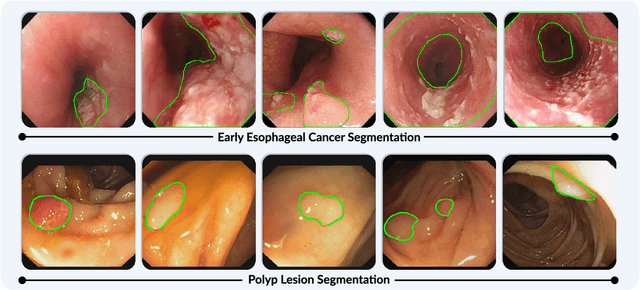
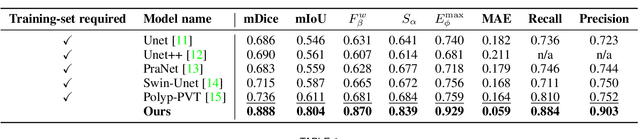

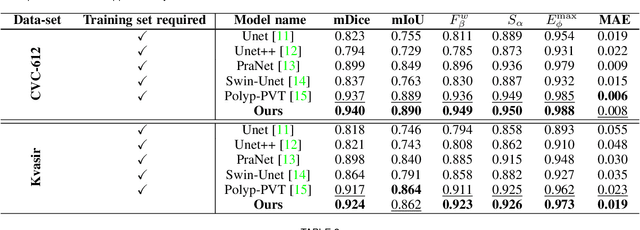
Accurate segmentation of lesions is crucial for diagnosis and treatment of early esophageal cancer (EEC). However, neither traditional nor deep learning-based methods up to today can meet the clinical requirements, with the mean Dice score - the most important metric in medical image analysis - hardly exceeding 0.75. In this paper, we present a novel deep learning approach for segmenting EEC lesions. Our approach stands out for its uniqueness, as it relies solely on a single image coming from one patient, forming the so-called "You-Only-Have-One" (YOHO) framework. On one hand, this "one-image-one-network" learning ensures complete patient privacy as it does not use any images from other patients as the training data. On the other hand, it avoids nearly all generalization-related problems since each trained network is applied only to the input image itself. In particular, we can push the training to "over-fitting" as much as possible to increase the segmentation accuracy. Our technical details include an interaction with clinical physicians to utilize their expertise, a geometry-based rendering of a single lesion image to generate the training set (the \emph{biggest} novelty), and an edge-enhanced UNet. We have evaluated YOHO over an EEC data-set created by ourselves and achieved a mean Dice score of 0.888, which represents a significant advance toward clinical applications.