 Add to Chrome
 Add to Firefox
 Add to Edge
NaviRAG: Towards Active Knowledge Navigation for Retrieval-Augmented Generation
Apr 14, 2026
Retrieval-augmented generation (RAG) typically relies on a flat retrieval paradigm that maps queries directly to static, isolated text segments. This approach struggles with more complex tasks that require the conditional retrieval and dynamic synthesis of information across different levels of granularity (e.g., from broad concepts to specific evidence). To bridge this gap, we introduce NaviRAG, a novel framework that shifts from passive segment retrieval to active knowledge navigation. NaviRAG first structures the knowledge documents into a hierarchical form, preserving semantic relationships from coarse-grained topics to fine-grained details. Leveraging this reorganized knowledge records, a large language model (LLM) agent actively navigates the records, iteratively identifying information gaps and retrieving relevant content from the most appropriate granularity level. Extensive experiments on long-document QA benchmarks show that NaviRAG consistently improves both retrieval recall and end-to-end answer performance over conventional RAG baselines. Ablation studies confirm performance gains stem from our method's capacity for multi-granular evidence localization and dynamic retrieval planning. We further discuss efficiency, applicable scenario, and future directions of our method, hoping to make RAG systems more intelligent and autonomous.

KG-Infused RAG: Augmenting Corpus-Based RAG with External Knowledge Graphs
Jun 11, 2025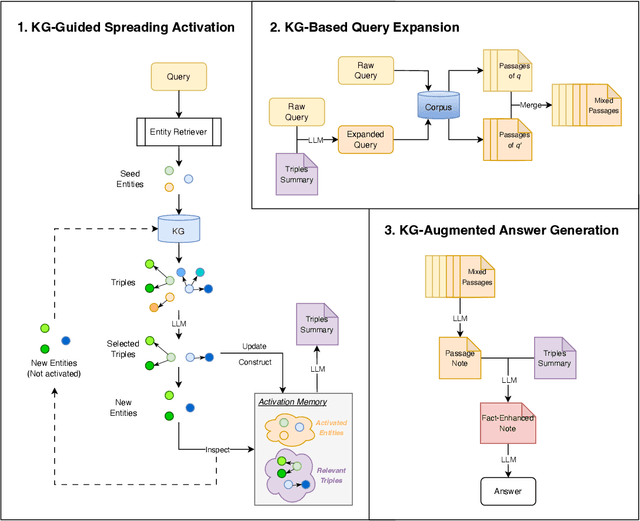
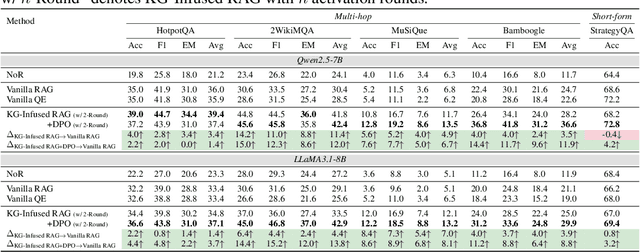
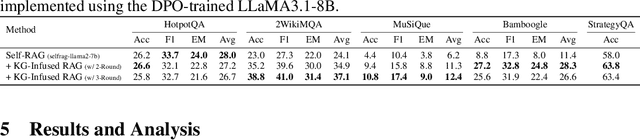
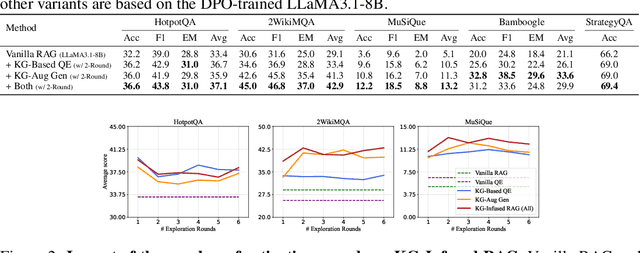
Retrieval-Augmented Generation (RAG) improves factual accuracy by grounding responses in external knowledge. However, existing methods typically rely on a single source, either unstructured text or structured knowledge. Moreover, they lack cognitively inspired mechanisms for activating relevant knowledge. To address these issues, we propose KG-Infused RAG, a framework that integrates KGs into RAG systems to implement spreading activation, a cognitive process that enables concept association and inference. KG-Infused RAG retrieves KG facts, expands the query accordingly, and enhances generation by combining corpus passages with structured facts, enabling interpretable, multi-source retrieval grounded in semantic structure. We further improve KG-Infused RAG via preference learning on sampled key stages in the pipeline. Experiments on five QA benchmarks show that KG-Infused RAG consistently outperforms vanilla RAG (by 3.8% to 13.8%). Additionally, when integrated into Self-RAG, KG-Infused RAG brings further performance gains, demonstrating its effectiveness and versatility as a plug-and-play enhancement module for corpus-based RAG methods.
Chain of Thought Prompting Elicits Knowledge Augmentation
Jul 04, 2023The knowledge-augmented deep learning paradigm refers to a paradigm in which domain knowledge is identified and integrated into deep models. Conventional methods typically employ task-specific approaches to gather external knowledge from various sources. In contrast, large language models are extensively pre-trained and can serve as a comprehensive source of external knowledge. In this paper, we propose CoT-KA, a Chain-of-Thought-based method that augments knowledge for deep learning. CoT-KA avoids the need for additional knowledge retrieval or knowledge reasoning models, as required in conventional augmentation methods. Our results demonstrate that CoT-KA outperforms both pure CoT-based methods and the non-augmented method across the majority of eleven publicly available benchmarks for various reasoning tasks.