 Add to Chrome
 Add to Firefox
 Add to Edge
OccamView: Object-Conditioned View Selection for Frame-Budgeted Active 3D Gaussian Reconstruction
Aug 17, 2026
Active 3D Gaussian reconstruction fundamentally relies on selecting informative next-best views under limited sensing budgets. Existing active 3DGS methods primarily plan viewpoints according to geometric information gain, treating object-induced hidden regions in the same manner as general unexplored space. Under tight frame budgets, such geometry-driven strategies may prioritize global scene coverage while leaving partially observed objects incompletely reconstructed. To address this limitation, we propose OccamView, an object-conditioned view-selection framework for frame-budgeted active 3D Gaussian reconstruction. Rather than predicting unseen object geometry or performing shape completion, OccamView maintains an online object memory from open-vocabulary detections grounded in measured RGB-D observations and represents unresolved local occupancy around detected objects as conservative hidden-region proxies. Candidate viewpoints are then evaluated using an occlusion-aware proxy-coverage score. Furthermore, we introduce a Geo-Floor mechanism that restricts object-conditioned re-ranking to geometrically competitive candidates, allowing object-conditioned cues to guide complementary observations while preserving the geometry-driven exploration behavior of the underlying planner. Experiments on Replica and Matterport3D under a unified frame-budgeted protocol show that OccamView consistently reduces Completion and improves Completion Ratio across five frame budgets, with particularly pronounced gains under limited frame budgets. These results demonstrate that lightweight object-conditioned cues effectively complement geometry-driven active view planning.

StellaVLA: In-Context Structured Demonstration for Generalizable Vision-Language-Action Models
Aug 12, 2026Vision-Language-Action (VLA) models can follow instructions and manipulate objects, but their performance often collapses out of distribution (OOD), when the scene, viewpoint, or object differs from training. Adapting to each new situation typically requires collecting more data and fine-tuning. We present StellaVLA, a framework that instead adapts at test time by conditioning on a single retrieved demonstration. The key idea is to move beyond imitating what an expert did and instead convey why: an automated offline pipeline converts each raw trajectory into a structured demonstration, e.g., a task plan, sub-goal descriptions, and verbalized 3D motion, at zero human-annotation cost. Provided as in-context guidance, this structured demonstration lets the policy reason about the task rather than mimic a pixel trajectory, which also makes it transferable across embodiments (real-robot, human-hand, or XR demonstrations). A parallel dual-training design internalizes this reasoning during training through a joint action-and-language objective, while inference uses the action expert alone, preserving real-time, high-frequency control with no added latency. On the VLA-Arena leaderboard(Aug 1, 2026), StellaVLA ranks first with an overall score of 0.63, versus 0.44 and 0.22 for the strong prior models ($π_{0.5}$ and LingBot-VLA), and it further leads on LIBERO with 98.8% average success rate and LIBERO-Plus with 85.1% success rate. Our real-robot benchmark demonstrates that StellaVLA can use both human/robot demos and human-to-robot (XR) demos as in-context structured demonstration to help VLA model adapt to OOD tasks.
VLA-Cache: Towards Efficient Vision-Language-Action Model via Adaptive Token Caching in Robotic Manipulation
Feb 04, 2025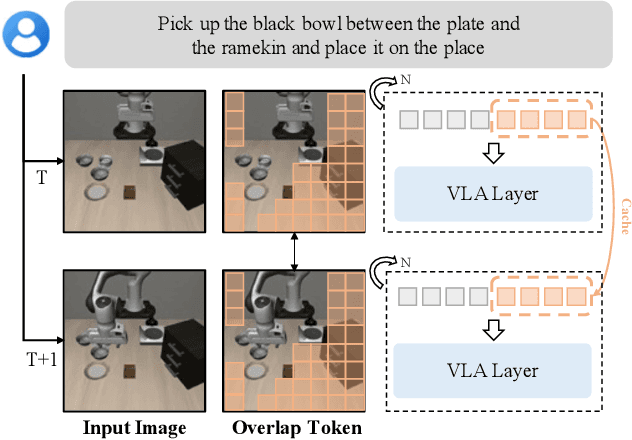


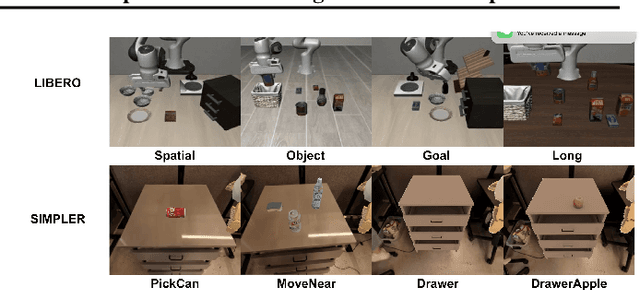
Vision-Language-Action (VLA) model can process instructions and visual perception to directly generate actions as output in an end-to-end fashion due to its strong multi-modal reasoning capabilities. While the performance of VLA models is promising, their computational cost can be substantial. This raises challenge for applying them on robotics tasks, which requires real-time decision-making to respond quickly to environmental changes. Since robotic control involves sequential decision-making, the visual input often exhibits minimal variation between successive steps. A natural idea is to reuse the computational results of unchanged visual tokens from the last step. Motivated by this idea, we propose VLA-Cache, an efficient vision-language-action model. VLA-Cache incorporates a token-selection mechanism that compares the visual input at each step with the input from the previous step, adaptively identifying visual tokens with minimal changes. The computational results for these unchanged tokens are then reused in subsequent steps via KV-cache, thereby significantly improving the efficiency of the VLA-Cache model. Experimental results on both simulation (e.g., LIBERO benchmark and SIMPLER) and real-world robot valid VLA-Cache can achieve practical acceleration with minimal sacrifice in success rate.