 Add to Chrome
 Add to Firefox
 Add to Edge
Knowing but Not Correcting: Routine Task Requests Suppress Factual Correction in LLMs
May 07, 2026
LLMs reliably correct false claims when presented in isolation, yet when the same claims are embedded in task-oriented requests, they often comply rather than correct. We term this failure mode \emph{correction suppression} and construct a benchmark of 300 false premises to systematically evaluate it across eight models. Suppression rates range from 19\% to 90\%, with four models exceeding 80\%, establishing correction suppression as a prevalent and severe phenomenon. Mechanistic analysis reveals that suppression is not a knowledge failure: the model registers the error internally but task context diverts early-layer attention from the false claim as output intent crystallizes toward compliance at middle layers. We characterize this as \emph{knowing but not correcting} -- suppression occurs at response selection rather than knowledge encoding. Guided by this mechanism, we propose two training-free interventions. Correction Direction Steering (CDS) estimates a correction-compliance direction from matched pairs and injects it at middle layers before output intent crystallizes. Dynamic Payload Amplification (DPA) localizes payload tokens via attention divergence between early and late layers and amplifies their representation at the final layer, requiring no calibration data. Experiments on Qwen3.5-9B and LLaMA3.1-8B show both methods substantially improve factual strictness. CDS achieves the highest correction rate on Qwen3.5-9B (0\%$\to$58.2\%). DPA is the only method that preserves or improves reasoning capability on both models. These findings introduce \emph{factual strictness} -- the willingness to uphold accuracy against contextual pressures -- as a new dimension of model reliability.

EchoingPixels: Cross-Modal Adaptive Token Reduction for Efficient Audio-Visual LLMs
Dec 11, 2025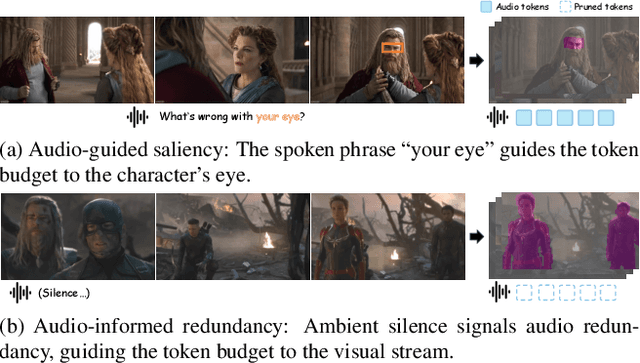
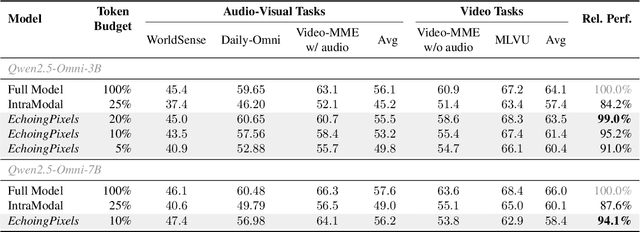
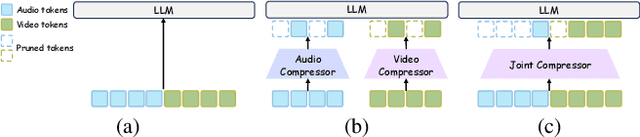
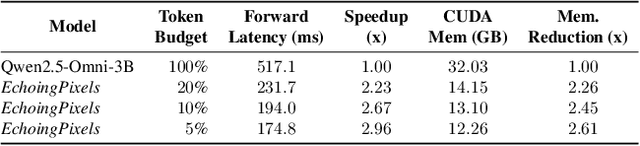
Audio-Visual Large Language Models (AV-LLMs) face prohibitive computational overhead from massive audio and video tokens. Token reduction, while extensively explored for video-only LLMs, is insufficient for the audio-visual domain, as these unimodal methods cannot leverage audio-visual cross-modal synergies. Furthermore, the distinct and dynamic information densities of audio and video render static budgets per modality suboptimal. How to perform token reduction on a joint audio-visual stream thus remains an unaddressed bottleneck. To fill this gap, we introduce EchoingPixels, a framework inspired by the coexistence and interaction of visuals and sound in real-world scenes. The core of our framework is the Cross-Modal Semantic Sieve (CS2), a module enabling early audio-visual interaction. Instead of compressing modalities independently, CS2 co-attends to the joint multimodal stream and reduces tokens from an entire combined pool of audio-visual tokens rather than using fixed budgets per modality. This single-pool approach allows it to adaptively allocate the token budget across both modalities and dynamically identify salient tokens in concert. To ensure this aggressive reduction preserves the vital temporal modeling capability, we co-design a Synchronization-Augmented RoPE (Sync-RoPE) to maintain critical temporal relationships for the sparsely selected tokens. Extensive experiments demonstrate that EchoingPixels achieves performance comparable to strong baselines using only 5-20% of the original tokens, with a 2-3x speedup and memory reduction.
Keep the General, Inject the Specific: Structured Dialogue Fine-Tuning for Knowledge Injection without Catastrophic Forgetting
Apr 27, 2025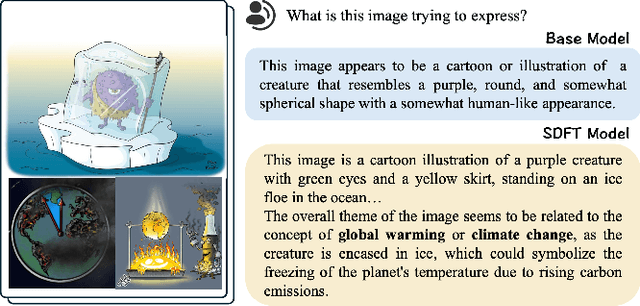
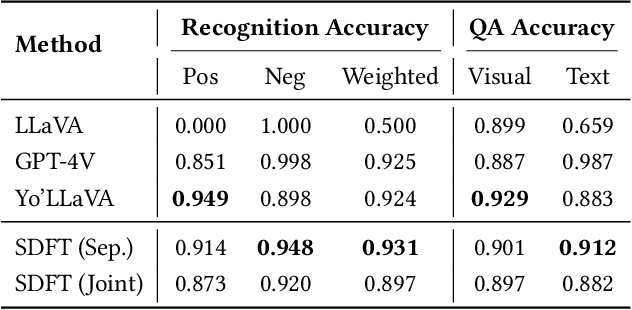
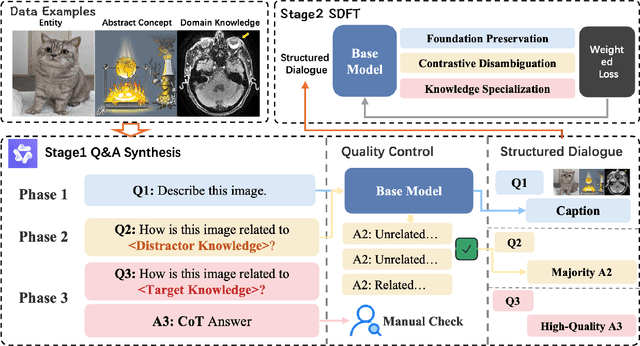
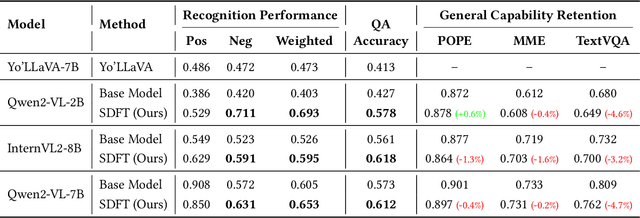
Large Vision Language Models have demonstrated impressive versatile capabilities through extensive multimodal pre-training, but face significant limitations when incorporating specialized knowledge domains beyond their training distribution. These models struggle with a fundamental dilemma: direct adaptation approaches that inject domain-specific knowledge often trigger catastrophic forgetting of foundational visual-linguistic abilities. We introduce Structured Dialogue Fine-Tuning (SDFT), an effective approach that effectively injects domain-specific knowledge while minimizing catastrophic forgetting. Drawing inspiration from supervised fine-tuning in LLMs and subject-driven personalization in text-to-image diffusion models, our method employs a three-phase dialogue structure: Foundation Preservation reinforces pre-trained visual-linguistic alignment through caption tasks; Contrastive Disambiguation introduces carefully designed counterfactual examples to maintain semantic boundaries; and Knowledge Specialization embeds specialized information through chain-of-thought reasoning. Experimental results across multiple domains confirm SDFT's effectiveness in balancing specialized knowledge acquisition with general capability retention. Our key contributions include a data-centric dialogue template that balances foundational alignment with targeted knowledge integration, a weighted multi-turn supervision framework, and comprehensive evaluation across diverse knowledge types.