 Add to Chrome
 Add to Firefox
 Add to Edge
Up to 36x Speedup: Mask-based Parallel Inference Paradigm for Key Information Extraction in MLLMs
Jan 27, 2026
Key Information Extraction (KIE) from visually-rich documents (VrDs) is a critical task, for which recent Large Language Models (LLMs) and Multi-Modal Large Language Models (MLLMs) have demonstrated strong potential. However, their reliance on autoregressive inference, which generates outputs sequentially, creates a significant efficiency bottleneck, especially as KIE tasks often involve extracting multiple, semantically independent fields. To overcome this limitation, we introduce PIP: a Parallel Inference Paradigm for KIE. Our approach reformulates the problem by using "[mask]" tokens as placeholders for all target values, enabling their simultaneous generation in a single forward pass. To facilitate this paradigm, we develop a tailored mask pre-training strategy and construct large-scale supervised datasets. Experimental results show that our PIP-models achieve a 5-36x inference speedup with negligible performance degradation compared to traditional autoregressive base models. By substantially improving efficiency while maintaining high accuracy, PIP paves the way for scalable and practical real-world KIE solutions.

Keep the General, Inject the Specific: Structured Dialogue Fine-Tuning for Knowledge Injection without Catastrophic Forgetting
Apr 27, 2025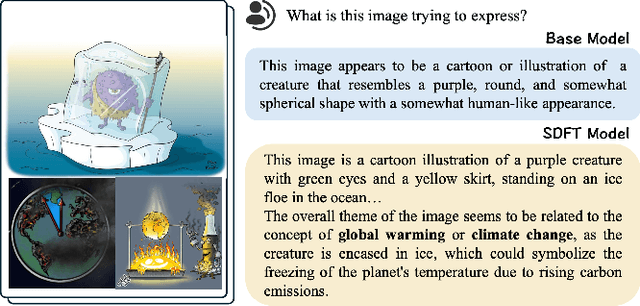
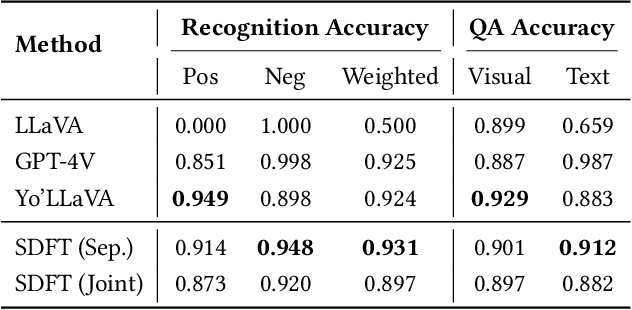
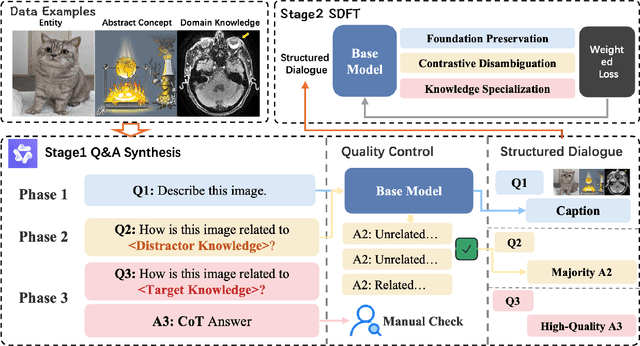
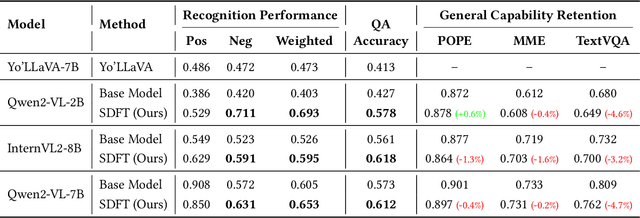
Large Vision Language Models have demonstrated impressive versatile capabilities through extensive multimodal pre-training, but face significant limitations when incorporating specialized knowledge domains beyond their training distribution. These models struggle with a fundamental dilemma: direct adaptation approaches that inject domain-specific knowledge often trigger catastrophic forgetting of foundational visual-linguistic abilities. We introduce Structured Dialogue Fine-Tuning (SDFT), an effective approach that effectively injects domain-specific knowledge while minimizing catastrophic forgetting. Drawing inspiration from supervised fine-tuning in LLMs and subject-driven personalization in text-to-image diffusion models, our method employs a three-phase dialogue structure: Foundation Preservation reinforces pre-trained visual-linguistic alignment through caption tasks; Contrastive Disambiguation introduces carefully designed counterfactual examples to maintain semantic boundaries; and Knowledge Specialization embeds specialized information through chain-of-thought reasoning. Experimental results across multiple domains confirm SDFT's effectiveness in balancing specialized knowledge acquisition with general capability retention. Our key contributions include a data-centric dialogue template that balances foundational alignment with targeted knowledge integration, a weighted multi-turn supervision framework, and comprehensive evaluation across diverse knowledge types.