 Add to Chrome
 Add to Firefox
 Add to Edge
Twin Agent: Context Residual Compression for Privilege Separated Agents
Jul 21, 2026
Large language model (LLM) agents are vulnerable to security risks, such as prompt injection attacks from untrusted context that manipulate downstream reasoning and tool use. Existing secure-by-design approaches mitigate this risk by separating untrusted observations from privileged execution and careful control of information flow, but often degrade utility and require extensive task-specific engineering. We thus propose Twin Agent, a general privilege separation design pattern inspired by residual coding in the agent context. Twin Agent consists of two nearly symmetric agents: an Explore Agent that inspects untrusted information and a Safe Agent that executes privileged actions. The Explore Agent is conditioned on the Safe Agent's current context and communicates only compact hints to the Safe Agent about the next action to take. This design reduces the information needed to preserve task utility and thus achieves a better security--utility tradeoff, which we empirically verify by measuring how utility and attack success change as the length of hints varies. We evaluate Twin Agent on long-horizon software engineering tasks with SWE-bench Lite and on heterogeneous multi-tool interaction tasks with AgentDojo and DecodingTrust-Agent. Across both benchmarks, Twin Agent preserves high task utility while preventing prompt injection attacks, outperforming both undefended agents and privilege separation baselines.

PatchDEMUX: A Certifiably Robust Framework for Multi-label Classifiers Against Adversarial Patches
May 30, 2025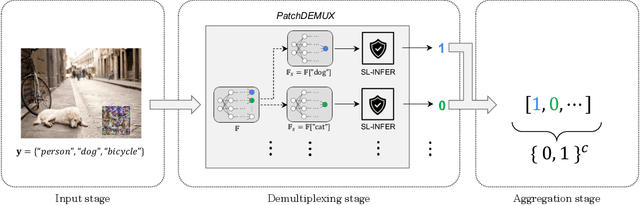
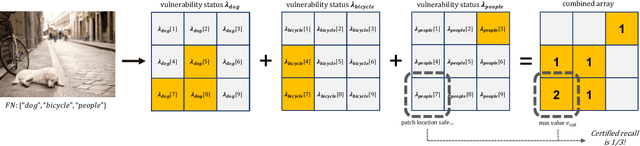
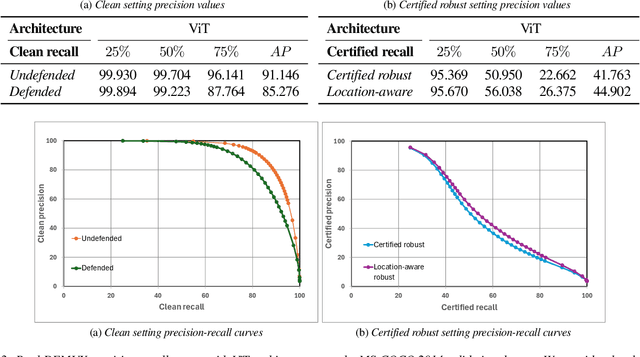
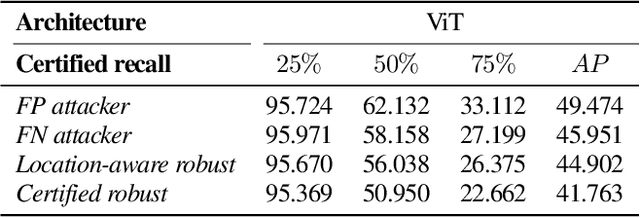
Deep learning techniques have enabled vast improvements in computer vision technologies. Nevertheless, these models are vulnerable to adversarial patch attacks which catastrophically impair performance. The physically realizable nature of these attacks calls for certifiable defenses, which feature provable guarantees on robustness. While certifiable defenses have been successfully applied to single-label classification, limited work has been done for multi-label classification. In this work, we present PatchDEMUX, a certifiably robust framework for multi-label classifiers against adversarial patches. Our approach is a generalizable method which can extend any existing certifiable defense for single-label classification; this is done by considering the multi-label classification task as a series of isolated binary classification problems to provably guarantee robustness. Furthermore, in the scenario where an attacker is limited to a single patch we propose an additional certification procedure that can provide tighter robustness bounds. Using the current state-of-the-art (SOTA) single-label certifiable defense PatchCleanser as a backbone, we find that PatchDEMUX can achieve non-trivial robustness on the MS-COCO and PASCAL VOC datasets while maintaining high clean performance