 Add to Chrome
 Add to Firefox
 Add to Edge
S2MDF: A Plug-And-Play Layer for Intersection-Free Multi-Object Signed Distance Fields
May 28, 2026
Compositional implicit surface representations model scenes as collections of objects, each encoded by a Signed Distance Field (SDF). A fundamental limitation of this approach is that multiple SDFs can produce geometries that interpenetrate, violating physical plausibility. Existing mitigation strategies rely on soft penalty terms that reduce but do not eliminate intersections, and require careful loss weighting. To truly prevent interpenetration, we propose a hard constraint on vector-valued SDFs and introduce S2MDF, a lightweight plug-and-play module that enforces the constraint on any object-compositional SDF representation without architectural modifications. It introduces negligible computational overhead and is compatible with linearly-interpolated standard meshing algorithms such as Marching Cubes. It can be applied during training or as a post-processing step. Experiments on multiple state-of-the-art compositional methods show that S2MDF reduces intersections to numerical precision while preserving reconstruction quality, outperforming existing mitigation strategies.

MedTet: An Online Motion Model for 4D Heart Reconstruction
Dec 03, 2024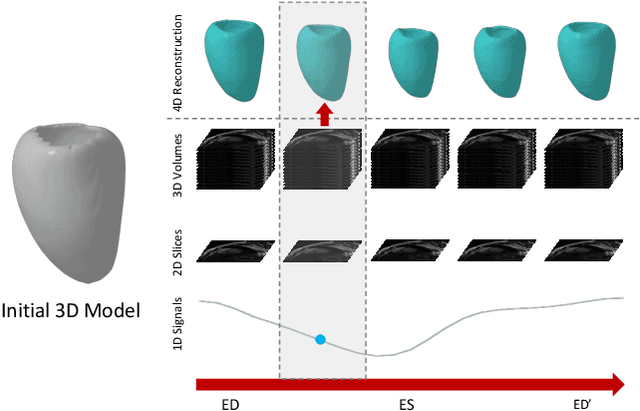
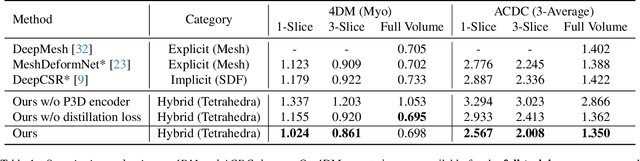
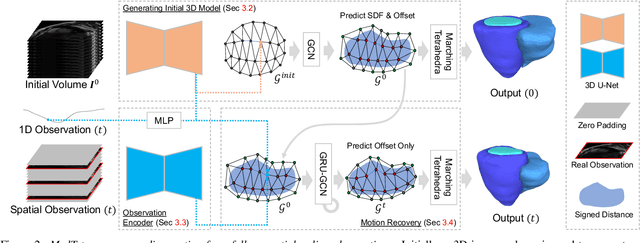
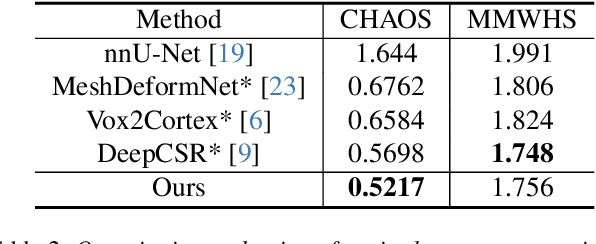
We present a novel approach to reconstruction of 3D cardiac motion from sparse intraoperative data. While existing methods can accurately reconstruct 3D organ geometries from full 3D volumetric imaging, they cannot be used during surgical interventions where usually limited observed data, such as a few 2D frames or 1D signals, is available in real-time. We propose a versatile framework for reconstructing 3D motion from such partial data. It discretizes the 3D space into a deformable tetrahedral grid with signed distance values, providing implicit unlimited resolution while maintaining explicit control over motion dynamics. Given an initial 3D model reconstructed from pre-operative full volumetric data, our system, equipped with an universal observation encoder, can reconstruct coherent 3D cardiac motion from full 3D volumes, a few 2D MRI slices or even 1D signals. Extensive experiments on cardiac intervention scenarios demonstrate our ability to generate plausible and anatomically consistent 3D motion reconstructions from various sparse real-time observations, highlighting its potential for multimodal cardiac imaging. Our code and model will be made available at https://github.com/Scalsol/MedTet.