 Add to Chrome
 Add to Firefox
 Add to Edge
The MiniMax-M2 Series: Mini Activations Unleashing Max Real-World Intelligence
May 26, 2026
We introduce the MiniMax-M2 series, a family of Mixture-of-Experts language models built around the principle that mini activations can unleash maximum real-world intelligence. The flagship M2 contains 229.9B total parameters with only 9.8B activated per token. Designed end-to-end for agentic deployment, the M2 series rests on three components: (i) agent-driven data pipelines producing large-scale, verifiable trajectories across agentic coding and agentic cowork, each grounded in an executable workspace and an artifact-aligned reward; (ii) Forge, a scalable agent-native RL system that adapts to long-horizon agent trajectories, paired with windowed-FIFO scheduling, prefix-tree merging, inference optimization, and a clean training-inference-agent decoupling that supports both white-box and black-box agents; (iii) the latest M2.7 checkpoint takes an early step toward self-evolution -- autonomously debugging training runs and modifying its own scaffold. Across M2 through M2.7, this combination translates a mini-activation footprint into frontier-tier performance on agentic coding, deep search, office-task, and reasoning benchmarks.

HER: Human-like Reasoning and Reinforcement Learning for LLM Role-playing
Jan 29, 2026LLM role-playing, i.e., using LLMs to simulate specific personas, has emerged as a key capability in various applications, such as companionship, content creation, and digital games. While current models effectively capture character tones and knowledge, simulating the inner thoughts behind their behaviors remains a challenge. Towards cognitive simulation in LLM role-play, previous efforts mainly suffer from two deficiencies: data with high-quality reasoning traces, and reliable reward signals aligned with human preferences. In this paper, we propose HER, a unified framework for cognitive-level persona simulation. HER introduces dual-layer thinking, which distinguishes characters' first-person thinking from LLMs' third-person thinking. To bridge these gaps, we curate reasoning-augmented role-playing data via reverse engineering and construct human-aligned principles and reward models. Leveraging these resources, we train \method models based on Qwen3-32B via supervised and reinforcement learning. Extensive experiments validate the effectiveness of our approach. Notably, our models significantly outperform the Qwen3-32B baseline, achieving a 30.26 improvement on the CoSER benchmark and a 14.97 gain on the Minimax Role-Play Bench. Our datasets, principles, and models will be released to facilitate future research.
OctoBench: Benchmarking Scaffold-Aware Instruction Following in Repository-Grounded Agentic Coding
Jan 16, 2026Modern coding scaffolds turn LLMs into capable software agents, but their ability to follow scaffold-specified instructions remains under-examined, especially when constraints are heterogeneous and persist across interactions. To fill this gap, we introduce OctoBench, which benchmarks scaffold-aware instruction following in repository-grounded agentic coding. OctoBench includes 34 environments and 217 tasks instantiated under three scaffold types, and is paired with 7,098 objective checklist items. To disentangle solving the task from following the rules, we provide an automated observation-and-scoring toolkit that captures full trajectories and performs fine-grained checks. Experiments on eight representative models reveal a systematic gap between task-solving and scaffold-aware compliance, underscoring the need for training and evaluation that explicitly targets heterogeneous instruction following. We release the benchmark to support reproducible benchmarking and to accelerate the development of more scaffold-aware coding agents.
MiniMax-M1: Scaling Test-Time Compute Efficiently with Lightning Attention
Jun 16, 2025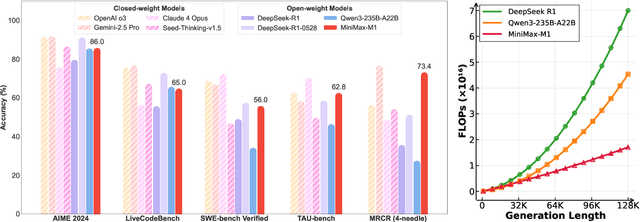

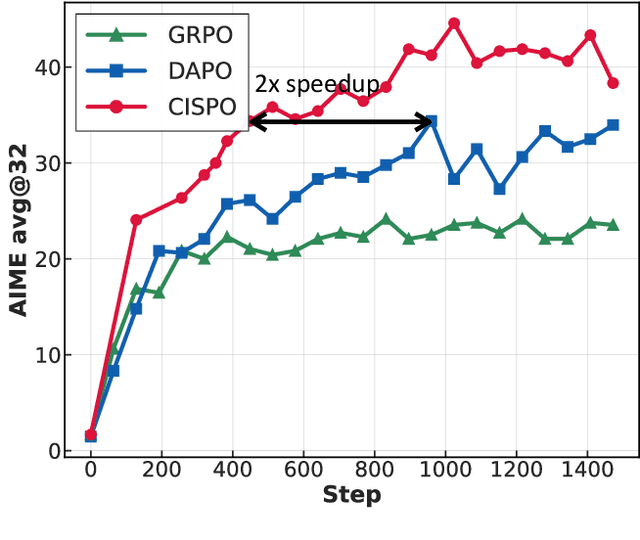
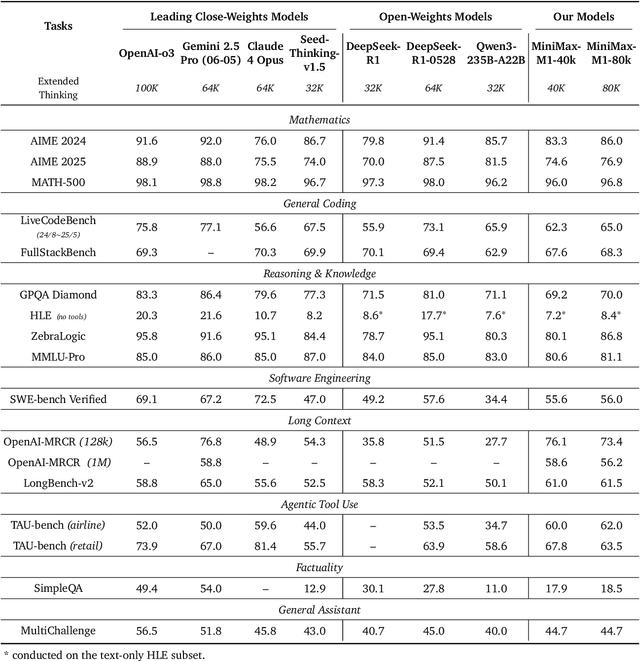
We introduce MiniMax-M1, the world's first open-weight, large-scale hybrid-attention reasoning model. MiniMax-M1 is powered by a hybrid Mixture-of-Experts (MoE) architecture combined with a lightning attention mechanism. The model is developed based on our previous MiniMax-Text-01 model, which contains a total of 456 billion parameters with 45.9 billion parameters activated per token. The M1 model natively supports a context length of 1 million tokens, 8x the context size of DeepSeek R1. Furthermore, the lightning attention mechanism in MiniMax-M1 enables efficient scaling of test-time compute. These properties make M1 particularly suitable for complex tasks that require processing long inputs and thinking extensively. MiniMax-M1 is trained using large-scale reinforcement learning (RL) on diverse problems including sandbox-based, real-world software engineering environments. In addition to M1's inherent efficiency advantage for RL training, we propose CISPO, a novel RL algorithm to further enhance RL efficiency. CISPO clips importance sampling weights rather than token updates, outperforming other competitive RL variants. Combining hybrid-attention and CISPO enables MiniMax-M1's full RL training on 512 H800 GPUs to complete in only three weeks, with a rental cost of just $534,700. We release two versions of MiniMax-M1 models with 40K and 80K thinking budgets respectively, where the 40K model represents an intermediate phase of the 80K training. Experiments on standard benchmarks show that our models are comparable or superior to strong open-weight models such as the original DeepSeek-R1 and Qwen3-235B, with particular strengths in complex software engineering, tool utilization, and long-context tasks. We publicly release MiniMax-M1 at https://github.com/MiniMax-AI/MiniMax-M1.