 Add to Chrome
 Add to Firefox
 Add to Edge
Cosmos 3: Omnimodal World Models for Physical AI
Jun 01, 2026
We introduce Cosmos 3, a family of omnimodal world models designed to jointly process and generate language, image, video, audio, and action sequences within a unified mixture-of-transformers architecture. By supporting highly flexible input-output configurations, Cosmos 3 seamlessly unifies critical modalities for Physical AI -- effectively subsuming vision-language models, video generators, world simulators, and world-action models into a single framework. Our evaluation demonstrates that Cosmos 3 establishes a new state-of-the-art across a diverse suite of understanding and generation tasks, demonstrating omnimodal world models as scalable, general-purpose backbones for embodied agents. Our post-trained Cosmos 3 models were ranked as the best open-source Text-to-Image and Image-to-Video models by Artificial Analysis, and the best policy model by RoboArena at the time the technical report was written. To accelerate open research and deployment in Physical AI, we make our code, model checkpoints, curated synthetic datasets, and evaluation benchmark available under the Linux Foundation's OpenMDW-1.1 https://openmdw.ai/license/1-1/ License at https://github.com/nvidia/cosmos}{github.com/nvidia/cosmos and https://huggingface.co/collections/nvidia/cosmos3 . The project website is available at https://research.nvidia.com/labs/cosmos-lab/cosmos3 .

Hybrid Verified Decoding: Learning to Allocate Verification in Speculative Decoding
May 31, 2026Large Language Model (LLM) generation remains expensive because autoregressive decoding calls the model once for each new token. Speculative decoding reduces this cost by drafting multiple tokens and verifying them with the target model in one step, but its speedup depends on how many drafted tokens are accepted. Parameter-free draft sources can propose long continuations at low cost in structured and agentic workloads, yet a cache match that looks promising at one generation step may have low payoff at the next. We propose Hybrid Verified Decoding, which predicts the accepted length of a cache draft before verification and uses this payoff estimate to choose between cache verification and a model-based drafter. Across three LLMs and sixteen datasets, Hybrid Verified Decoding is especially effective on agentic workflows, where it outperforms EAGLE3 in every setting with a 2.73x average speedup. Our analysis shows how prompt structure creates cache opportunities, how high-payoff cache drafts concentrate in a small part of the draft space, and how payoff-guided selection reduces sequential decoding work, pointing to runtime draft selection as a promising direction for speculative decoding.
TSPP: A Unified Benchmarking Tool for Time-series Forecasting
Jan 08, 2024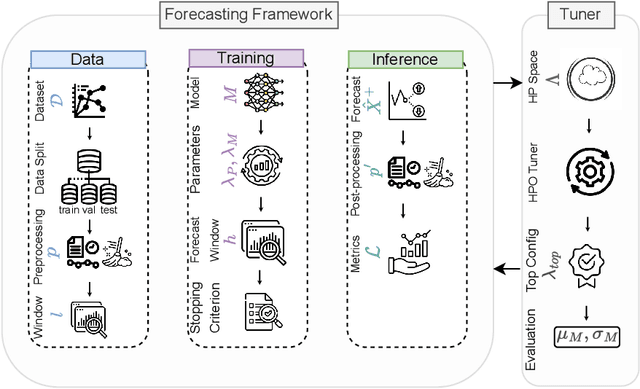
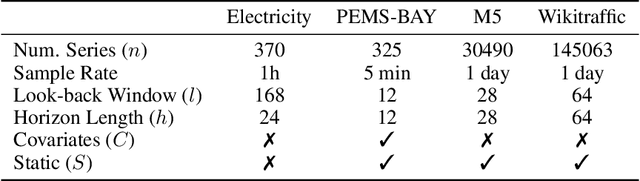
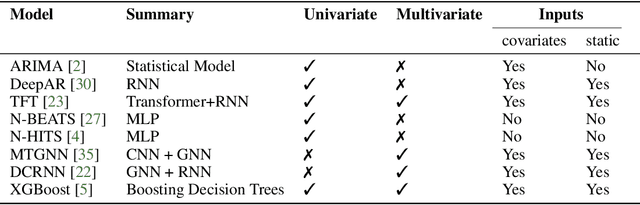
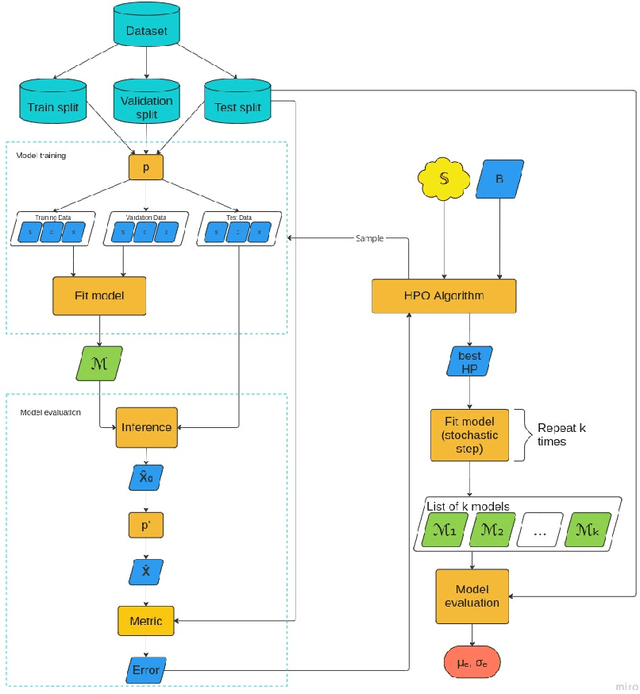
While machine learning has witnessed significant advancements, the emphasis has largely been on data acquisition and model creation. However, achieving a comprehensive assessment of machine learning solutions in real-world settings necessitates standardization throughout the entire pipeline. This need is particularly acute in time series forecasting, where diverse settings impede meaningful comparisons between various methods. To bridge this gap, we propose a unified benchmarking framework that exposes the crucial modelling and machine learning decisions involved in developing time series forecasting models. This framework fosters seamless integration of models and datasets, aiding both practitioners and researchers in their development efforts. We benchmark recently proposed models within this framework, demonstrating that carefully implemented deep learning models with minimal effort can rival gradient-boosting decision trees requiring extensive feature engineering and expert knowledge.
A Framework for Large Scale Synthetic Graph Dataset Generation
Oct 06, 2022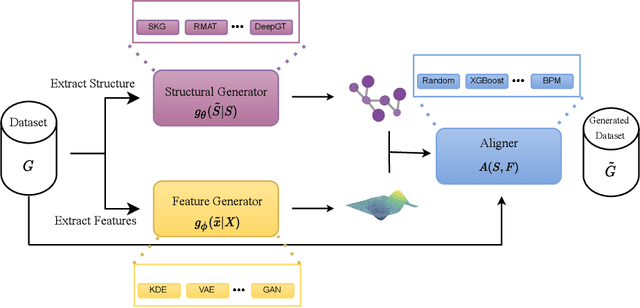
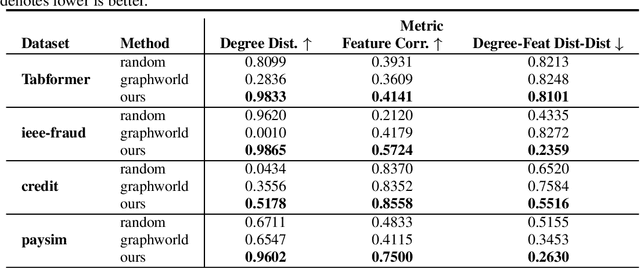
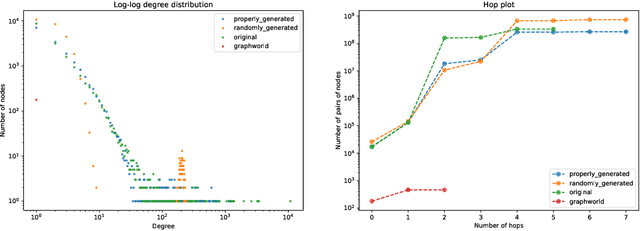
Recently there has been increasing interest in developing and deploying deep graph learning algorithms for many graph analysis tasks such as node and edge classification, link prediction, and clustering with numerous practical applications such as fraud detection, drug discovery, or recommender systems. Allbeit there is a limited number of publicly available graph-structured datasets, most of which are tiny compared to production-sized applications with trillions of edges and billions of nodes. Further, new algorithms and models are benchmarked across similar datasets with similar properties. In this work, we tackle this shortcoming by proposing a scalable synthetic graph generation tool that can mimic the original data distribution of real-world graphs and scale them to arbitrary sizes. This tool can be used then to learn a set of parametric models from proprietary datasets that can subsequently be released to researchers to study various graph methods on the synthetic data increasing prototype development and novel applications. Finally, the performance of the graph learning algorithms depends not only on the size but also on the dataset's structure. We show how our framework generalizes across a set of datasets, mimicking both structural and feature distributions as well as its scalability across varying dataset sizes.
Relative Molecule Self-Attention Transformer
Oct 12, 2021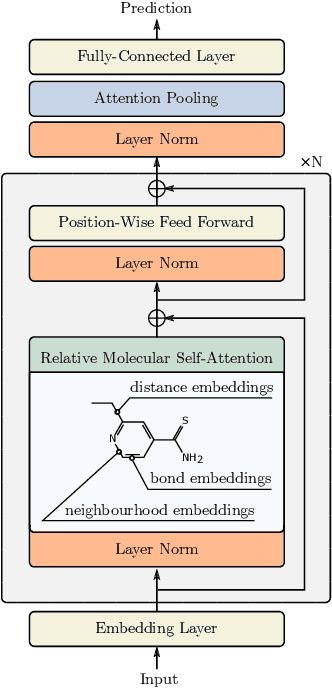
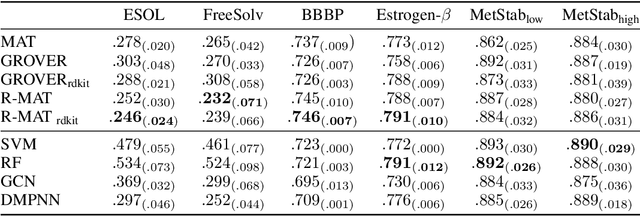
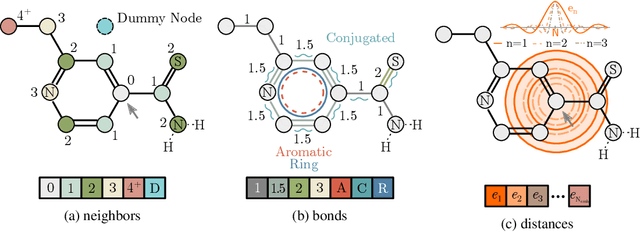
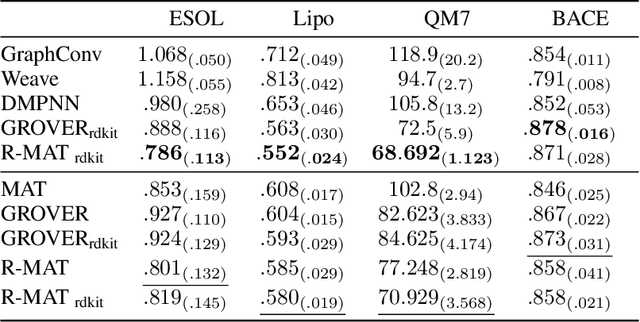
Self-supervised learning holds promise to revolutionize molecule property prediction - a central task to drug discovery and many more industries - by enabling data efficient learning from scarce experimental data. Despite significant progress, non-pretrained methods can be still competitive in certain settings. We reason that architecture might be a key bottleneck. In particular, enriching the backbone architecture with domain-specific inductive biases has been key for the success of self-supervised learning in other domains. In this spirit, we methodologically explore the design space of the self-attention mechanism tailored to molecular data. We identify a novel variant of self-attention adapted to processing molecules, inspired by the relative self-attention layer, which involves fusing embedded graph and distance relationships between atoms. Our main contribution is Relative Molecule Attention Transformer (R-MAT): a novel Transformer-based model based on the developed self-attention layer that achieves state-of-the-art or very competitive results across a~wide range of molecule property prediction tasks.