 Add to Chrome
 Add to Firefox
 Add to Edge
PosterHarness: Turning Scientific Poster Generation into an Auditable Instruction-Following Benchmark
Jul 03, 2026
Text-rich image models can now design poster-scale layouts, but we lack ways to measure whether they honor scientific communication contracts: legible labels, prescribed aspect ratios, and -- above all -- abstaining from fabricated scientific figures. We present POSTERHARNESS, an auditable harness reframing poster generation as measurable instruction-following tasks, with a pilot benchmark and failure taxonomy. POSTERHARNESS uses a placeholder-first contract to separate two jobs models otherwise conflate. The model performs visual-summary design: typography, reading path, color, and background -- but never draws data-bearing figures. Every figure region must be an empty labeled placeholder; a deterministic compositor inserts real source-paper figures at detected coordinates. This makes properties measurable: placeholder count and ID accuracy, blankness, aspect-ratio compliance, abstention from synthesized graphics, public-text hygiene, and source-figure provenance -- with failures logged as explicit rejections, not hidden in plausible-looking output. We instantiate the harness on 12 papers (6 HEP, 6 AI/ML-adjacent) and report three findings. (i) A counterfactual probe shows the placeholder contract drives VLM-counted synthesized figures from 34 to 0 across three papers. (ii) A failure taxonomy identifies blocking contracts: placeholder geometry, placeholder QA, template critic, and public text. (iii) Comparison with Paper2Poster shows a trade-off: PosterHarness yields higher-resolution artifacts, lower white-canvas fraction, and stronger VLM visual preference; the deterministic baseline retains slightly more PosterQuiz-style information and runs faster. We report this as regime characterization, not a superiority claim. All artifacts, prompts, manifests, and audit scripts are released as a reusable evaluation component.

Agentic Hybrid RAG for Evidence-Grounded Muon Collider Analysis
Jun 09, 2026Muon collider research spans accelerator physics, detector instrumentation, and high-energy phenomenology, with relevant evidence scattered across a rapidly expanding and heterogeneous body of scientific literature. As high-energy physics (HEP) increasingly explores agent-assisted analysis workflows, efficiently locating, integrating, and verifying scientific evidence becomes an essential capability. While retrieval-augmented generation (RAG) offers a promising framework for scientific question answering, integrating agentic reasoning without compromising retrieval precision remains a key challenge. In this work, we present agentic hybrid RAG, an evidence-grounded RAG framework for muon collider research. The framework combines a hybrid retriever, integrating sparse lexical and dense semantic retrieval, with an agentic reasoning module for query decomposition, evidence expansion, and grounded answer generation. To enable systematic evaluation, we construct the first benchmark for retrieval-augmented scientific question answering in the muon collider domain, comprising a curated literature corpus together with dedicated retrieval and answer-generation benchmarks covering major detector and physics research topics. Extensive evaluation shows that hybrid retrieval provides the strongest retrieval backbone, while agentic reasoning is most effective for controlled evidence expansion and answer synthesis. Built on this principle, agentic hybrid RAG consistently outperforms representative retrieval and RAG baselines in retrieval effectiveness, answer quality, evidence coverage, and factual grounding. Together, the benchmark and framework provide a foundation for evidence-grounded scientific question answering and future HEP analysis agents operating over large-scale scientific literature.
Knowledge-enhanced Memory Model for Emotional Support Conversation
Oct 11, 2023
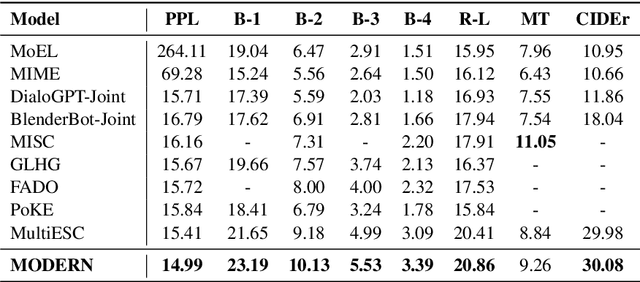

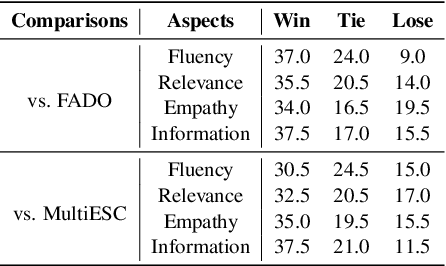
The prevalence of mental disorders has become a significant issue, leading to the increased focus on Emotional Support Conversation as an effective supplement for mental health support. Existing methods have achieved compelling results, however, they still face three challenges: 1) variability of emotions, 2) practicality of the response, and 3) intricate strategy modeling. To address these challenges, we propose a novel knowledge-enhanced Memory mODEl for emotional suppoRt coNversation (MODERN). Specifically, we first devise a knowledge-enriched dialogue context encoding to perceive the dynamic emotion change of different periods of the conversation for coherent user state modeling and select context-related concepts from ConceptNet for practical response generation. Thereafter, we implement a novel memory-enhanced strategy modeling module to model the semantic patterns behind the strategy categories. Extensive experiments on a widely used large-scale dataset verify the superiority of our model over cutting-edge baselines.