 Add to Chrome
 Add to Firefox
 Add to Edge
Test-Time Scaling in the Wild: Why Exploitation, Not Exploration, Is the Bottleneck
Aug 19, 2026
Test-time scaling (TTS) improves language model outputs by spending additional inference compute - generating multiple candidates, searching over partial sequences, or iteratively refining drafts. These techniques yield large gains on mathematics and code, but have been developed and stress-tested almost exclusively on tasks where verification is straightforward. We conduct the first compute-normalised comparison of five TTS families across five open-ended generation benchmarks spanning medicine, law, finance, general chat, and creative writing - grounded in a unified framework that decomposes the effectiveness of each method's token budget into exploration and exploitation. The answer depends on which side of that decomposition you examine. Scaling exploration works: the best candidate in the pool improves steadily with compute across all settings. What breaks is exploitation - the step that converts a rich candidate pool into a final output. With state-of-the-art generators, reward models correlate at only $ρ_v \approx 0.12$ with true quality, rendering selection near-random regardless of budget. Tree search amplifies this failure through diversity collapse. Refinement helps on one of five benchmarks; its apparent gains elsewhere are confounded. Only synthesis across candidates (Fusion) consistently improves over single-sample baselines, yet still recovers only ~40% of available quality. The candidate pool is not the bottleneck - choosing from it is.

From Explanations to Action: A Zero-Shot, Theory-Driven LLM Framework for Student Performance Feedback
Sep 12, 2024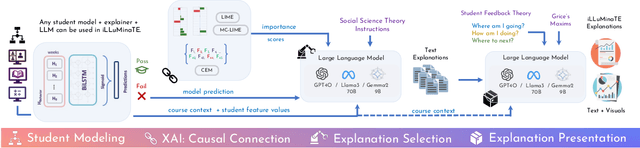
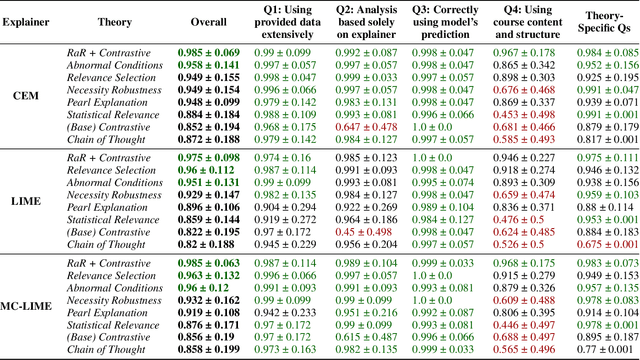
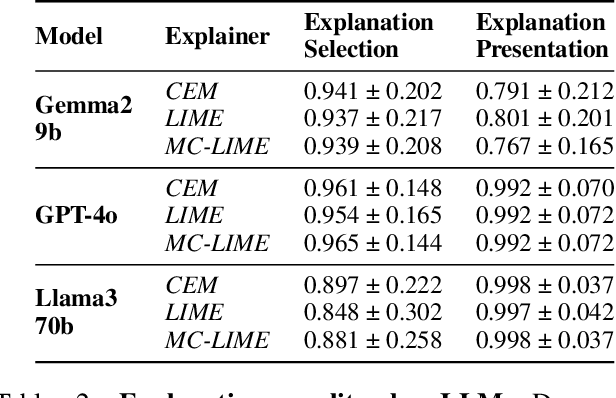
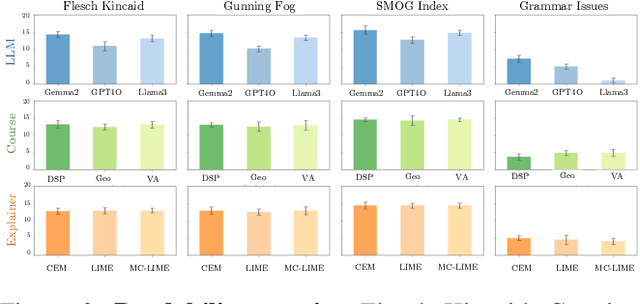
Recent advances in eXplainable AI (XAI) for education have highlighted a critical challenge: ensuring that explanations for state-of-the-art AI models are understandable for non-technical users such as educators and students. In response, we introduce iLLuMinaTE, a zero-shot, chain-of-prompts LLM-XAI pipeline inspired by Miller's cognitive model of explanation. iLLuMinaTE is designed to deliver theory-driven, actionable feedback to students in online courses. iLLuMinaTE navigates three main stages - causal connection, explanation selection, and explanation presentation - with variations drawing from eight social science theories (e.g. Abnormal Conditions, Pearl's Model of Explanation, Necessity and Robustness Selection, Contrastive Explanation). We extensively evaluate 21,915 natural language explanations of iLLuMinaTE extracted from three LLMs (GPT-4o, Gemma2-9B, Llama3-70B), with three different underlying XAI methods (LIME, Counterfactuals, MC-LIME), across students from three diverse online courses. Our evaluation involves analyses of explanation alignment to the social science theory, understandability of the explanation, and a real-world user preference study with 114 university students containing a novel actionability simulation. We find that students prefer iLLuMinaTE explanations over traditional explainers 89.52% of the time. Our work provides a robust, ready-to-use framework for effectively communicating hybrid XAI-driven insights in education, with significant generalization potential for other human-centric fields.