 Add to Chrome
 Add to Firefox
 Add to Edge
Test-Time Scaling in the Wild: Why Exploitation, Not Exploration, Is the Bottleneck
Aug 19, 2026
Test-time scaling (TTS) improves language model outputs by spending additional inference compute - generating multiple candidates, searching over partial sequences, or iteratively refining drafts. These techniques yield large gains on mathematics and code, but have been developed and stress-tested almost exclusively on tasks where verification is straightforward. We conduct the first compute-normalised comparison of five TTS families across five open-ended generation benchmarks spanning medicine, law, finance, general chat, and creative writing - grounded in a unified framework that decomposes the effectiveness of each method's token budget into exploration and exploitation. The answer depends on which side of that decomposition you examine. Scaling exploration works: the best candidate in the pool improves steadily with compute across all settings. What breaks is exploitation - the step that converts a rich candidate pool into a final output. With state-of-the-art generators, reward models correlate at only $ρ_v \approx 0.12$ with true quality, rendering selection near-random regardless of budget. Tree search amplifies this failure through diversity collapse. Refinement helps on one of five benchmarks; its apparent gains elsewhere are confounded. Only synthesis across candidates (Fusion) consistently improves over single-sample baselines, yet still recovers only ~40% of available quality. The candidate pool is not the bottleneck - choosing from it is.

Neural Machine Translation with Monte-Carlo Tree Search
Apr 27, 2020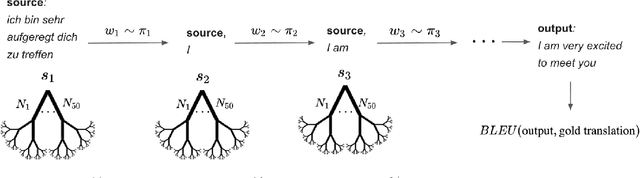
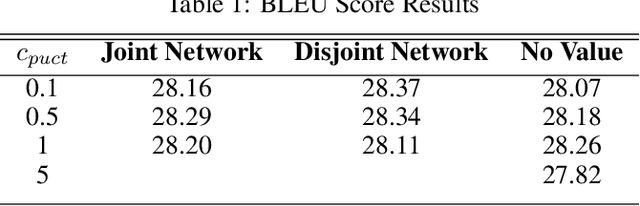
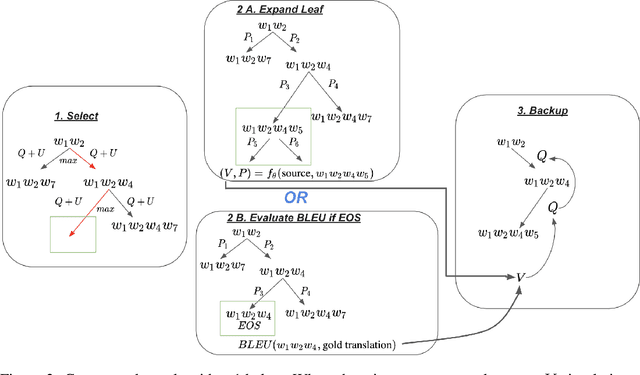
Recent algorithms in machine translation have included a value network to assist the policy network when deciding which word to output at each step of the translation. The addition of a value network helps the algorithm perform better on evaluation metrics like the BLEU score. After training the policy and value networks in a supervised setting, the policy and value networks can be jointly improved through common actor-critic methods. The main idea of our project is to instead leverage Monte-Carlo Tree Search (MCTS) to search for good output words with guidance from a combined policy and value network architecture in a similar fashion as AlphaZero. This network serves both as a local and a global look-ahead reference that uses the result of the search to improve itself. Experiments using the IWLST14 German to English translation dataset show that our method outperforms the actor-critic methods used in recent machine translation papers.
Adaptive Attention Span in Computer Vision
Apr 18, 2020


Recent developments in Transformers for language modeling have opened new areas of research in computer vision. Results from late 2019 showed vast performance increases in both object detection and recognition when convolutions are replaced by local self-attention kernels. Models using local self-attention kernels were also shown to have less parameters and FLOPS compared to equivalent architectures that only use convolutions. In this work we propose a novel method for learning the local self-attention kernel size. We then compare its performance to fixed-size local attention and convolution kernels. The code for all our experiments and models is available at https://github.com/JoeRoussy/adaptive-attention-in-cv
Adaptive Transformers in RL
Apr 08, 2020


Recent developments in Transformers have opened new interesting areas of research in partially observable reinforcement learning tasks. Results from late 2019 showed that Transformers are able to outperform LSTMs on both memory intense and reactive tasks. In this work we first partially replicate the results shown in Stabilizing Transformers in RL on both reactive and memory based environments. We then show performance improvement coupled with reduced computation when adding adaptive attention span to this Stable Transformer on a challenging DMLab30 environment. The code for all our experiments and models is available at https://github.com/jerrodparker20/adaptive-transformers-in-rl.