 Add to Chrome
 Add to Firefox
 Add to Edge
Test-Time Scaling in the Wild: Why Exploitation, Not Exploration, Is the Bottleneck
Aug 19, 2026
Test-time scaling (TTS) improves language model outputs by spending additional inference compute - generating multiple candidates, searching over partial sequences, or iteratively refining drafts. These techniques yield large gains on mathematics and code, but have been developed and stress-tested almost exclusively on tasks where verification is straightforward. We conduct the first compute-normalised comparison of five TTS families across five open-ended generation benchmarks spanning medicine, law, finance, general chat, and creative writing - grounded in a unified framework that decomposes the effectiveness of each method's token budget into exploration and exploitation. The answer depends on which side of that decomposition you examine. Scaling exploration works: the best candidate in the pool improves steadily with compute across all settings. What breaks is exploitation - the step that converts a rich candidate pool into a final output. With state-of-the-art generators, reward models correlate at only $ρ_v \approx 0.12$ with true quality, rendering selection near-random regardless of budget. Tree search amplifies this failure through diversity collapse. Refinement helps on one of five benchmarks; its apparent gains elsewhere are confounded. Only synthesis across candidates (Fusion) consistently improves over single-sample baselines, yet still recovers only ~40% of available quality. The candidate pool is not the bottleneck - choosing from it is.

Transformers Remember First, Forget Last: Dual-Process Interference in LLMs
Feb 27, 2026When large language models encounter conflicting information in context, which memories survive -- early or recent? We adapt classical interference paradigms from cognitive psychology to answer this question, testing 39 LLMs across diverse architectures and scales. Every model shows the same pattern: proactive interference (PI) dominates retroactive interference (RI) universally (Cohen's d = 1.73, p < 0.0001), meaning early encodings are protected at the cost of recent information -- the opposite of human memory, where RI typically dominates. Three findings indicate that RI and PI reflect separate memory mechanisms. RI and PI are uncorrelated (R^2 = 0.044), rejecting a unified "memory capacity." Model size predicts RI resistance (R^2 = 0.49) but not PI (R^2 = 0.06, n.s.) -- only RI is capacity-dependent. And error analysis reveals distinct failure modes: RI failures are passive retrieval failures (51%), while PI failures show active primacy intrusion (56%); both show <1% hallucination. These patterns parallel the consolidation-retrieval distinction in cognitive science, suggesting that transformer attention creates a primacy bias with direct implications for interference-heavy applications.
K-PERM: Personalized Response Generation Using Dynamic Knowledge Retrieval and Persona-Adaptive Queries
Dec 29, 2023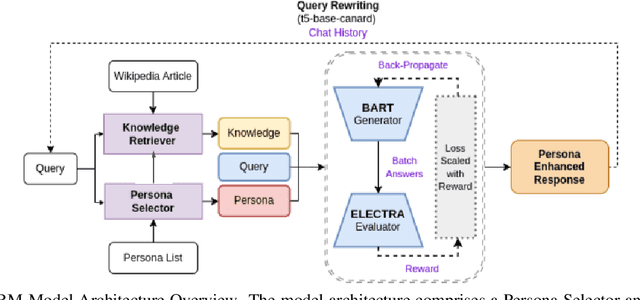
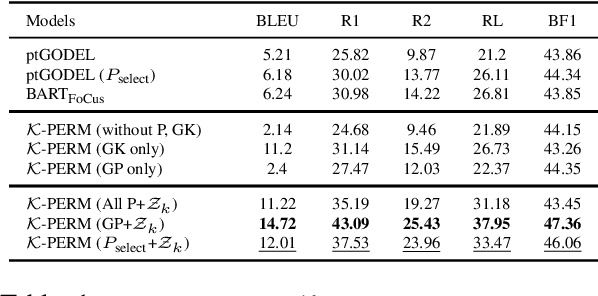
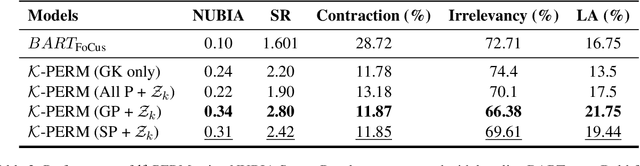
Personalizing conversational agents can enhance the quality of conversations and increase user engagement. However, they often lack external knowledge to appropriately tend to a user's persona. This is particularly crucial for practical applications like mental health support, nutrition planning, culturally sensitive conversations, or reducing toxic behavior in conversational agents. To enhance the relevance and comprehensiveness of personalized responses, we propose using a two-step approach that involves (1) selectively integrating user personas and (2) contextualizing the response with supplementing information from a background knowledge source. We develop K-PERM (Knowledge-guided PErsonalization with Reward Modulation), a dynamic conversational agent that combines these elements. K-PERM achieves state-of-the-art performance on the popular FoCus dataset, containing real-world personalized conversations concerning global landmarks. We show that using responses from K-PERM can improve performance in state-of-the-art LLMs (GPT 3.5) by 10.5%, highlighting the impact of K-PERM for personalizing chatbots.
Cook-Gen: Robust Generative Modeling of Cooking Actions from Recipes
Jun 01, 2023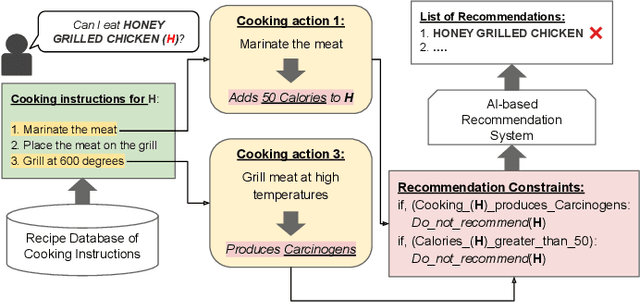
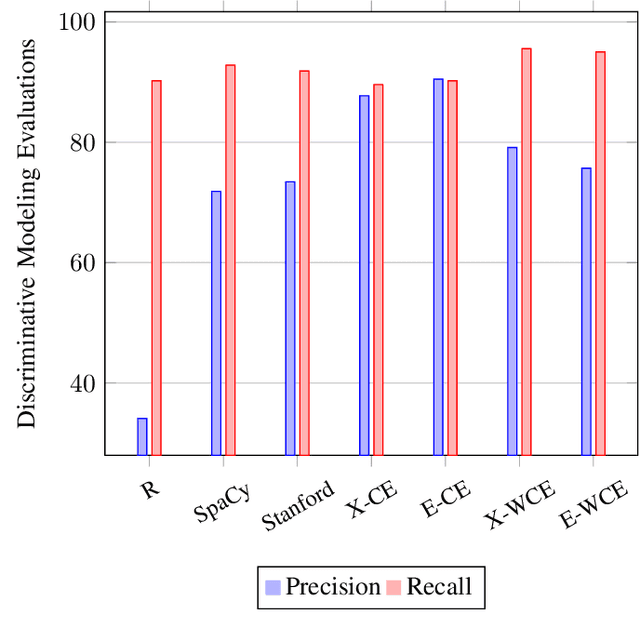
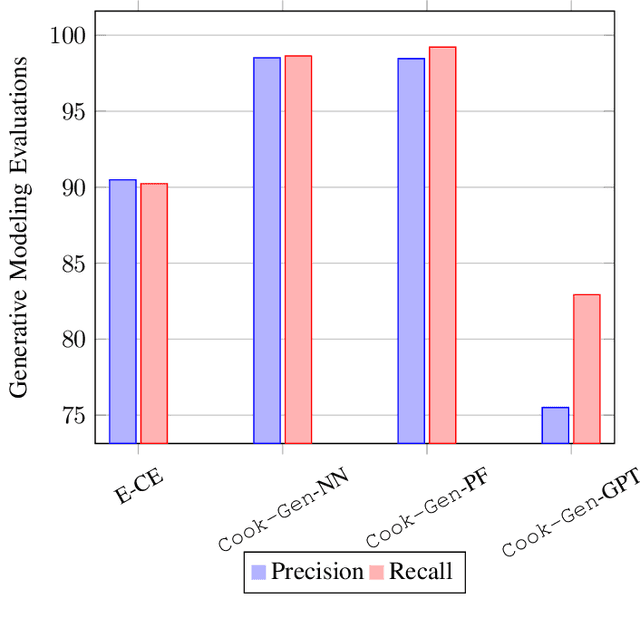
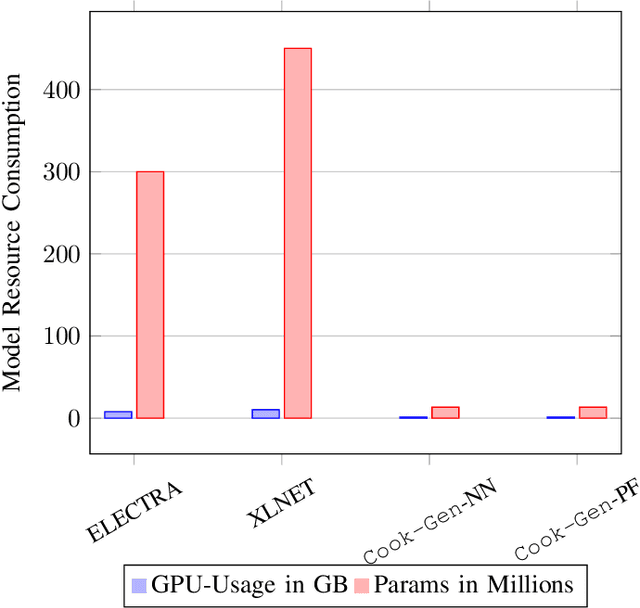
As people become more aware of their food choices, food computation models have become increasingly popular in assisting people in maintaining healthy eating habits. For example, food recommendation systems analyze recipe instructions to assess nutritional contents and provide recipe recommendations. The recent and remarkable successes of generative AI methods, such as auto-regressive large language models, can lead to robust methods for a more comprehensive understanding of recipes for healthy food recommendations beyond surface-level nutrition content assessments. In this study, we explore the use of generative AI methods to extend current food computation models, primarily involving the analysis of nutrition and ingredients, to also incorporate cooking actions (e.g., add salt, fry the meat, boil the vegetables, etc.). Cooking actions are notoriously hard to model using statistical learning methods due to irregular data patterns - significantly varying natural language descriptions for the same action (e.g., marinate the meat vs. marinate the meat and leave overnight) and infrequently occurring patterns (e.g., add salt occurs far more frequently than marinating the meat). The prototypical approach to handling irregular data patterns is to increase the volume of data that the model ingests by orders of magnitude. Unfortunately, in the cooking domain, these problems are further compounded with larger data volumes presenting a unique challenge that is not easily handled by simply scaling up. In this work, we propose novel aggregation-based generative AI methods, Cook-Gen, that reliably generate cooking actions from recipes, despite difficulties with irregular data patterns, while also outperforming Large Language Models and other strong baselines.