 Add to Chrome
 Add to Firefox
 Add to Edge
"OK Aura, Be Fair With Me": Demographics-Agnostic Training for Bias Mitigation in Wake-up Word Detection
Apr 07, 2026
Voice-based interfaces are widely used; however, achieving fair Wake-up Word detection across diverse speaker populations remains a critical challenge due to persistent demographic biases. This study evaluates the effectiveness of demographics-agnostic training techniques in mitigating performance disparities among speakers of varying sex, age, and accent. We utilize the OK Aura database for our experiments, employing a training methodology that excludes demographic labels, which are reserved for evaluation purposes. We explore (i) data augmentation techniques to enhance model generalization and (ii) knowledge distillation of pre-trained foundational speech models. The experimental results indicate that these demographics-agnostic training techniques markedly reduce demographic bias, leading to a more equitable performance profile across different speaker groups. Specifically, one of the evaluated techniques achieves a Predictive Disparity reduction of 39.94\% for sex, 83.65\% for age, and 40.48\% for accent when compared to the baseline. This study highlights the effectiveness of label-agnostic methodologies in fostering fairness in Wake-up Word detection.

Non-IID data in Federated Learning: A Systematic Review with Taxonomy, Metrics, Methods, Frameworks and Future Directions
Nov 19, 2024Recent advances in machine learning have highlighted Federated Learning (FL) as a promising approach that enables multiple distributed users (so-called clients) to collectively train ML models without sharing their private data. While this privacy-preserving method shows potential, it struggles when data across clients is not independent and identically distributed (non-IID) data. The latter remains an unsolved challenge that can result in poorer model performance and slower training times. Despite the significance of non-IID data in FL, there is a lack of consensus among researchers about its classification and quantification. This systematic review aims to fill that gap by providing a detailed taxonomy for non-IID data, partition protocols, and metrics to quantify data heterogeneity. Additionally, we describe popular solutions to address non-IID data and standardized frameworks employed in FL with heterogeneous data. Based on our state-of-the-art review, we present key lessons learned and suggest promising future research directions.
Human Response to an AI-Based Decision Support System: A User Study on the Effects of Accuracy and Bias
Mar 24, 2022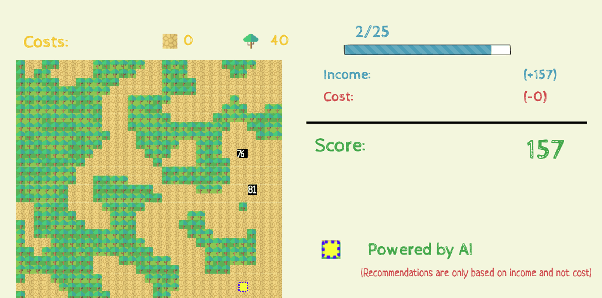
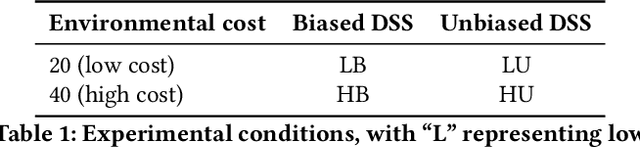
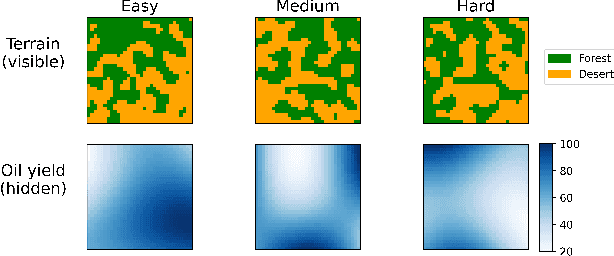
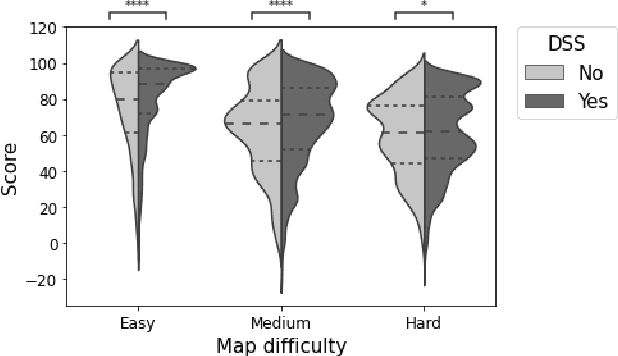
Artificial Intelligence (AI) is increasingly used to build Decision Support Systems (DSS) across many domains. This paper describes a series of experiments designed to observe human response to different characteristics of a DSS such as accuracy and bias, particularly the extent to which participants rely on the DSS, and the performance they achieve. In our experiments, participants play a simple online game inspired by so-called "wildcat" (i.e., exploratory) drilling for oil. The landscape has two layers: a visible layer describing the costs (terrain), and a hidden layer describing the reward (oil yield). Participants in the control group play the game without receiving any assistance, while in treatment groups they are assisted by a DSS suggesting places to drill. For certain treatments, the DSS does not consider costs, but only rewards, which introduces a bias that is observable by users. Between subjects, we vary the accuracy and bias of the DSS, and observe the participants' total score, time to completion, the extent to which they follow or ignore suggestions. We also measure the acceptability of the DSS in an exit survey. Our results show that participants tend to score better with the DSS, that the score increase is due to users following the DSS advice, and related to the difficulty of the game and the accuracy of the DSS. We observe that this setting elicits mostly rational behavior from participants, who place a moderate amount of trust in the DSS and show neither algorithmic aversion (under-reliance) nor automation bias (over-reliance).However, their stated willingness to accept the DSS in the exit survey seems less sensitive to the accuracy of the DSS than their behavior, suggesting that users are only partially aware of the (lack of) accuracy of the DSS.
Poisoning Attacks on Algorithmic Fairness
Apr 23, 2020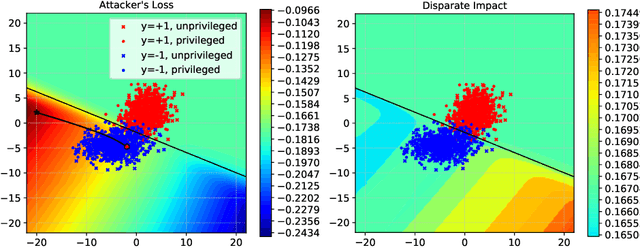
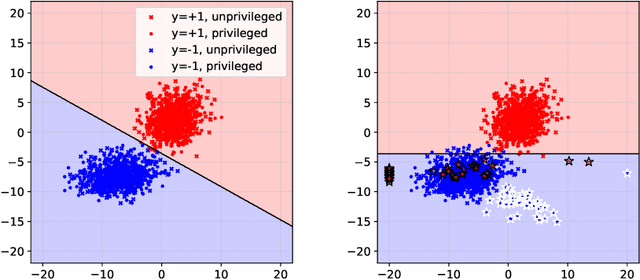
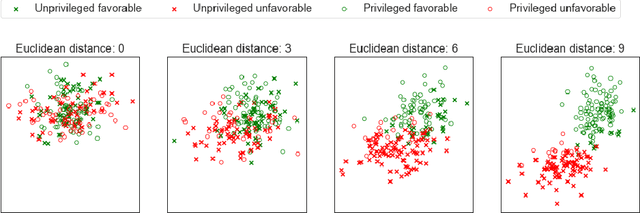
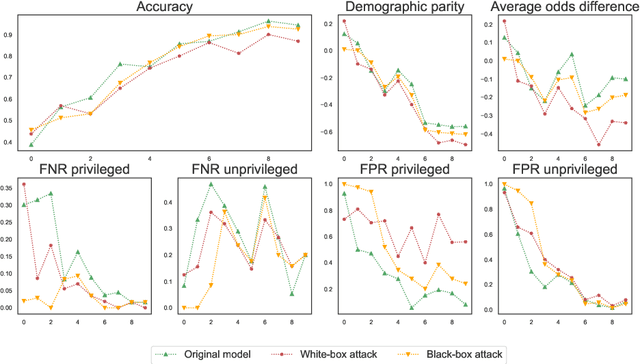
Research in adversarial machine learning has shown how the performance of machine learning models can be seriously compromised by injecting even a small fraction of poisoning points into the training data. While the effects on model accuracy of such poisoning attacks have been widely studied, their potential effects on other model performance metrics remain to be evaluated. In this work, we introduce an optimization framework for poisoning attacks against algorithmic fairness, and develop a gradient-based poisoning attack aimed at introducing classification disparities among different groups in the data. We empirically show that our attack is effective not only in the white-box setting, in which the attacker has full access to the target model, but also in a more challenging black-box scenario in which the attacks are optimized against a substitute model and then transferred to the target model. We believe that our findings pave the way towards the definition of an entirely novel set of adversarial attacks targeting algorithmic fairness in different scenarios, and that investigating such vulnerabilities will help design more robust algorithms and countermeasures in the future.