 Add to Chrome
 Add to Firefox
 Add to Edge
Model Multiplicity and Predictive Arbitrariness in Recidivism Risk Assessment
Jun 01, 2026
Prediction tasks over individual futures, which are inherently noisy, often admit multiple similarly accurate models. When these models produce different predictions for the same individual, they raise concerns of arbitrariness in decision-making. How severe can this arbitrariness be, in theory and in practice? How can it be resolved to support high-stakes risk assessment? We address these questions through a study of a machine learning-based decision support system for recidivism risk assessment that has been in use for over 15 years. By translating complex legal rules into an algorithm for labeling post release outcomes (recidivist or non-recidivist), we first construct a dataset of thousands of inmate releases. Using this dataset, we learn interpretable models that improve predictive performance, reduce error-rate disparities between groups, and ensure that rehabilitative progress lowers risk scores. Next, we study predictive multiplicity, by first deriving a tight lower bound on the expected predictive agreement of any finite set of models over a dataset, and then by evaluating the extent to which structural diversity (e.g., different model coefficients) within this set translates to predictive multiplicity (i.e., different predictions for the same individual). Our experiments indicate that the existence of many similarly accurate models with comparable error-rate disparities does not necessarily translate into severe predictive multiplicity. Empirically, similarly performant models can exhibit substantially higher predictive agreement than worst-case theoretical guarantees suggest. We find that a simple policy that assigns each inmate the lowest risk among these models is effective for addressing predictive arbitrariness.

An empirical evaluation of the risks of AI model updates using clinical data: stability, arbitrariness, and fairness
Apr 27, 2026Artificial Intelligence and Machine Learning (AI/ML) models used in clinical settings are increasingly deployed to support clinical decision-making. However, when training data become stale due to changes in demographics, environment, or patient behaviors, model performance can degrade substantially. While updating models with new training data is necessary, such updates may also introduce new risks. We evaluated the proposed monitoring framework on four publicly available U.S.-based Type 1 Diabetes datasets containing high-resolution continuous glucose monitoring (CGM) data, comprising approximately 11,300 weekly observations from 496 participants under 20 years of age. All datasets included structured sociodemographic information. Using the prediction of severe hyperglycemia events in children with type 1 diabetes as a case study, we examine how different model update strategies can adversely affect model stability (e.g., by causing predictions to "flip" for a large number of cases after an update), increase arbitrariness in predictions, or worsen accuracy equity and the balance of error rates across subpopulations. We propose multiple dimensions for continuous monitoring to detect these issues and argue that such monitoring is essential for the development of trustworthy clinical decision support systems.
Fast Voxelization and Level of Detail for Microgeometry Rendering
Apr 14, 2026Many materials show anisotropic light scattering patterns due to the shape and local alignment of their underlying micro structures: surfaces with small elements such as fibers, or the ridges of a brushed metal, are very sparse and require a high spatial resolution to be properly represented as a volume. The acquisition of voxel data from such objects is a time and memory-intensive task, and most rendering approaches require an additional Level-of-Detail (LoD) data structure to aggregate the visual appearance, as observed from multiple distances, in order to reduce the number of samples computed per pixel (E.g.: MIP mapping). In this work we introduce first, an efficient parallel voxelization method designed to facilitate fast data aggregation at multiple resolution levels, and second, a novel representation based on hierarchical SGGX clustering that provides better accuracy than baseline methods. We validate our approach with a CUDA-based implementation of the voxelizer, tested both on triangle meshes and volumetric fabrics modeled with explicit fibers. Finally, we show the results generated with a path tracer based on the proposed LoD rendering model.
The Echo Chamber Multi-Turn LLM Jailbreak
Jan 09, 2026The availability of Large Language Models (LLMs) has led to a new generation of powerful chatbots that can be developed at relatively low cost. As companies deploy these tools, security challenges need to be addressed to prevent financial loss and reputational damage. A key security challenge is jailbreaking, the malicious manipulation of prompts and inputs to bypass a chatbot's safety guardrails. Multi-turn attacks are a relatively new form of jailbreaking involving a carefully crafted chain of interactions with a chatbot. We introduce Echo Chamber, a new multi-turn attack using a gradual escalation method. We describe this attack in detail, compare it to other multi-turn attacks, and demonstrate its performance against multiple state-of-the-art models through extensive evaluation.
Synthetic CVs To Build and Test Fairness-Aware Hiring Tools
Aug 28, 2025Algorithmic hiring has become increasingly necessary in some sectors as it promises to deal with hundreds or even thousands of applicants. At the heart of these systems are algorithms designed to retrieve and rank candidate profiles, which are usually represented by Curricula Vitae (CVs). Research has shown, however, that such technologies can inadvertently introduce bias, leading to discrimination based on factors such as candidates' age, gender, or national origin. Developing methods to measure, mitigate, and explain bias in algorithmic hiring, as well as to evaluate and compare fairness techniques before deployment, requires sets of CVs that reflect the characteristics of people from diverse backgrounds. However, datasets of these characteristics that can be used to conduct this research do not exist. To address this limitation, this paper introduces an approach for building a synthetic dataset of CVs with features modeled on real materials collected through a data donation campaign. Additionally, the resulting dataset of 1,730 CVs is presented, which we envision as a potential benchmarking standard for research on algorithmic hiring discrimination.
Disparate Model Performance and Stability in Machine Learning Clinical Support for Diabetes and Heart Diseases
Dec 27, 2024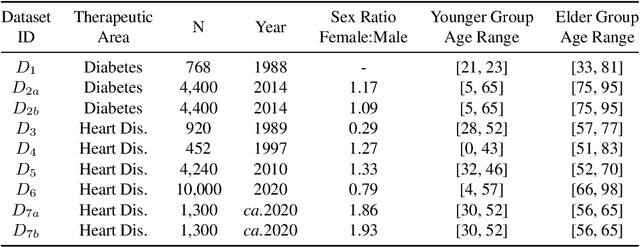
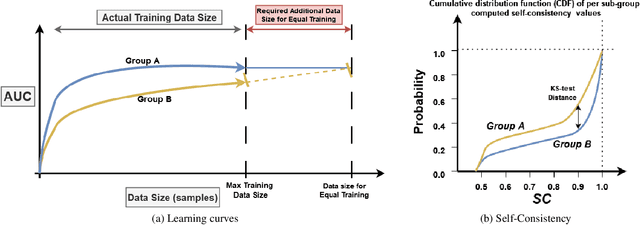
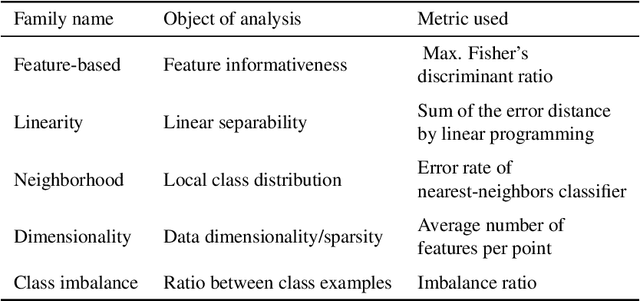
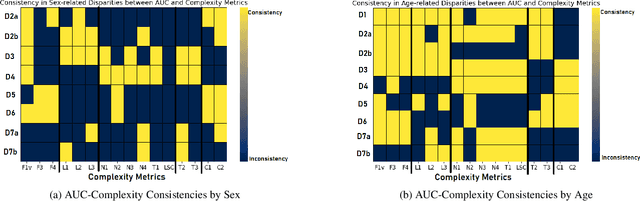
Machine Learning (ML) algorithms are vital for supporting clinical decision-making in biomedical informatics. However, their predictive performance can vary across demographic groups, often due to the underrepresentation of historically marginalized populations in training datasets. The investigation reveals widespread sex- and age-related inequities in chronic disease datasets and their derived ML models. Thus, a novel analytical framework is introduced, combining systematic arbitrariness with traditional metrics like accuracy and data complexity. The analysis of data from over 25,000 individuals with chronic diseases revealed mild sex-related disparities, favoring predictive accuracy for males, and significant age-related differences, with better accuracy for younger patients. Notably, older patients showed inconsistent predictive accuracy across seven datasets, linked to higher data complexity and lower model performance. This highlights that representativeness in training data alone does not guarantee equitable outcomes, and model arbitrariness must be addressed before deploying models in clinical settings.
Understanding and Addressing Gender Bias in Expert Finding Task
Jul 07, 2024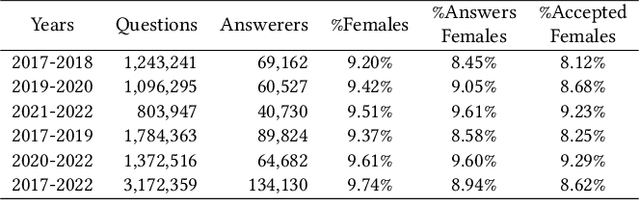
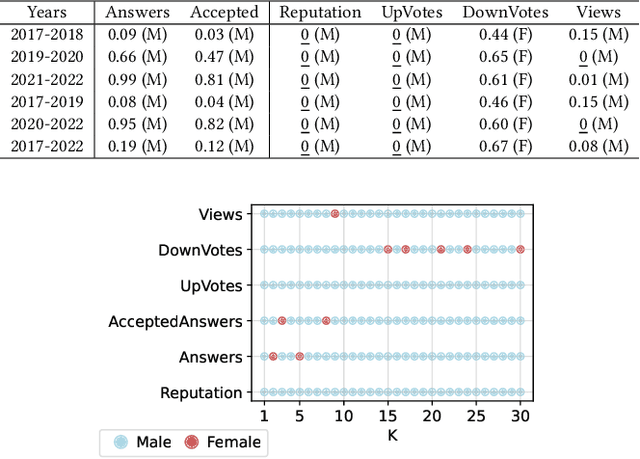
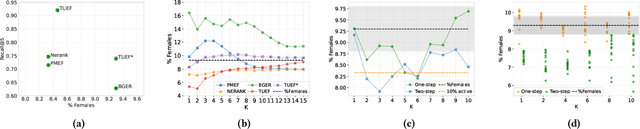
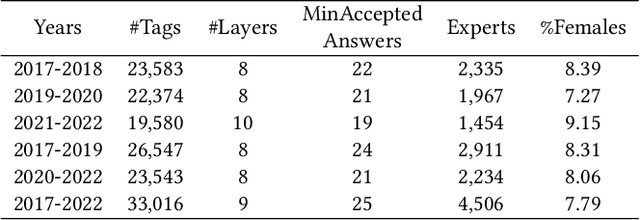
The Expert Finding (EF) task is critical in community Question&Answer (CQ&A) platforms, significantly enhancing user engagement by improving answer quality and reducing response times. However, biases, especially gender biases, have been identified in these platforms. This study investigates gender bias in state-of-the-art EF models and explores methods to mitigate it. Utilizing a comprehensive dataset from StackOverflow, the largest community in the StackExchange network, we conduct extensive experiments to analyze how EF models' candidate identification processes influence gender representation. Our findings reveal that models relying on reputation metrics and activity levels disproportionately favor male users, who are more active on the platform. This bias results in the underrepresentation of female experts in the ranking process. We propose adjustments to EF models that incorporate a more balanced preprocessing strategy and leverage content-based and social network-based information, with the aim to provide a fairer representation of genders among identified experts. Our analysis shows that integrating these methods can significantly enhance gender balance without compromising model accuracy. To the best of our knowledge, this study is the first to focus on detecting and mitigating gender bias in EF methods.
Responsible AI Research Needs Impact Statements Too
Nov 20, 2023All types of research, development, and policy work can have unintended, adverse consequences - work in responsible artificial intelligence (RAI), ethical AI, or ethics in AI is no exception.
Disparity, Inequality, and Accuracy Tradeoffs in Graph Neural Networks for Node Classification
Aug 18, 2023
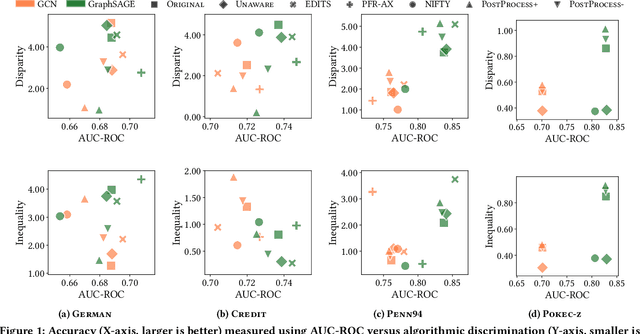
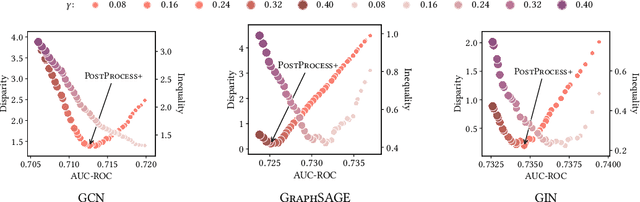

Graph neural networks (GNNs) are increasingly used in critical human applications for predicting node labels in attributed graphs. Their ability to aggregate features from nodes' neighbors for accurate classification also has the capacity to exacerbate existing biases in data or to introduce new ones towards members from protected demographic groups. Thus, it is imperative to quantify how GNNs may be biased and to what extent their harmful effects may be mitigated. To this end, we propose two new GNN-agnostic interventions namely, (i) PFR-AX which decreases the separability between nodes in protected and non-protected groups, and (ii) PostProcess which updates model predictions based on a blackbox policy to minimize differences between error rates across demographic groups. Through a large set of experiments on four datasets, we frame the efficacies of our approaches (and three variants) in terms of their algorithmic fairness-accuracy tradeoff and benchmark our results against three strong baseline interventions on three state-of-the-art GNN models. Our results show that no single intervention offers a universally optimal tradeoff, but PFR-AX and PostProcess provide granular control and improve model confidence when correctly predicting positive outcomes for nodes in protected groups.
Fairness and Diversity in Information Access Systems
May 16, 2023Among the seven key requirements to achieve trustworthy AI proposed by the High-Level Expert Group on Artificial Intelligence (AI-HLEG) established by the European Commission (EC), the fifth requirement ("Diversity, non-discrimination and fairness") declares: "In order to achieve Trustworthy AI, we must enable inclusion and diversity throughout the entire AI system's life cycle. [...] This requirement is closely linked with the principle of fairness". In this paper, we try to shed light on how closely these two distinct concepts, diversity and fairness, may be treated by focusing on information access systems and ranking literature. These concepts should not be used interchangeably because they do represent two different values, but what we argue is that they also cannot be considered totally unrelated or divergent. Having diversity does not imply fairness, but fostering diversity can effectively lead to fair outcomes, an intuition behind several methods proposed to mitigate the disparate impact of information access systems, i.e. recommender systems and search engines.