 Add to Chrome
 Add to Firefox
 Add to Edge
Fatigue-Aware Learning to Defer via Constrained Optimisation
Apr 01, 2026
Learning to defer (L2D) enables human-AI cooperation by deciding when an AI system should act autonomously or defer to a human expert. Existing L2D methods, however, assume static human performance, contradicting well-established findings on fatigue-induced degradation. We propose Fatigue-Aware Learning to Defer via Constrained Optimisation (FALCON), which explicitly models workload-varying human performance using psychologically grounded fatigue curves. FALCON formulates L2D as a Constrained Markov Decision Process (CMDP) whose state includes both task features and cumulative human workload, and optimises accuracy under human-AI cooperation budgets via PPO-Lagrangian training. We further introduce FA-L2D, a benchmark that systematically varies fatigue dynamics from near-static to rapidly degrading regimes. Experiments across multiple datasets show that FALCON consistently outperforms state-of-the-art L2D methods across coverage levels, generalises zero-shot to unseen experts with different fatigue patterns, and demonstrates the advantage of adaptive human-AI collaboration over AI-only or human-only decision-making when coverage lies strictly between 0 and 1.

Fair Distillation: Teaching Fairness from Biased Teachers in Medical Imaging
Nov 18, 2024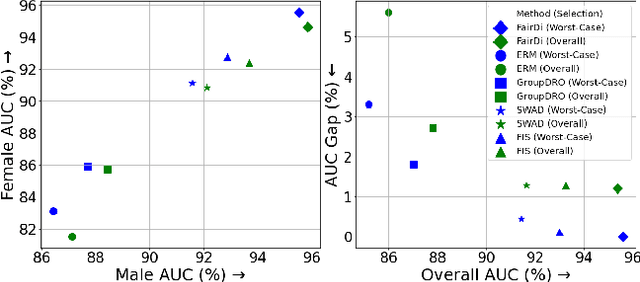
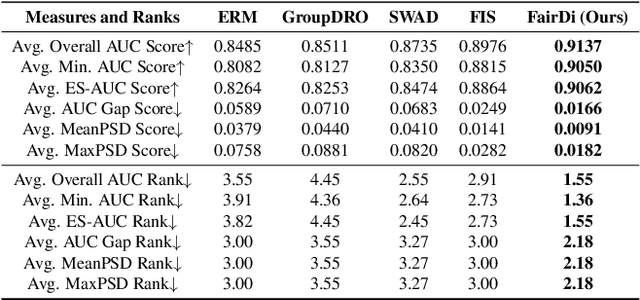
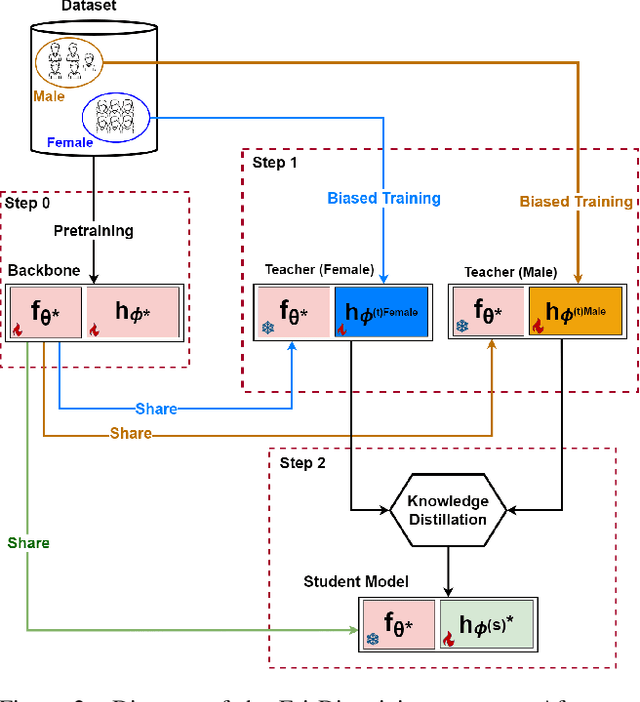
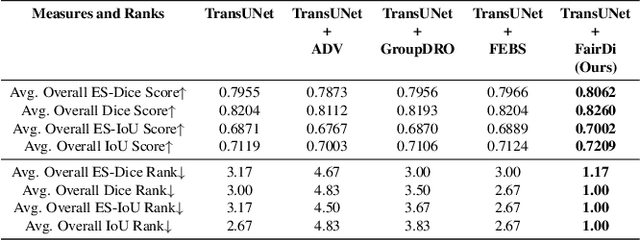
Deep learning has achieved remarkable success in image classification and segmentation tasks. However, fairness concerns persist, as models often exhibit biases that disproportionately affect demographic groups defined by sensitive attributes such as race, gender, or age. Existing bias-mitigation techniques, including Subgroup Re-balancing, Adversarial Training, and Domain Generalization, aim to balance accuracy across demographic groups, but often fail to simultaneously improve overall accuracy, group-specific accuracy, and fairness due to conflicts among these interdependent objectives. We propose the Fair Distillation (FairDi) method, a novel fairness approach that decomposes these objectives by leveraging biased ``teacher'' models, each optimized for a specific demographic group. These teacher models then guide the training of a unified ``student'' model, which distills their knowledge to maximize overall and group-specific accuracies, while minimizing inter-group disparities. Experiments on medical imaging datasets show that FairDi achieves significant gains in both overall and group-specific accuracy, along with improved fairness, compared to existing methods. FairDi is adaptable to various medical tasks, such as classification and segmentation, and provides an effective solution for equitable model performance.
Learning to Complement and to Defer to Multiple Users
Jul 09, 2024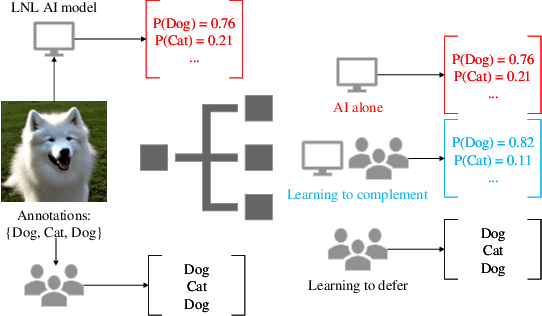
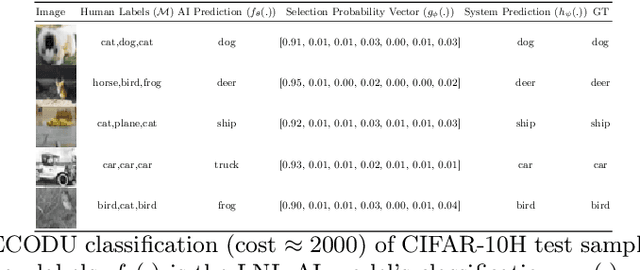


With the development of Human-AI Collaboration in Classification (HAI-CC), integrating users and AI predictions becomes challenging due to the complex decision-making process. This process has three options: 1) AI autonomously classifies, 2) learning to complement, where AI collaborates with users, and 3) learning to defer, where AI defers to users. Despite their interconnected nature, these options have been studied in isolation rather than as components of a unified system. In this paper, we address this weakness with the novel HAI-CC methodology, called Learning to Complement and to Defer to Multiple Users (LECODU). LECODU not only combines learning to complement and learning to defer strategies, but it also incorporates an estimation of the optimal number of users to engage in the decision process. The training of LECODU maximises classification accuracy and minimises collaboration costs associated with user involvement. Comprehensive evaluations across real-world and synthesized datasets demonstrate LECODU's superior performance compared to state-of-the-art HAI-CC methods. Remarkably, even when relying on unreliable users with high rates of label noise, LECODU exhibits significant improvement over both human decision-makers alone and AI alone.