 Add to Chrome
 Add to Firefox
 Add to Edge
Multi-agent decision making: A Blackwell's informativeness approach
May 07, 2026
The rapid development of large language models (LLMs) has motivated research on decision-making in multi-agent systems, where multiple agents collaborate to achieve shared objectives. Existing aggregation approaches, such as voting and debate, are largely ad-hoc and lack formal guarantees regarding the informativeness of the resulting decisions. In this paper, we provide a principled approach to analyse decisions made in the multi-LLM setting using Blackwell's informativeness framework. Within the Blackwell information-structure abstraction, we show that voting and debate induce information structures that are no more informative than the pooled private information of all agents. This result identifies Bayesian pooled posterior maximisation as an information-theoretic upper-bound decision rule under the Blackwell ordering. Motivated by this theoretical analysis, we introduce a practical method for LLM-based question-answering (QA) tasks that estimates each agent's posterior and approximates the pooled posterior using a product-of-posteriors estimator. Extensive experiments on six QA benchmarks demonstrate that our approach outperforms state-of-the-art multi-LLM debate and voting methods.

Fatigue-Aware Learning to Defer via Constrained Optimisation
Apr 01, 2026Learning to defer (L2D) enables human-AI cooperation by deciding when an AI system should act autonomously or defer to a human expert. Existing L2D methods, however, assume static human performance, contradicting well-established findings on fatigue-induced degradation. We propose Fatigue-Aware Learning to Defer via Constrained Optimisation (FALCON), which explicitly models workload-varying human performance using psychologically grounded fatigue curves. FALCON formulates L2D as a Constrained Markov Decision Process (CMDP) whose state includes both task features and cumulative human workload, and optimises accuracy under human-AI cooperation budgets via PPO-Lagrangian training. We further introduce FA-L2D, a benchmark that systematically varies fatigue dynamics from near-static to rapidly degrading regimes. Experiments across multiple datasets show that FALCON consistently outperforms state-of-the-art L2D methods across coverage levels, generalises zero-shot to unseen experts with different fatigue patterns, and demonstrates the advantage of adaptive human-AI collaboration over AI-only or human-only decision-making when coverage lies strictly between 0 and 1.
MetaAug: Meta-Data Augmentation for Post-Training Quantization
Jul 27, 2024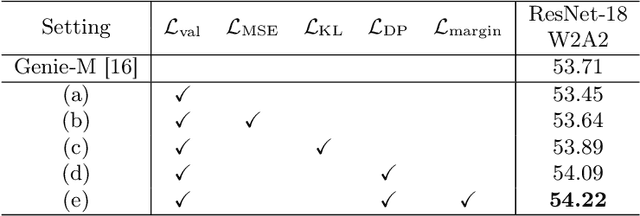
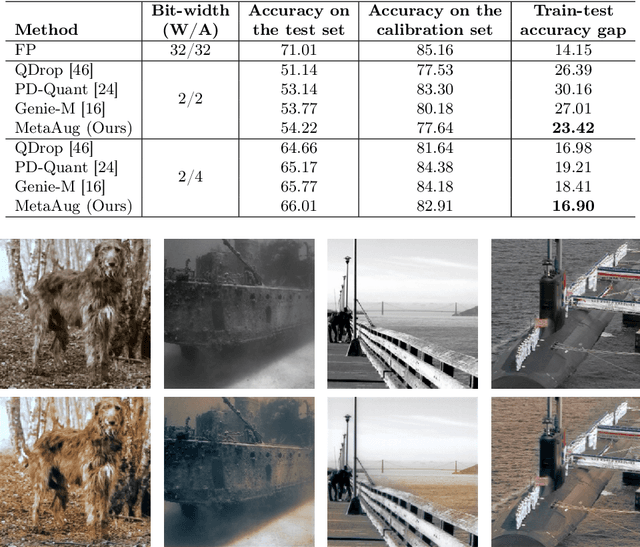
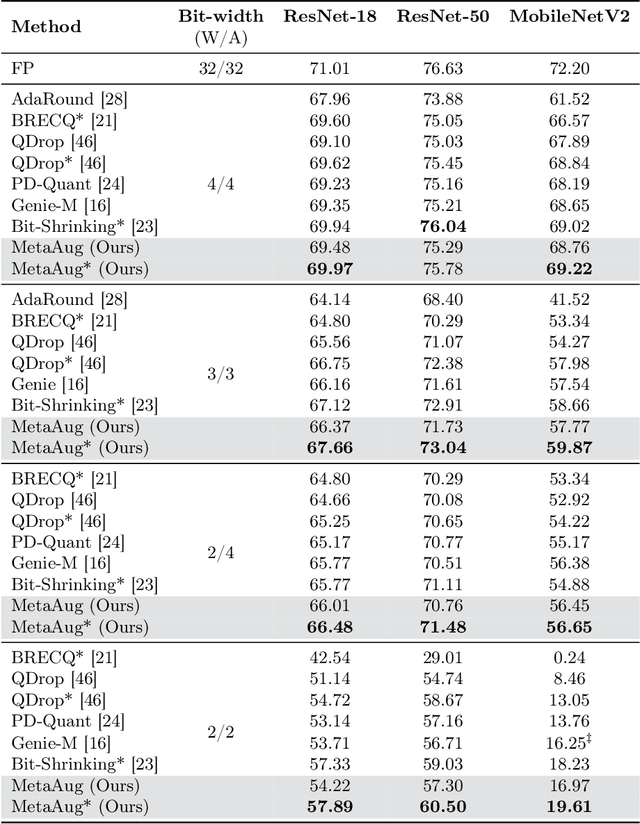
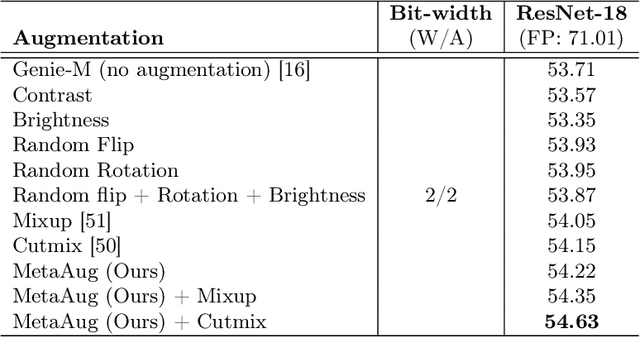
Post-Training Quantization (PTQ) has received significant attention because it requires only a small set of calibration data to quantize a full-precision model, which is more practical in real-world applications in which full access to a large training set is not available. However, it often leads to overfitting on the small calibration dataset. Several methods have been proposed to address this issue, yet they still rely on only the calibration set for the quantization and they do not validate the quantized model due to the lack of a validation set. In this work, we propose a novel meta-learning based approach to enhance the performance of post-training quantization. Specifically, to mitigate the overfitting problem, instead of only training the quantized model using the original calibration set without any validation during the learning process as in previous PTQ works, in our approach, we both train and validate the quantized model using two different sets of images. In particular, we propose a meta-learning based approach to jointly optimize a transformation network and a quantized model through bi-level optimization. The transformation network modifies the original calibration data and the modified data will be used as the training set to learn the quantized model with the objective that the quantized model achieves a good performance on the original calibration data. Extensive experiments on the widely used ImageNet dataset with different neural network architectures demonstrate that our approach outperforms the state-of-the-art PTQ methods.
Model and Feature Diversity for Bayesian Neural Networks in Mutual Learning
Jul 03, 2024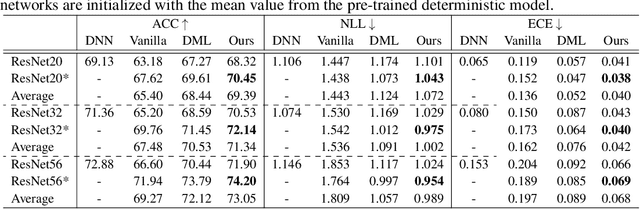
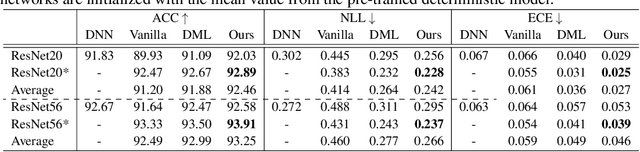

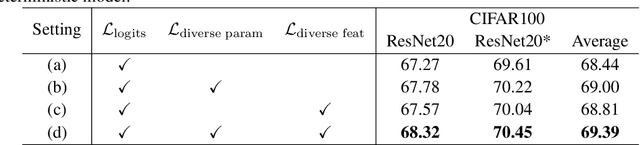
Bayesian Neural Networks (BNNs) offer probability distributions for model parameters, enabling uncertainty quantification in predictions. However, they often underperform compared to deterministic neural networks. Utilizing mutual learning can effectively enhance the performance of peer BNNs. In this paper, we propose a novel approach to improve BNNs performance through deep mutual learning. The proposed approaches aim to increase diversity in both network parameter distributions and feature distributions, promoting peer networks to acquire distinct features that capture different characteristics of the input, which enhances the effectiveness of mutual learning. Experimental results demonstrate significant improvements in the classification accuracy, negative log-likelihood, and expected calibration error when compared to traditional mutual learning for BNNs.
Probabilistic task modelling for meta-learning
Jun 09, 2021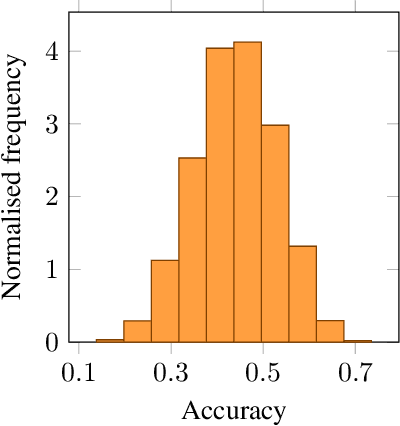
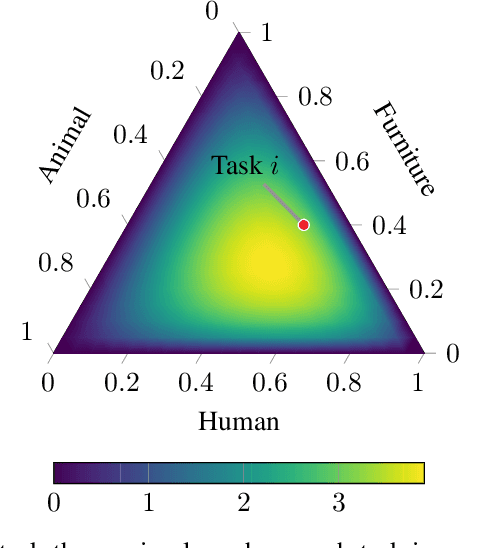
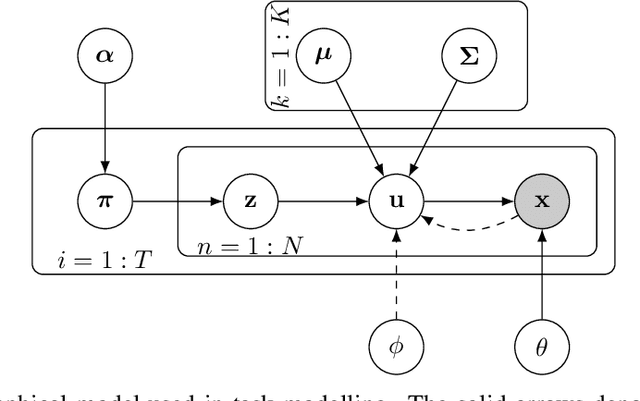
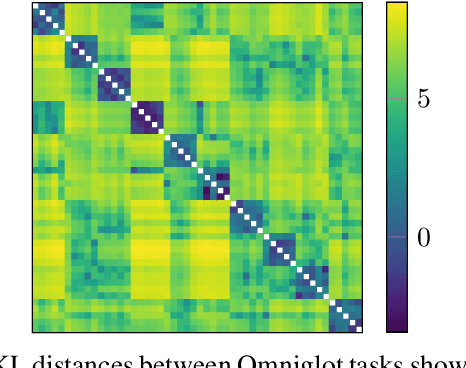
We propose probabilistic task modelling -- a generative probabilistic model for collections of tasks used in meta-learning. The proposed model combines variational auto-encoding and latent Dirichlet allocation to model each task as a mixture of Gaussian distribution in an embedding space. Such modelling provides an explicit representation of a task through its task-theme mixture. We present an efficient approximation inference technique based on variational inference method for empirical Bayes parameter estimation. We perform empirical evaluations to validate the task uncertainty and task distance produced by the proposed method through correlation diagrams of the prediction accuracy on testing tasks. We also carry out experiments of task selection in meta-learning to demonstrate how the task relatedness inferred from the proposed model help to facilitate meta-learning algorithms.