 Add to Chrome
 Add to Firefox
 Add to Edge
SpaceDrive: Infusing Spatial Awareness into VLM-based Autonomous Driving
Dec 11, 2025
End-to-end autonomous driving methods built on vision language models (VLMs) have undergone rapid development driven by their universal visual understanding and strong reasoning capabilities obtained from the large-scale pretraining. However, we find that current VLMs struggle to understand fine-grained 3D spatial relationships which is a fundamental requirement for systems interacting with the physical world. To address this issue, we propose SpaceDrive, a spatial-aware VLM-based driving framework that treats spatial information as explicit positional encodings (PEs) instead of textual digit tokens, enabling joint reasoning over semantic and spatial representations. SpaceDrive employs a universal positional encoder to all 3D coordinates derived from multi-view depth estimation, historical ego-states, and text prompts. These 3D PEs are first superimposed to augment the corresponding 2D visual tokens. Meanwhile, they serve as a task-agnostic coordinate representation, replacing the digit-wise numerical tokens as both inputs and outputs for the VLM. This mechanism enables the model to better index specific visual semantics in spatial reasoning and directly regress trajectory coordinates rather than generating digit-by-digit, thereby enhancing planning accuracy. Extensive experiments validate that SpaceDrive achieves state-of-the-art open-loop performance on the nuScenes dataset and the second-best Driving Score of 78.02 on the Bench2Drive closed-loop benchmark over existing VLM-based methods.

SEER-VAR: Semantic Egocentric Environment Reasoner for Vehicle Augmented Reality
Aug 24, 2025We present SEER-VAR, a novel framework for egocentric vehicle-based augmented reality (AR) that unifies semantic decomposition, Context-Aware SLAM Branches (CASB), and LLM-driven recommendation. Unlike existing systems that assume static or single-view settings, SEER-VAR dynamically separates cabin and road scenes via depth-guided vision-language grounding. Two SLAM branches track egocentric motion in each context, while a GPT-based module generates context-aware overlays such as dashboard cues and hazard alerts. To support evaluation, we introduce EgoSLAM-Drive, a real-world dataset featuring synchronized egocentric views, 6DoF ground-truth poses, and AR annotations across diverse driving scenarios. Experiments demonstrate that SEER-VAR achieves robust spatial alignment and perceptually coherent AR rendering across varied environments. As one of the first to explore LLM-based AR recommendation in egocentric driving, we address the lack of comparable systems through structured prompting and detailed user studies. Results show that SEER-VAR enhances perceived scene understanding, overlay relevance, and driver ease, providing an effective foundation for future research in this direction. Code and dataset will be made open source.
NVP-HRI: Zero Shot Natural Voice and Posture-based Human-Robot Interaction via Large Language Model
Mar 12, 2025Effective Human-Robot Interaction (HRI) is crucial for future service robots in aging societies. Existing solutions are biased toward only well-trained objects, creating a gap when dealing with new objects. Currently, HRI systems using predefined gestures or language tokens for pretrained objects pose challenges for all individuals, especially elderly ones. These challenges include difficulties in recalling commands, memorizing hand gestures, and learning new names. This paper introduces NVP-HRI, an intuitive multi-modal HRI paradigm that combines voice commands and deictic posture. NVP-HRI utilizes the Segment Anything Model (SAM) to analyze visual cues and depth data, enabling precise structural object representation. Through a pre-trained SAM network, NVP-HRI allows interaction with new objects via zero-shot prediction, even without prior knowledge. NVP-HRI also integrates with a large language model (LLM) for multimodal commands, coordinating them with object selection and scene distribution in real time for collision-free trajectory solutions. We also regulate the action sequence with the essential control syntax to reduce LLM hallucination risks. The evaluation of diverse real-world tasks using a Universal Robot showcased up to 59.2\% efficiency improvement over traditional gesture control, as illustrated in the video https://youtu.be/EbC7al2wiAc. Our code and design will be openly available at https://github.com/laiyuzhi/NVP-HRI.git.
NMM-HRI: Natural Multi-modal Human-Robot Interaction with Voice and Deictic Posture via Large Language Model
Jan 01, 2025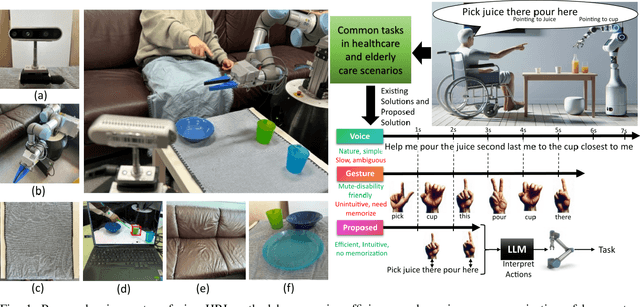
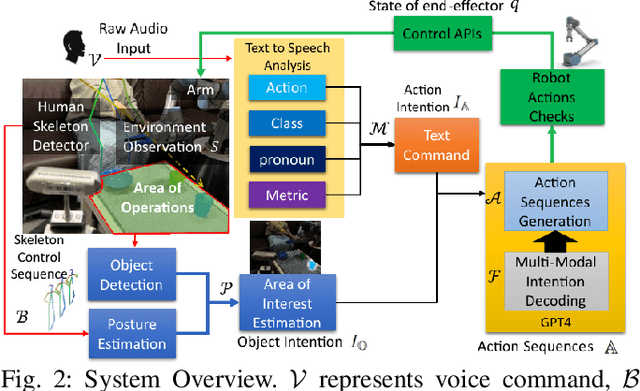
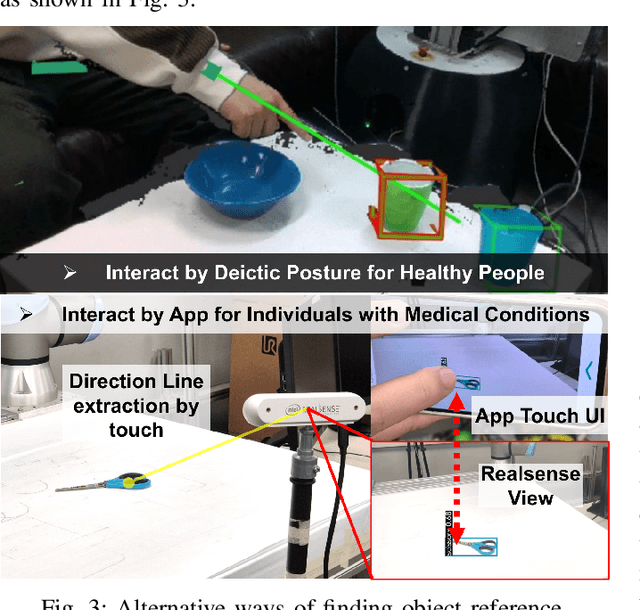
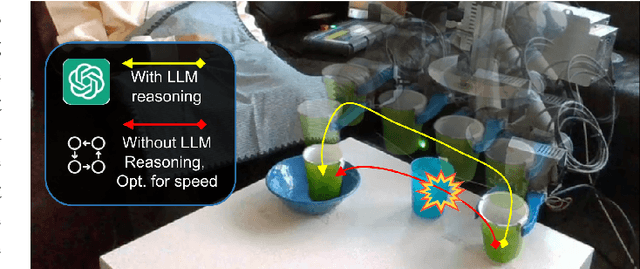
Translating human intent into robot commands is crucial for the future of service robots in an aging society. Existing Human-Robot Interaction (HRI) systems relying on gestures or verbal commands are impractical for the elderly due to difficulties with complex syntax or sign language. To address the challenge, this paper introduces a multi-modal interaction framework that combines voice and deictic posture information to create a more natural HRI system. The visual cues are first processed by the object detection model to gain a global understanding of the environment, and then bounding boxes are estimated based on depth information. By using a large language model (LLM) with voice-to-text commands and temporally aligned selected bounding boxes, robot action sequences can be generated, while key control syntax constraints are applied to avoid potential LLM hallucination issues. The system is evaluated on real-world tasks with varying levels of complexity using a Universal Robots UR3e manipulator. Our method demonstrates significantly better performance in HRI in terms of accuracy and robustness. To benefit the research community and the general public, we will make our code and design open-source.