 Add to Chrome
 Add to Firefox
 Add to Edge
Inference-Time Code Selection via Symbolic Equivalence Partitioning
Apr 07, 2026
"Best-of-N" selection is a popular inference-time scaling method for code generation using Large Language Models (LLMs). However, to reliably identify correct solutions, existing methods often depend on expensive or stochastic external verifiers. In this paper, we propose Symbolic Equivalence Partitioning, a selection framework that uses symbolic execution to group candidate programs by semantic behavior and select a representative from the dominant functional partition. To improve grouping and selection, we encode domain-specific constraints as Satisfiability Modulo Theories (SMT) assumptions during symbolic execution to reduce path explosion and prevent invalid input searches outside the problem domain. At N=10, our method improves average accuracy over Pass@1 from 0.728 to 0.803 on HumanEval+ and from 0.516 to 0.604 on LiveCodeBench, without requiring any additional LLM inference beyond the initial N candidate generations.

SARL: Label-Free Reinforcement Learning by Rewarding Reasoning Topology
Mar 30, 2026Reinforcement learning has become central to improving large reasoning models, but its success still relies heavily on verifiable rewards or labeled supervision. This limits its applicability to open ended domains where correctness is ambiguous and cannot be verified. Moreover, reasoning trajectories remain largely unconstrained, and optimization towards final answer can favor early exploitation over generalization. In this work, we ask whether general reasoning ability can be improved by teaching models how to think (the structure of reasoning) rather than what to produce (the outcome of reasoning) and extend traditional RLVR to open ended settings. We introduce structure aware reinforcement learning (SARL), a label free framework that constructs a per response Reasoning Map from intermediate thinking steps and rewards its small world topology, inspired by complex networks and the functional organization of the human brain. SARL encourages reasoning trajectories that are both locally coherent and globally efficient, shifting supervision from destination to path. Our experiments on Qwen3-4B show SARL surpasses ground truth based RL and prior label free RL baselines, achieving the best average gain of 9.1% under PPO and 11.6% under GRPO on math tasks and 34.6% under PPO and 30.4% under GRPO on open ended tasks. Beyond good performance, SARL also exhibits lower KL divergence, higher policy entropy, indicating a more stable and exploratory training and generalized reasoning ability.
More is Less: The Pitfalls of Multi-Model Synthetic Preference Data in DPO Safety Alignment
Apr 03, 2025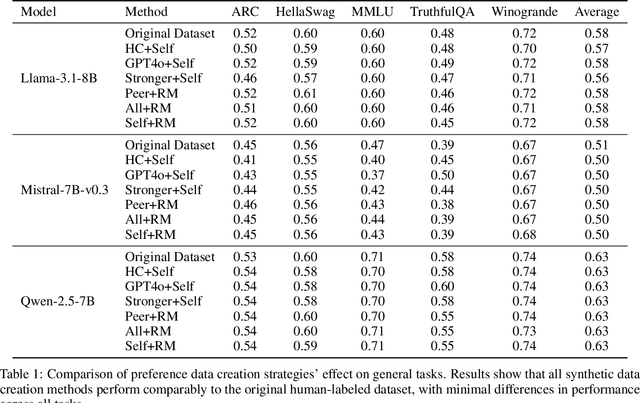
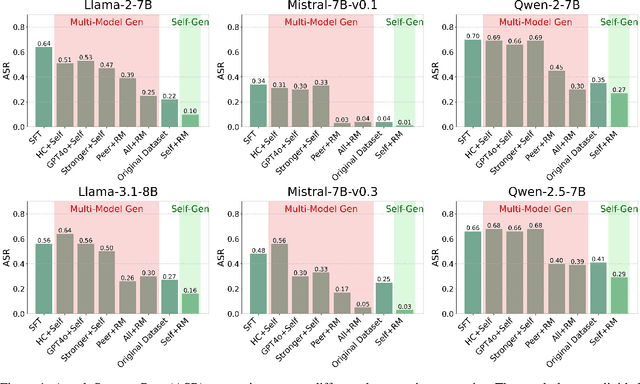
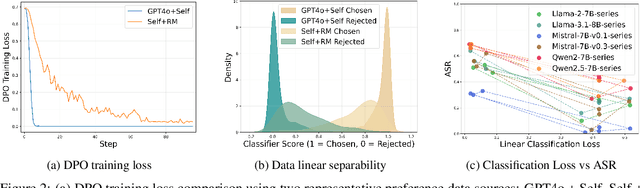

Aligning large language models (LLMs) with human values is an increasingly critical step in post-training. Direct Preference Optimization (DPO) has emerged as a simple, yet effective alternative to reinforcement learning from human feedback (RLHF). Synthetic preference data with its low cost and high quality enable effective alignment through single- or multi-model generated preference data. Our study reveals a striking, safety-specific phenomenon associated with DPO alignment: Although multi-model generated data enhances performance on general tasks (ARC, Hellaswag, MMLU, TruthfulQA, Winogrande) by providing diverse responses, it also tends to facilitate reward hacking during training. This can lead to a high attack success rate (ASR) when models encounter jailbreaking prompts. The issue is particularly pronounced when employing stronger models like GPT-4o or larger models in the same family to generate chosen responses paired with target model self-generated rejected responses, resulting in dramatically poorer safety outcomes. Furthermore, with respect to safety, using solely self-generated responses (single-model generation) for both chosen and rejected pairs significantly outperforms configurations that incorporate responses from stronger models, whether used directly as chosen data or as part of a multi-model response pool. We demonstrate that multi-model preference data exhibits high linear separability between chosen and rejected responses, which allows models to exploit superficial cues rather than internalizing robust safety constraints. Our experiments, conducted on models from the Llama, Mistral, and Qwen families, consistently validate these findings.