 Add to Chrome
 Add to Firefox
 Add to Edge
Tri-Space Operational Control of Redundant Multilink and Hybrid Cable-Driven Parallel Robots Using an Iterative-Learning based Reactive Approach
Jul 31, 2026
Cable-Driven Parallel Robots (CDPRs) are a type of parallel mechanism in which cables are used as actuators. Due to the two levels of redundancy and numerous constraints within the CDPR actuation, joint and operational spaces (together known as the tri-space), tracking a given trajectory in the operational space while satisfying constraints in tri-space simultaneously is challenging. To the best of the authors' knowledge, there does not exist any tri-space control framework, which is robust, effective, and directly applicable to several architectures of redundantly actuated CDPRs. This paper proposes a tri-space control framework that combines Reactive Control (RC) and Iterative-Learning Control (ILC) to perform repetitive tasks in the operational space. The framework allows the tracking of operational space trajectories online with feasible cable forces, while avoiding undesirable situations such as cable-link interference, joint interference, and loss of manipulability. On the other hand, by finding an optimal parameter in the null space using a novel parameterization of a null space vector, the performance can be improved through ILC when the task is repeatedly executed. Simulation and hardware results on various Multilink Cable-Driven Robot (MCDRs) and Hybrid Cable-Driven Robots (HCDRs) show that the proposed tri-space control framework can be conveniently and effectively applied to the real-time control of different CDPRs.
* 17 pages, 9 figures. Published in IEEE TCST, 2023. CC BY 4.0

Picking by Tilting: In-Hand Manipulation for Object Picking using Effector with Curved Form
Nov 25, 2024This paper presents a robotic in-hand manipulation technique that can be applied to pick an object too large to grasp in a prehensile manner, by taking advantage of its contact interactions with a curved, passive end-effector, and two flat support surfaces. First, the object is tilted up while being held between the end-effector and the supports. Then, the end-effector is tucked into the gap underneath the object, which is formed by tilting, in order to obtain a grasp against gravity. In this paper, we first examine the mechanics of tilting to understand the different ways in which the object can be initially tilted. We then present a strategy to tilt up the object in a secure manner. Finally, we demonstrate successful picking of objects of various size and geometry using our technique through a set of experiments performed with a custom-made robotic device and a conventional robot arm. Our experiment results show that object picking can be performed reliably with our method using simple hardware and control, and when possible, with appropriate fixture design.
Why-So-Deep: Towards Boosting Previously Trained Models for Visual Place Recognition
Jan 10, 2022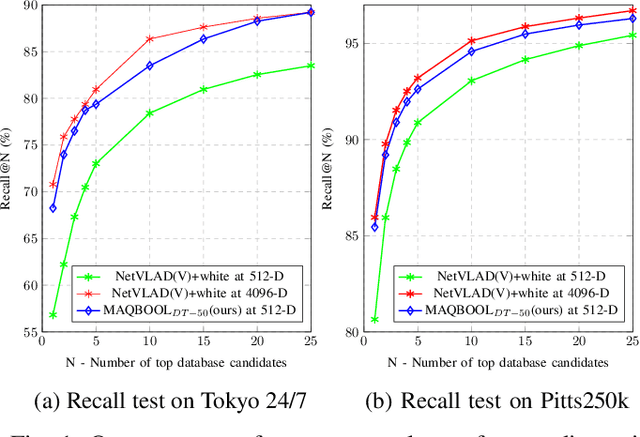
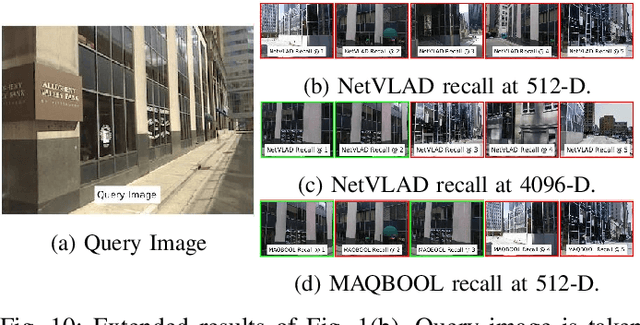
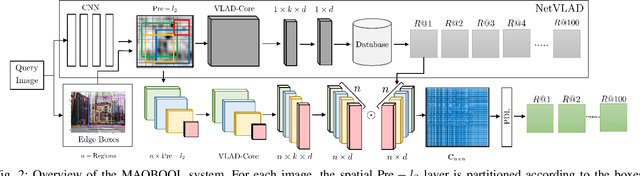
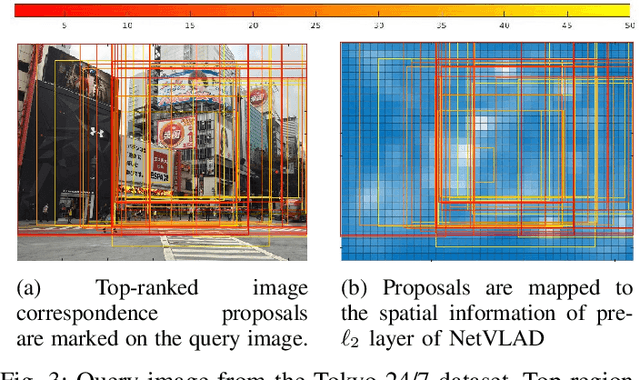
Deep learning-based image retrieval techniques for the loop closure detection demonstrate satisfactory performance. However, it is still challenging to achieve high-level performance based on previously trained models in different geographical regions. This paper addresses the problem of their deployment with simultaneous localization and mapping (SLAM) systems in the new environment. The general baseline approach uses additional information, such as GPS, sequential keyframes tracking, and re-training the whole environment to enhance the recall rate. We propose a novel approach for improving image retrieval based on previously trained models. We present an intelligent method, MAQBOOL, to amplify the power of pre-trained models for better image recall and its application to real-time multiagent SLAM systems. We achieve comparable image retrieval results at a low descriptor dimension (512-D), compared to the high descriptor dimension (4096-D) of state-of-the-art methods. We use spatial information to improve the recall rate in image retrieval on pre-trained models.