 Add to Chrome
 Add to Firefox
 Add to Edge
RW-Post: Auditable Evidence-Grounded Multimodal Fact-Checking in the Wild
May 11, 2026
Multimodal misinformation increasingly leverages visual persuasion, where repurposed or manipulated images strengthen misleading text. We introduce \textbf{RW-Post}, a post-aligned \textbf{text--image benchmark} for real-world multimodal fact-checking with \emph{auditable} annotations: each instance links the original social-media post with reasoning traces and explicitly linked evidence items derived from human fact-check articles via an LLM-assisted extraction-and-auditing pipeline. RW-Post supports controlled evaluation across closed-book, evidence-bounded, and open-web regimes, enabling systematic diagnosis of visual grounding and evidence utilization. We provide \textbf{AgentFact} as a reference verification baseline and benchmark strong open-source LVLMs under unified protocols. Experiments show substantial headroom: current models struggle with faithful evidence grounding, while evidence-bounded evaluation improves both accuracy and faithfulness. Code and dataset will be released at https://github.com/xudanni0927/AgentFact.

Multimodal Fact-Checking: An Agent-based Approach
Dec 31, 2025The rapid spread of multimodal misinformation poses a growing challenge for automated fact-checking systems. Existing approaches, including large vision language models (LVLMs) and deep multimodal fusion methods, often fall short due to limited reasoning and shallow evidence utilization. A key bottleneck is the lack of dedicated datasets that provide complete real-world multimodal misinformation instances accompanied by annotated reasoning processes and verifiable evidence. To address this limitation, we introduce RW-Post, a high-quality and explainable dataset for real-world multimodal fact-checking. RW-Post aligns real-world multimodal claims with their original social media posts, preserving the rich contextual information in which the claims are made. In addition, the dataset includes detailed reasoning and explicitly linked evidence, which are derived from human written fact-checking articles via a large language model assisted extraction pipeline, enabling comprehensive verification and explanation. Building upon RW-Post, we propose AgentFact, an agent-based multimodal fact-checking framework designed to emulate the human verification workflow. AgentFact consists of five specialized agents that collaboratively handle key fact-checking subtasks, including strategy planning, high-quality evidence retrieval, visual analysis, reasoning, and explanation generation. These agents are orchestrated through an iterative workflow that alternates between evidence searching and task-aware evidence filtering and reasoning, facilitating strategic decision-making and systematic evidence analysis. Extensive experimental results demonstrate that the synergy between RW-Post and AgentFact substantially improves both the accuracy and interpretability of multimodal fact-checking.
Uncovering the Unseen: Discover Hidden Intentions by Micro-Behavior Graph Reasoning
Aug 29, 2023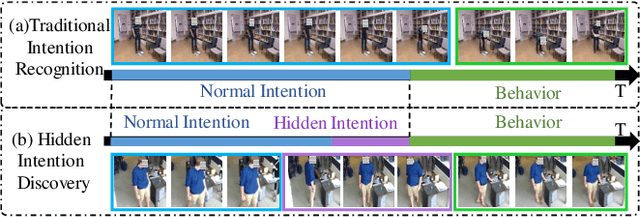
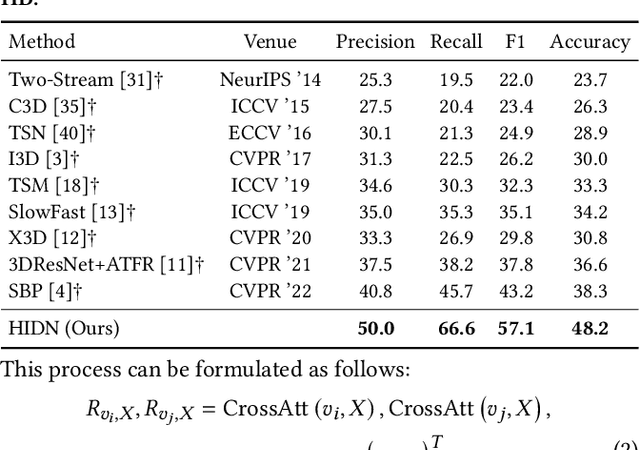
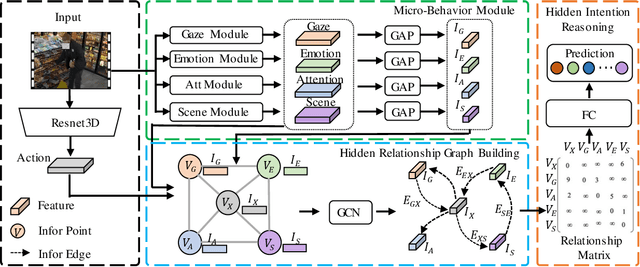
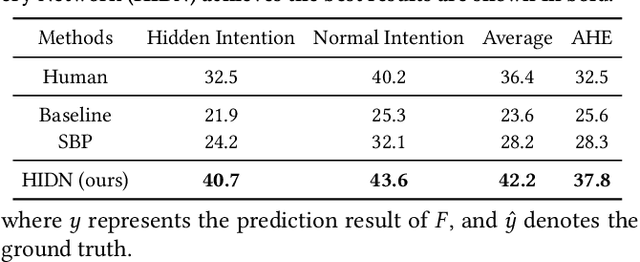
This paper introduces a new and challenging Hidden Intention Discovery (HID) task. Unlike existing intention recognition tasks, which are based on obvious visual representations to identify common intentions for normal behavior, HID focuses on discovering hidden intentions when humans try to hide their intentions for abnormal behavior. HID presents a unique challenge in that hidden intentions lack the obvious visual representations to distinguish them from normal intentions. Fortunately, from a sociological and psychological perspective, we find that the difference between hidden and normal intentions can be reasoned from multiple micro-behaviors, such as gaze, attention, and facial expressions. Therefore, we first discover the relationship between micro-behavior and hidden intentions and use graph structure to reason about hidden intentions. To facilitate research in the field of HID, we also constructed a seminal dataset containing a hidden intention annotation of a typical theft scenario for HID. Extensive experiments show that the proposed network improves performance on the HID task by 9.9\% over the state-of-the-art method SBP.
Group Activity Recognition via Dynamic Composition and Interaction
May 09, 2023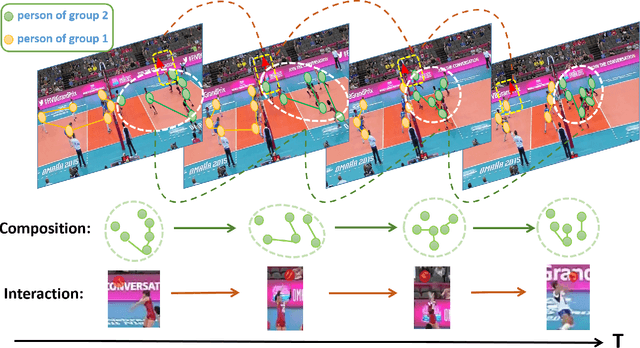
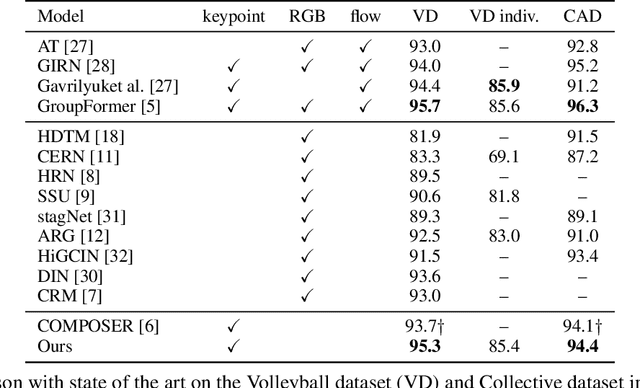
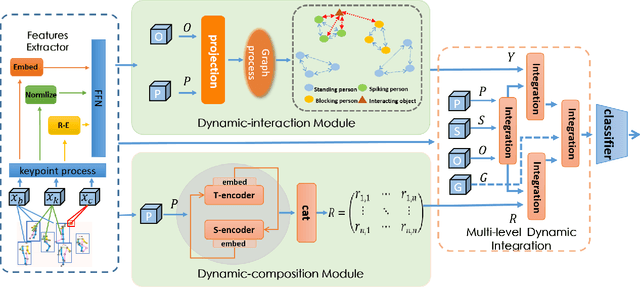
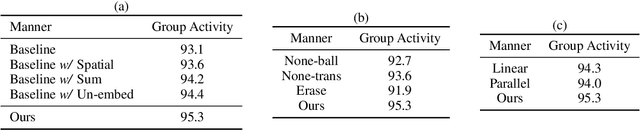
Previous group activity recognition approaches were limited to reasoning using human relations or finding important subgroups and tended to ignore indispensable group composition and human-object interactions. This absence makes a partial interpretation of the scene and increases the interference of irrelevant actions on the results. Therefore, we propose our DynamicFormer with Dynamic composition Module (DcM) and Dynamic interaction Module (DiM) to model relations and locations of persons and discriminate the contribution of participants, respectively. Our findings on group composition and human-object interaction inspire our core idea. Group composition tells us the location of people and their relations inside the group, while interaction reflects the relation between humans and objects outside the group. We utilize spatial and temporal encoders in DcM to model our dynamic composition and build DiM to explore interaction with a novel GCN, which has a transformer inside to consider the temporal neighbors of human/object. Also, a Multi-level Dynamic Integration is employed to integrate features from different levels. We conduct extensive experiments on two public datasets and show that our method achieves state-of-the-art.