 Add to Chrome
 Add to Firefox
 Add to Edge
Federated Learning with Energy-Based Structured Probabilistic Inference
Jun 29, 2026
Federated learning typically aggregates client updates using fixed or heuristic weighting rules, which can be suboptimal when clients have heterogeneous data and varying contributions to the global model. We propose a framework that refines client aggregation weights using Conditional Random Fields (CRFs). Our method defines unary potentials for individual clients and pairwise potentials for all client pairs, allowing the server to model both client-specific reliability and interactions between clients. The resulting CRF inference produces aggregation weights that enable better convergence of the global training objective. Experiments show that, under non-IID heterogeneity, our approach consistently improves performance over well-established federated learning baselines.

Object-Centric Learning with Slot Mixture Module
Nov 08, 2023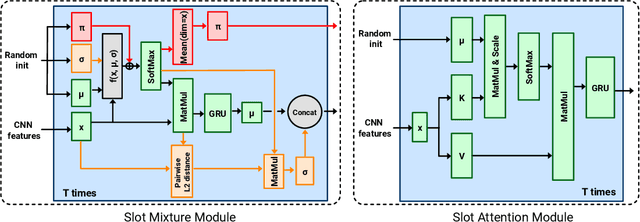
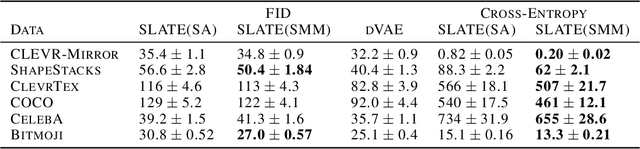
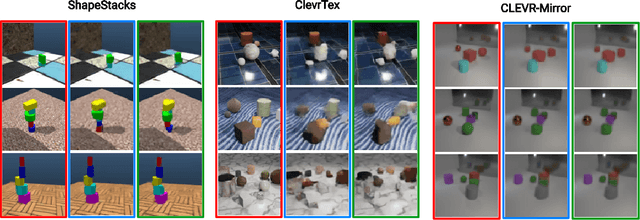
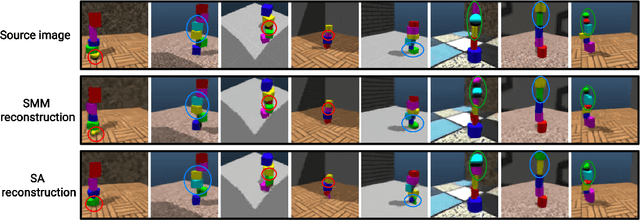
Object-centric architectures usually apply a differentiable module to the entire feature map to decompose it into sets of entity representations called slots. Some of these methods structurally resemble clustering algorithms, where the cluster's center in latent space serves as a slot representation. Slot Attention is an example of such a method, acting as a learnable analog of the soft k-means algorithm. Our work employs a learnable clustering method based on the Gaussian Mixture Model. Unlike other approaches, we represent slots not only as centers of clusters but also incorporate information about the distance between clusters and assigned vectors, leading to more expressive slot representations. Our experiments demonstrate that using this approach instead of Slot Attention improves performance in object-centric scenarios, achieving state-of-the-art results in the set property prediction task.
TransPath: Learning Heuristics For Grid-Based Pathfinding via Transformers
Dec 22, 2022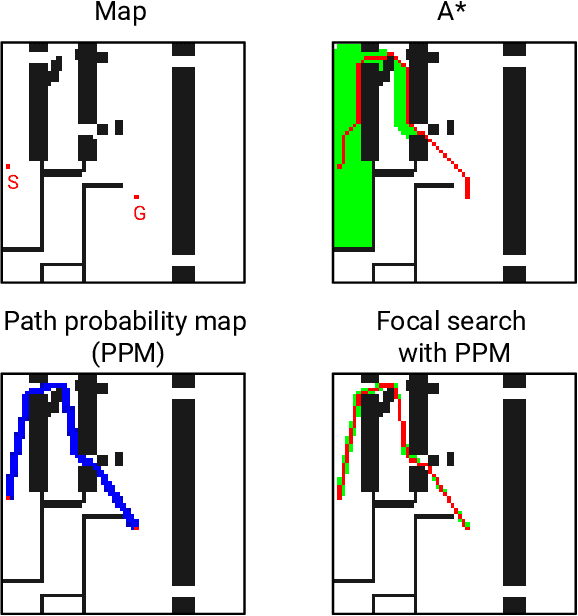
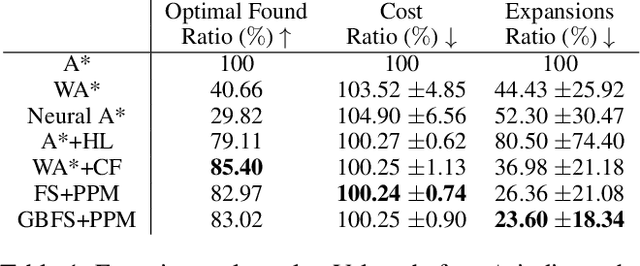

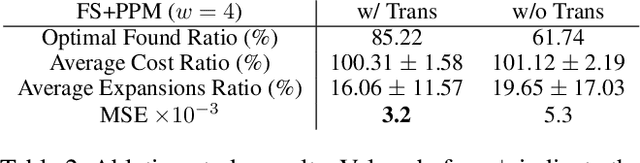
Heuristic search algorithms, e.g. A*, are the commonly used tools for pathfinding on grids, i.e. graphs of regular structure that are widely employed to represent environments in robotics, video games etc. Instance-independent heuristics for grid graphs, e.g. Manhattan distance, do not take the obstacles into account and, thus, the search led by such heuristics performs poorly in the obstacle-rich environments. To this end, we suggest learning the instance-dependent heuristic proxies that are supposed to notably increase the efficiency of the search. The first heuristic proxy we suggest to learn is the correction factor, i.e. the ratio between the instance independent cost-to-go estimate and the perfect one (computed offline at the training phase). Unlike learning the absolute values of the cost-to-go heuristic function, which was known before, when learning the correction factor the knowledge of the instance-independent heuristic is utilized. The second heuristic proxy is the path probability, which indicates how likely the grid cell is lying on the shortest path. This heuristic can be utilized in the Focal Search framework as the secondary heuristic, allowing us to preserve the guarantees on the bounded sub-optimality of the solution. We learn both suggested heuristics in a supervised fashion with the state-of-the-art neural networks containing attention blocks (transformers). We conduct a thorough empirical evaluation on a comprehensive dataset of planning tasks, showing that the suggested techniques i) reduce the computational effort of the A* up to a factor of $4$x while producing the solutions, which costs exceed the costs of the optimal solutions by less than $0.3$% on average; ii) outperform the competitors, which include the conventional techniques from the heuristic search, i.e. weighted A*, as well as the state-of-the-art learnable planners.