 Add to Chrome
 Add to Firefox
 Add to Edge
Qantara: Bridge-Flow Training for Multi-Paradigm JEPA Control
Jul 06, 2026
Joint-Embedding Predictive Architectures (JEPAs) underpin a growing family of latent world models for control from raw pixels, but every existing JEPA world model commits at training time to a single inference paradigm: either trajectory optimisation in a learned dynamics model, or direct behaviour cloning. A single checkpoint that serves both would defer this choice to inference, when deployment constraints (rollout cost, observation accessibility) determine which path wins. We present Qantara, an end-to-end JEPA whose joint training objective pairs a Brownian-bridge interpolant between consecutive clean latents on the state axis with noise-to-data flow matching on the action axis. The same checkpoint serves three inference paradigms without retraining: latent planning, behaviour-cloning action sampling, and inverse dynamics, which we query through a video-inverse composition that first predicts the next latent without action conditioning, then extracts the action. Training concentrates mass on the edges of the (action-time, state-time) noise square, where inference queries the predictor: replacing it with uniform interior sampling drops Push-T planning from 90.1 to 53.3 SR at matched compute. On the LeWM control suite, Qantara reaches a 91.2 SR three-train-seed average and sets new SOTA on OGBench-Cube (+7.7 SR over DINO-WM, +19.7 over LeWM). From the same weights, the behaviour-cloning and video-inverse paths reach 82-83 SR on Push-T and 71-73 SR on Cube. These results move JEPA world models from single-paradigm planners to multi-paradigm controllers.

Rank-Then-Act: Reward-Free Control from Frame-Order Progress
Jul 02, 2026We introduce Rank-Then-Act (RTA), a framework for learning control policies from expert video demonstrations without environment rewards. RTA trains a Vision-Language Model (VLM) offline as a progress-based ordinal scorer, using a Group Relative Policy Optimization (GRPO) objective over shuffled frame sequences, which forces the model to recover temporal ordering from visual semantics rather than trivial time cues. Importantly, instead of using the scorer directly as a scalar reward model, we propose a correlation-based reward function for reinforcement learning: at each interaction window, we compute the Spearman rank correlation between predicted progress rankings and true temporal indices, yielding a bounded, scale-invariant learning signal. This design decouples reward learning from absolute calibration and enables stable transfer across tasks and environments. We evaluate RTA on discrete control benchmarks (PyBoy: Catrap, Kirby) and continuous control tasks (PointMaze, MetaWorld). RTA consistently matches or outperforms prior video-based reward learning methods and rank-based baselines, while demonstrating strong cross-task reuse of a single pretrained progress scorer. Our results suggest that correlation-structured supervision over video-derived ordinal signals is sufficient for policy learning, offering a scalable alternative to explicit reward design.
Unstable Features, Reproducible Subspaces: Understanding Seed Dependence in Sparse Autoencoders
Jun 10, 2026Sparse autoencoders (SAEs) are widely used to interpret neural network representations, but their utility depends on whether the learned features are reproducible across training runs. We study this question through \emph{feature stability}: for each SAE feature, we estimate the probability that a similar feature reappears in an independently trained SAE. This yields a scalable per-feature signal that separates stable from unstable features. In a large-scale study across seeds, models, layers, dictionary sizes, and SAE variants, we find a pronounced functional asymmetry: stable features carry most of the reconstruction- and prediction-relevant signal, while unstable features have weak marginal impact and are dominated by low-frequency surface-form triggers in both activation statistics and automatic explanations. Geometrically, unstable features are individually non-reproducible but concentrate in reproducible lower-rank subspaces, suggesting that seed dependence often reflects basis ambiguity within a shared region of activation space rather than pure noise. A controlled synthetic model makes this mechanism explicit, showing that low-rank ground-truth features can be recovered at the subspace level while remaining non-identifiable as individual SAE latents across seeds. Finally, by pooling unique cross-seed features, we construct more stable SAEs while preserving explained variance in this setting. Together, these results show that unstable features are not merely failed or noisy latents: they have weak individual functional impact, but reflect reproducible low-dimensional structure that standard SAEs resolve differently across seeds.
Interpreting and Steering a Text-to-Speech Language Model with Sparse Autoencoders
Jun 08, 2026Language models increasingly serve as the backbone of text-to-speech (TTS) systems, yet we understand little about the representations they build when text and generated speech tokens share a single residual stream. We train BatchTopK sparse autoencoders on the LM backbone of CosyVoice3 and introduce a modality-aware auto-interp pipeline that labels each feature from where it fires-text-prefix context, 1-second speech clips, or both. The recovered features are interpretable, spanning phonemes, laughter, accent prompts and speaker gender. Steering through the SAE latent space shows these features are causal rather than merely descriptive: targeted interventions raise laughter probability from 0.02 to 0.79, flip perceived speaker gender, and control speech rate while preserving spoken content. SAE features thus serve both as interpretability objects and as control directions for TTS synthesis.
Trust-Region Behavior Blending for On-Policy Distillation
May 29, 2026On-policy distillation (OPD) trains a student on prefixes sampled from its own policy while matching a stronger teacher. This addresses the prefix mismatch of offline distillation, but early student rollouts can still be poor, placing teacher supervision on weak or low-quality prefixes. We propose Trust-Region behavior Blending (TRB), a warmup method that replaces the early rollout policy with the closest-to-teacher behavior policy inside a student-centered KL trust region, while keeping the per-prefix reverse-KL OPD loss unchanged. The KL budget is annealed to zero, so training returns to pure student rollouts after warmup. Across two math-reasoning distillation settings, TRB attains the strongest average among the compared methods.
Next Embedding Prediction Makes World Models Stronger
Mar 03, 2026Capturing temporal dependencies is critical for model-based reinforcement learning (MBRL) in partially observable, high-dimensional domains. We introduce NE-Dreamer, a decoder-free MBRL agent that leverages a temporal transformer to predict next-step encoder embeddings from latent state sequences, directly optimizing temporal predictive alignment in representation space. This approach enables NE-Dreamer to learn coherent, predictive state representations without reconstruction losses or auxiliary supervision. On the DeepMind Control Suite, NE-Dreamer matches or exceeds the performance of DreamerV3 and leading decoder-free agents. On a challenging subset of DMLab tasks involving memory and spatial reasoning, NE-Dreamer achieves substantial gains. These results establish next-embedding prediction with temporal transformers as an effective, scalable framework for MBRL in complex, partially observable environments.
F-GRPO: Don't Let Your Policy Learn the Obvious and Forget the Rare
Feb 06, 2026Reinforcement Learning with Verifiable Rewards (RLVR) is commonly based on group sampling to estimate advantages and stabilize policy updates. In practice, large group sizes are not feasible due to computational limits, which biases learning toward trajectories that are already likely. Smaller groups often miss rare-correct trajectories while still containing mixed rewards, concentrating probability on common solutions. We derive the probability that updates miss rare-correct modes as a function of group size, showing non-monotonic behavior, and characterize how updates redistribute mass within the correct set, revealing that unsampled-correct mass can shrink even as total correct mass grows. Motivated by this analysis, we propose a difficulty-aware advantage scaling coefficient, inspired by Focal loss, that down-weights updates on high-success prompts. The lightweight modification can be directly integrated into any group-relative RLVR algorithm such as GRPO, DAPO, and CISPO. On Qwen2.5-7B across in-domain and out-of-domain benchmarks, our method improves pass@256 from 64.1 $\rightarrow$ 70.3 (GRPO), 69.3 $\rightarrow$ 72.5 (DAPO), and 73.2 $\rightarrow$ 76.8 (CISPO), while preserving or improving pass@1, without increasing group size or computational cost.
Teach Old SAEs New Domain Tricks with Boosting
Jul 17, 2025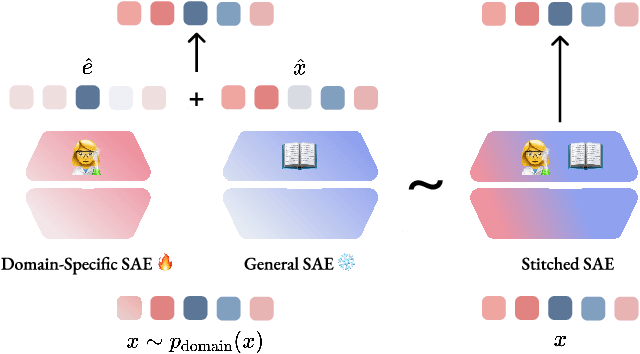
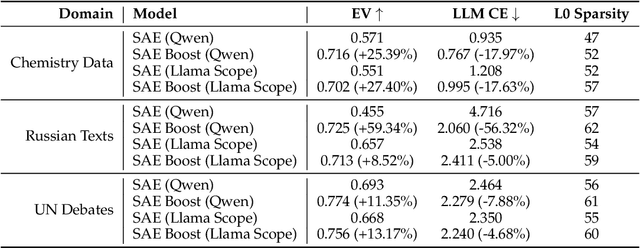
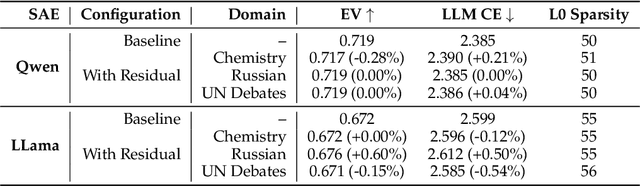
Sparse Autoencoders have emerged as powerful tools for interpreting the internal representations of Large Language Models, yet they often fail to capture domain-specific features not prevalent in their training corpora. This paper introduces a residual learning approach that addresses this feature blindness without requiring complete retraining. We propose training a secondary SAE specifically to model the reconstruction error of a pretrained SAE on domain-specific texts, effectively capturing features missed by the primary model. By summing the outputs of both models during inference, we demonstrate significant improvements in both LLM cross-entropy and explained variance metrics across multiple specialized domains. Our experiments show that this method efficiently incorporates new domain knowledge into existing SAEs while maintaining their performance on general tasks. This approach enables researchers to selectively enhance SAE interpretability for specific domains of interest, opening new possibilities for targeted mechanistic interpretability of LLMs.
Train One Sparse Autoencoder Across Multiple Sparsity Budgets to Preserve Interpretability and Accuracy
May 30, 2025Sparse Autoencoders (SAEs) have proven to be powerful tools for interpreting neural networks by decomposing hidden representations into disentangled, interpretable features via sparsity constraints. However, conventional SAEs are constrained by the fixed sparsity level chosen during training; meeting different sparsity requirements therefore demands separate models and increases the computational footprint during both training and evaluation. We introduce a novel training objective, \emph{HierarchicalTopK}, which trains a single SAE to optimise reconstructions across multiple sparsity levels simultaneously. Experiments with Gemma-2 2B demonstrate that our approach achieves Pareto-optimal trade-offs between sparsity and explained variance, outperforming traditional SAEs trained at individual sparsity levels. Further analysis shows that HierarchicalTopK preserves high interpretability scores even at higher sparsity. The proposed objective thus closes an important gap between flexibility and interpretability in SAE design.
Train Sparse Autoencoders Efficiently by Utilizing Features Correlation
May 28, 2025
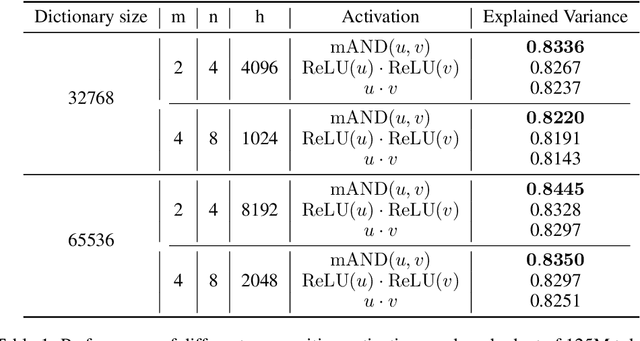
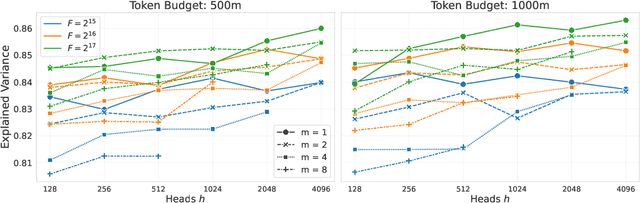
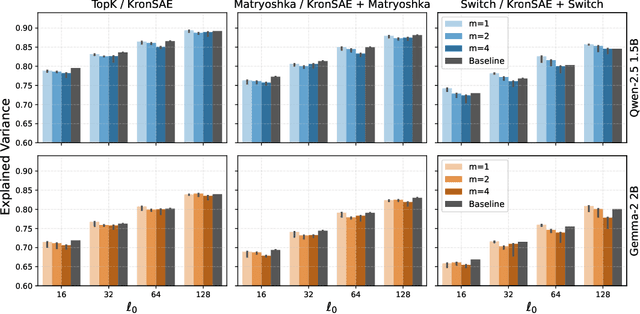
Sparse Autoencoders (SAEs) have demonstrated significant promise in interpreting the hidden states of language models by decomposing them into interpretable latent directions. However, training SAEs at scale remains challenging, especially when large dictionary sizes are used. While decoders can leverage sparse-aware kernels for efficiency, encoders still require computationally intensive linear operations with large output dimensions. To address this, we propose KronSAE, a novel architecture that factorizes the latent representation via Kronecker product decomposition, drastically reducing memory and computational overhead. Furthermore, we introduce mAND, a differentiable activation function approximating the binary AND operation, which improves interpretability and performance in our factorized framework.