 Add to Chrome
 Add to Firefox
 Add to Edge
Interpreting and Steering a Text-to-Speech Language Model with Sparse Autoencoders
Jun 08, 2026
Language models increasingly serve as the backbone of text-to-speech (TTS) systems, yet we understand little about the representations they build when text and generated speech tokens share a single residual stream. We train BatchTopK sparse autoencoders on the LM backbone of CosyVoice3 and introduce a modality-aware auto-interp pipeline that labels each feature from where it fires-text-prefix context, 1-second speech clips, or both. The recovered features are interpretable, spanning phonemes, laughter, accent prompts and speaker gender. Steering through the SAE latent space shows these features are causal rather than merely descriptive: targeted interventions raise laughter probability from 0.02 to 0.79, flip perceived speaker gender, and control speech rate while preserving spoken content. SAE features thus serve both as interpretability objects and as control directions for TTS synthesis.

Teach Old SAEs New Domain Tricks with Boosting
Jul 17, 2025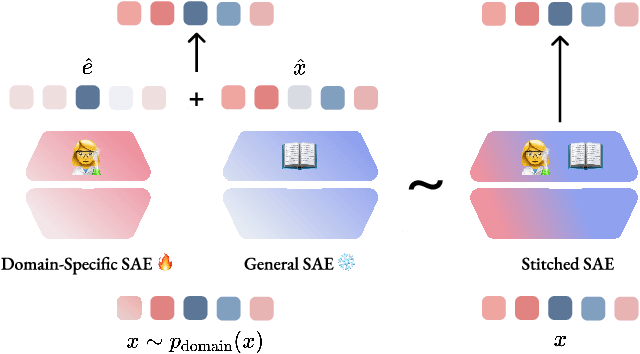
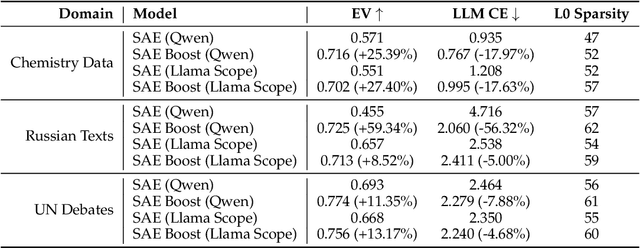
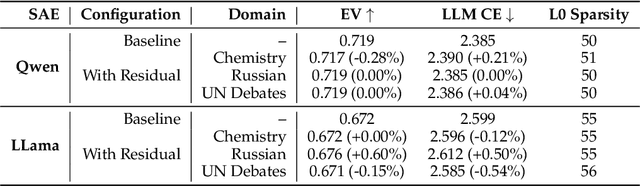
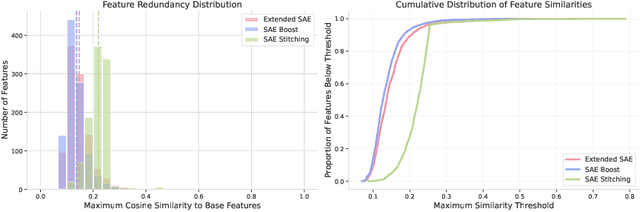
Sparse Autoencoders have emerged as powerful tools for interpreting the internal representations of Large Language Models, yet they often fail to capture domain-specific features not prevalent in their training corpora. This paper introduces a residual learning approach that addresses this feature blindness without requiring complete retraining. We propose training a secondary SAE specifically to model the reconstruction error of a pretrained SAE on domain-specific texts, effectively capturing features missed by the primary model. By summing the outputs of both models during inference, we demonstrate significant improvements in both LLM cross-entropy and explained variance metrics across multiple specialized domains. Our experiments show that this method efficiently incorporates new domain knowledge into existing SAEs while maintaining their performance on general tasks. This approach enables researchers to selectively enhance SAE interpretability for specific domains of interest, opening new possibilities for targeted mechanistic interpretability of LLMs.