 Add to Chrome
 Add to Firefox
 Add to Edge
Trust-Region Behavior Blending for On-Policy Distillation
May 29, 2026
On-policy distillation (OPD) trains a student on prefixes sampled from its own policy while matching a stronger teacher. This addresses the prefix mismatch of offline distillation, but early student rollouts can still be poor, placing teacher supervision on weak or low-quality prefixes. We propose Trust-Region behavior Blending (TRB), a warmup method that replaces the early rollout policy with the closest-to-teacher behavior policy inside a student-centered KL trust region, while keeping the per-prefix reverse-KL OPD loss unchanged. The KL budget is annealed to zero, so training returns to pure student rollouts after warmup. Across two math-reasoning distillation settings, TRB attains the strongest average among the compared methods.

F-GRPO: Don't Let Your Policy Learn the Obvious and Forget the Rare
Feb 06, 2026Reinforcement Learning with Verifiable Rewards (RLVR) is commonly based on group sampling to estimate advantages and stabilize policy updates. In practice, large group sizes are not feasible due to computational limits, which biases learning toward trajectories that are already likely. Smaller groups often miss rare-correct trajectories while still containing mixed rewards, concentrating probability on common solutions. We derive the probability that updates miss rare-correct modes as a function of group size, showing non-monotonic behavior, and characterize how updates redistribute mass within the correct set, revealing that unsampled-correct mass can shrink even as total correct mass grows. Motivated by this analysis, we propose a difficulty-aware advantage scaling coefficient, inspired by Focal loss, that down-weights updates on high-success prompts. The lightweight modification can be directly integrated into any group-relative RLVR algorithm such as GRPO, DAPO, and CISPO. On Qwen2.5-7B across in-domain and out-of-domain benchmarks, our method improves pass@256 from 64.1 $\rightarrow$ 70.3 (GRPO), 69.3 $\rightarrow$ 72.5 (DAPO), and 73.2 $\rightarrow$ 76.8 (CISPO), while preserving or improving pass@1, without increasing group size or computational cost.
The Differences Between Direct Alignment Algorithms are a Blur
Feb 03, 2025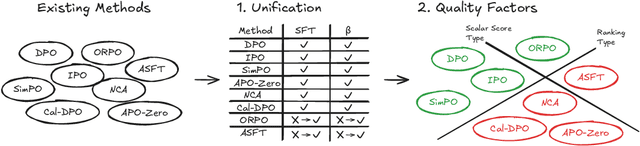
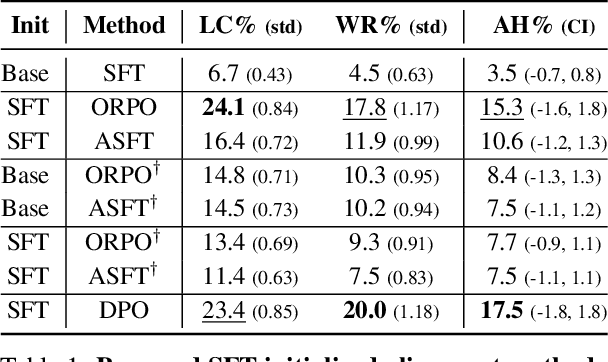
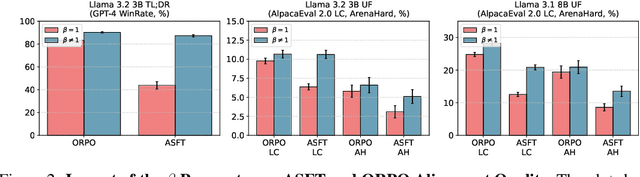
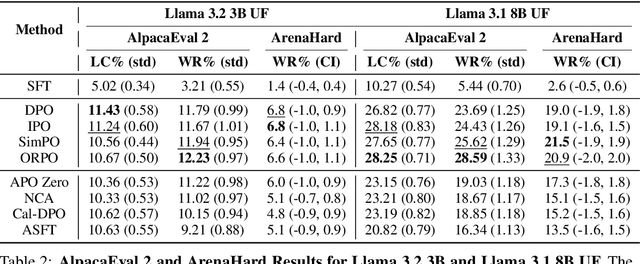
Direct Alignment Algorithms (DAAs) simplify language model alignment by replacing reinforcement learning (RL) and reward modeling (RM) in Reinforcement Learning from Human Feedback (RLHF) with direct policy optimization. DAAs can be classified by their ranking losses (pairwise vs. pointwise), by the rewards used in those losses (e.g., likelihood ratios of policy and reference policy, or odds ratios), or by whether a Supervised Fine-Tuning (SFT) phase is required (two-stage vs. one-stage). We first show that one-stage methods underperform two-stage methods. To address this, we incorporate an explicit SFT phase and introduce the $\beta$ parameter, controlling the strength of preference optimization, into single-stage ORPO and ASFT. These modifications improve their performance in Alpaca Eval 2 by +$3.46$ (ORPO) and +$8.27$ (ASFT), matching two-stage methods like DPO. Further analysis reveals that the key factor is whether the approach uses pairwise or pointwise objectives, rather than the specific implicit reward or loss function. These results highlight the importance of careful evaluation to avoid premature claims of performance gains or overall superiority in alignment algorithms.
Learn Your Reference Model for Real Good Alignment
Apr 15, 2024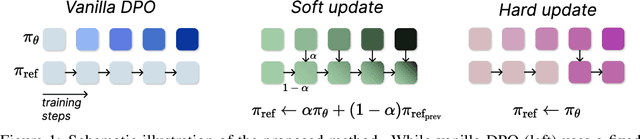
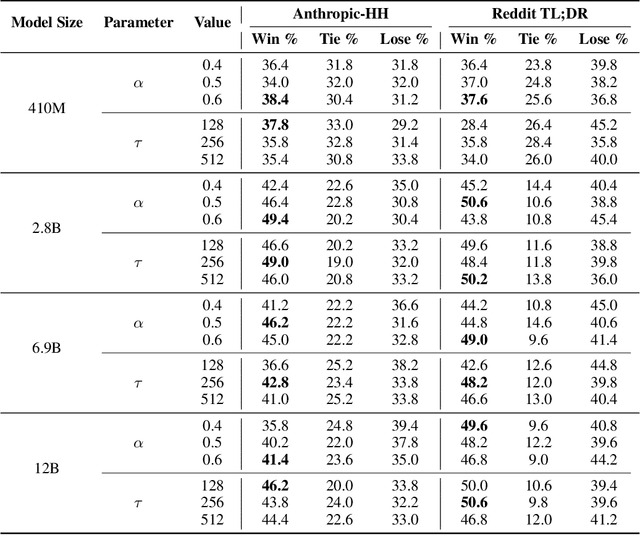
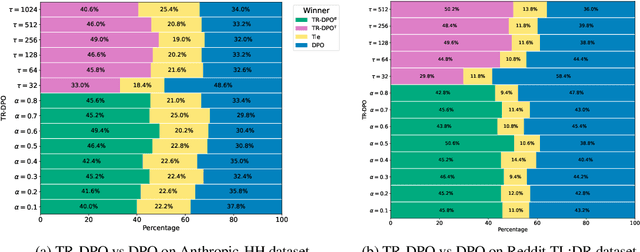
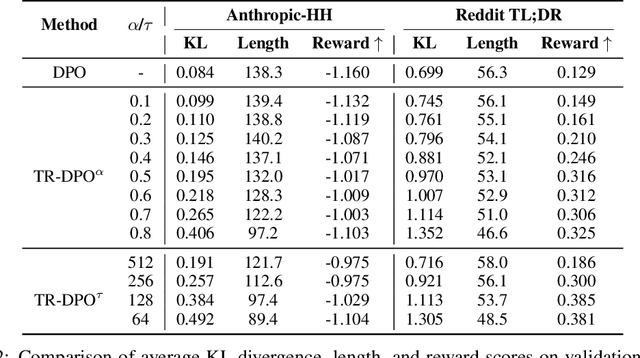
The complexity of the alignment problem stems from the fact that existing methods are unstable. Researchers continuously invent various tricks to address this shortcoming. For instance, in the fundamental Reinforcement Learning From Human Feedback (RLHF) technique of Language Model alignment, in addition to reward maximization, the Kullback-Leibler divergence between the trainable policy and the SFT policy is minimized. This addition prevents the model from being overfitted to the Reward Model (RM) and generating texts that are out-of-domain for the RM. The Direct Preference Optimization (DPO) method reformulates the optimization task of RLHF and eliminates the Reward Model while tacitly maintaining the requirement for the policy to be close to the SFT policy. In our paper, we argue that this implicit limitation in the DPO method leads to sub-optimal results. We propose a new method called Trust Region DPO (TR-DPO), which updates the reference policy during training. With such a straightforward update, we demonstrate the effectiveness of TR-DPO against DPO on the Anthropic HH and TLDR datasets. We show that TR-DPO outperforms DPO by up to 19%, measured by automatic evaluation with GPT-4. The new alignment approach that we propose allows us to improve the quality of models across several parameters at once, such as coherence, correctness, level of detail, helpfulness, and harmlessness.