 Add to Chrome
 Add to Firefox
 Add to Edge
Learning Selective LLM Autonomy from Copilot Feedback in Enterprise Customer Support Workflows
Apr 26, 2026
We present a deployed system that automates end-to-end customer support workflows inside an enterprise Business Process Management (BPM) platform. The approach is scalable in production and reaches selective automation within two weeks for a new process, leveraging supervision already generated at scale: structured per-case UI interaction traces and low-overhead copilot feedback, where operators either accept a suggestion or provide a correction. A staged deployment pipeline trains a next UI action policy, learns a critic from copilot feedback to calibrate abstention, and executes only high-confidence steps in the background while deferring uncertain decisions to operators and resuming from the updated UI state. This setup lets one operator supervise multiple concurrent sessions and be interrupted only when the system is uncertain. The system operates on a schema-driven view of the BPM interface and includes monitoring and safe fallbacks for production. In production, it automated 45% of sessions and reduced average handling time by 39% without degrading support quality level.

Learn Your Reference Model for Real Good Alignment
Apr 15, 2024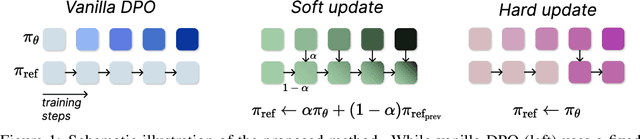
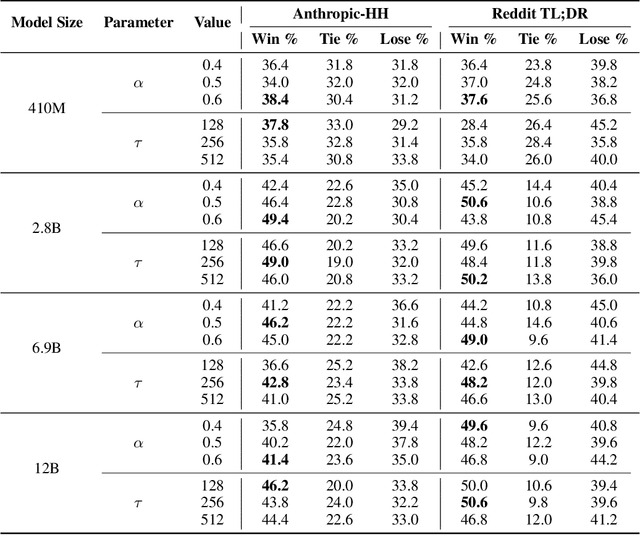
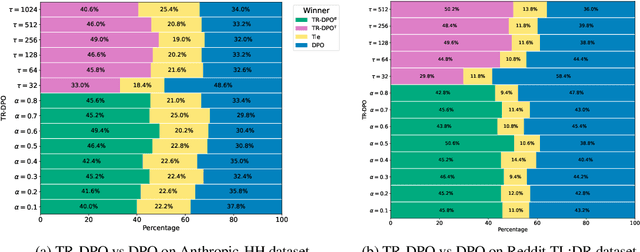
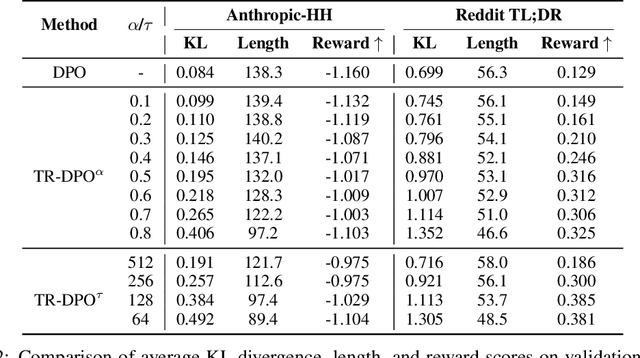
The complexity of the alignment problem stems from the fact that existing methods are unstable. Researchers continuously invent various tricks to address this shortcoming. For instance, in the fundamental Reinforcement Learning From Human Feedback (RLHF) technique of Language Model alignment, in addition to reward maximization, the Kullback-Leibler divergence between the trainable policy and the SFT policy is minimized. This addition prevents the model from being overfitted to the Reward Model (RM) and generating texts that are out-of-domain for the RM. The Direct Preference Optimization (DPO) method reformulates the optimization task of RLHF and eliminates the Reward Model while tacitly maintaining the requirement for the policy to be close to the SFT policy. In our paper, we argue that this implicit limitation in the DPO method leads to sub-optimal results. We propose a new method called Trust Region DPO (TR-DPO), which updates the reference policy during training. With such a straightforward update, we demonstrate the effectiveness of TR-DPO against DPO on the Anthropic HH and TLDR datasets. We show that TR-DPO outperforms DPO by up to 19%, measured by automatic evaluation with GPT-4. The new alignment approach that we propose allows us to improve the quality of models across several parameters at once, such as coherence, correctness, level of detail, helpfulness, and harmlessness.