 Add to Chrome
 Add to Firefox
 Add to Edge
Mashup Learning: Faster Finetuning by Remixing Past Checkpoints
Mar 10, 2026
Finetuning on domain-specific data is a well-established method for enhancing LLM performance on downstream tasks. Training on each dataset produces a new set of model weights, resulting in a multitude of checkpoints saved in-house or on open-source platforms. However, these training artifacts are rarely reused for subsequent experiments despite containing improved model abilities for potentially similar tasks. In this paper, we propose Mashup Learning, a simple method to leverage the outputs of prior training runs to enhance model adaptation to new tasks. Our procedure identifies the most relevant historical checkpoints for a target dataset, aggregates them with model merging, and uses the result as an improved initialization for training. Across 8 standard LLM benchmarks, four models, and two collections of source checkpoints, Mashup Learning consistently improves average downstream accuracy by 0.5-5 percentage points over training from scratch. It also accelerates convergence, requiring 41-46% fewer training steps and up to 37% less total wall-clock time to match from-scratch accuracy, including all selection and merging overhead.

Linear Transformers with Learnable Kernel Functions are Better In-Context Models
Feb 16, 2024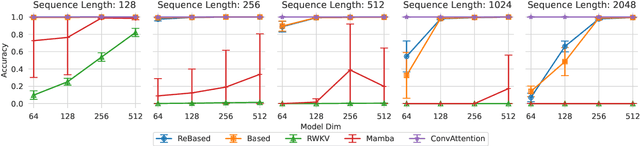
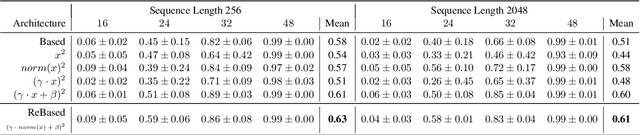
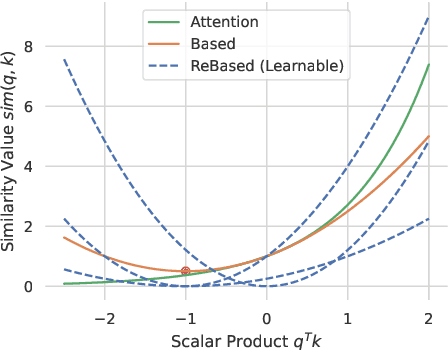
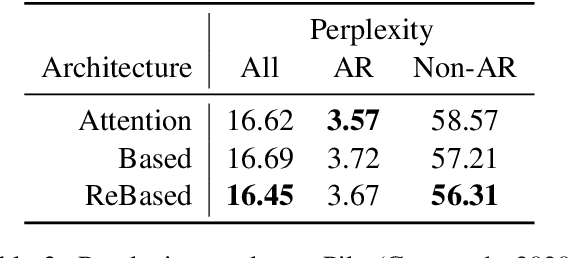
Advancing the frontier of subquadratic architectures for Language Models (LMs) is crucial in the rapidly evolving field of natural language processing. Current innovations, including State Space Models, were initially celebrated for surpassing Transformer performance on language modeling tasks. However, these models have revealed deficiencies in essential In-Context Learning capabilities - a domain where the Transformer traditionally shines. The Based model emerged as a hybrid solution, blending a Linear Transformer with a kernel inspired by the Taylor expansion of exponential functions, augmented by convolutional networks. Mirroring the Transformer's in-context adeptness, it became a strong contender in the field. In our work, we present a singular, elegant alteration to the Based kernel that amplifies its In-Context Learning abilities evaluated with the Multi-Query Associative Recall task and overall language modeling process, as demonstrated on the Pile dataset.