 Add to Chrome
 Add to Firefox
 Add to Edge
Partial recovery of meter-scale surface weather
Feb 26, 2026
Near-surface atmospheric conditions can differ sharply over tens to hundreds of meters due to land cover and topography, yet this variability is absent from current weather analyses and forecasts. It is unclear whether such meter-scale variability reflects irreducibly chaotic dynamics or contains a component predictable from surface characteristics and large-scale atmospheric forcing. Here we show that a substantial, physically coherent component of meter-scale near-surface weather is statistically recoverable from existing observations. By conditioning coarse atmospheric state on sparse surface station measurements and high-resolution Earth observation data, we infer spatially continuous fields of near-surface wind, temperature, and humidity at 10 m resolution across the contiguous United States. Relative to ERA5, the inferred fields reduce wind error by 29% and temperature and dewpoint error by 6%, while explaining substantially more spatial variance at fixed time steps. They also exhibit physically interpretable structure, including urban heat islands, evapotranspiration-driven humidity contrasts, and wind speed differences across land cover types. Our findings expand the frontier of weather modeling by demonstrating a computationally feasible approach to continental-scale meter-resolution inference. More broadly, they illustrate how conditioning coarse dynamical models on static fine-scale features can reveal previously unresolved components of the Earth system.

Multi-modal graph neural networks for localized off-grid weather forecasting
Oct 16, 2024Urgent applications like wildfire management and renewable energy generation require precise, localized weather forecasts near the Earth's surface. However, weather forecast products from machine learning or numerical weather models are currently generated on a global regular grid, on which a naive interpolation cannot accurately reflect fine-grained weather patterns close to the ground. In this work, we train a heterogeneous graph neural network (GNN) end-to-end to downscale gridded forecasts to off-grid locations of interest. This multi-modal GNN takes advantage of local historical weather observations (e.g., wind, temperature) to correct the gridded weather forecast at different lead times towards locally accurate forecasts. Each data modality is modeled as a different type of node in the graph. Using message passing, the node at the prediction location aggregates information from its heterogeneous neighbor nodes. Experiments using weather stations across the Northeastern United States show that our model outperforms a range of data-driven and non-data-driven off-grid forecasting methods. Our approach demonstrates how the gap between global large-scale weather models and locally accurate predictions can be bridged to inform localized decision-making.
AI Foundation Models for Weather and Climate: Applications, Design, and Implementation
Sep 20, 2023
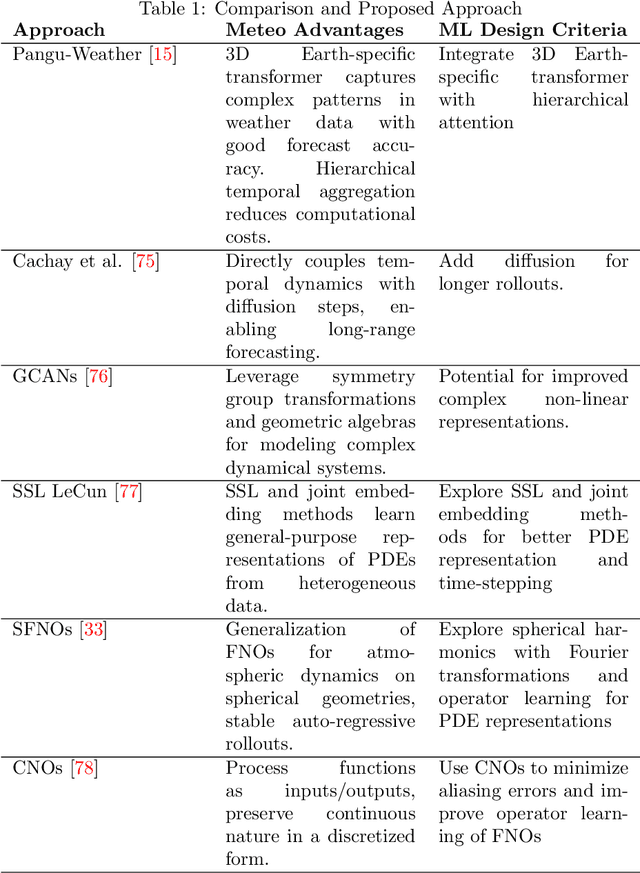
Machine learning and deep learning methods have been widely explored in understanding the chaotic behavior of the atmosphere and furthering weather forecasting. There has been increasing interest from technology companies, government institutions, and meteorological agencies in building digital twins of the Earth. Recent approaches using transformers, physics-informed machine learning, and graph neural networks have demonstrated state-of-the-art performance on relatively narrow spatiotemporal scales and specific tasks. With the recent success of generative artificial intelligence (AI) using pre-trained transformers for language modeling and vision with prompt engineering and fine-tuning, we are now moving towards generalizable AI. In particular, we are witnessing the rise of AI foundation models that can perform competitively on multiple domain-specific downstream tasks. Despite this progress, we are still in the nascent stages of a generalizable AI model for global Earth system models, regional climate models, and mesoscale weather models. Here, we review current state-of-the-art AI approaches, primarily from transformer and operator learning literature in the context of meteorology. We provide our perspective on criteria for success towards a family of foundation models for nowcasting and forecasting weather and climate predictions. We also discuss how such models can perform competitively on downstream tasks such as downscaling (super-resolution), identifying conditions conducive to the occurrence of wildfires, and predicting consequential meteorological phenomena across various spatiotemporal scales such as hurricanes and atmospheric rivers. In particular, we examine current AI methodologies and contend they have matured enough to design and implement a weather foundation model.
TensorBank:Tensor Lakehouse for Foundation Model Training
Sep 07, 2023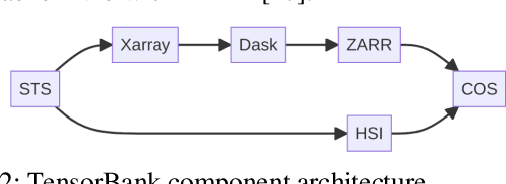
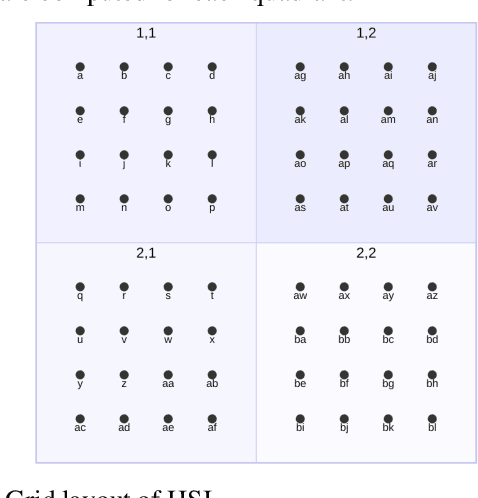
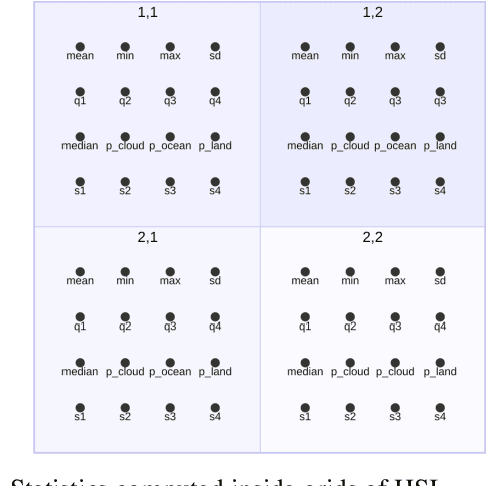
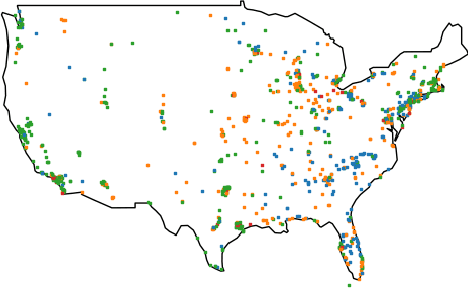
Storing and streaming high dimensional data for foundation model training became a critical requirement with the rise of foundation models beyond natural language. In this paper we introduce TensorBank, a petabyte scale tensor lakehouse capable of streaming tensors from Cloud Object Store (COS) to GPU memory at wire speed based on complex relational queries. We use Hierarchical Statistical Indices (HSI) for query acceleration. Our architecture allows to directly address tensors on block level using HTTP range reads. Once in GPU memory, data can be transformed using PyTorch transforms. We provide a generic PyTorch dataset type with a corresponding dataset factory translating relational queries and requested transformations as an instance. By making use of the HSI, irrelevant blocks can be skipped without reading them as those indices contain statistics on their content at different hierarchical resolution levels. This is an opinionated architecture powered by open standards and making heavy use of open-source technology. Although, hardened for production use using geospatial-temporal data, this architecture generalizes to other use case like computer vision, computational neuroscience, biological sequence analysis and more.
Extreme Precipitation Seasonal Forecast Using a Transformer Neural Network
Jul 14, 2021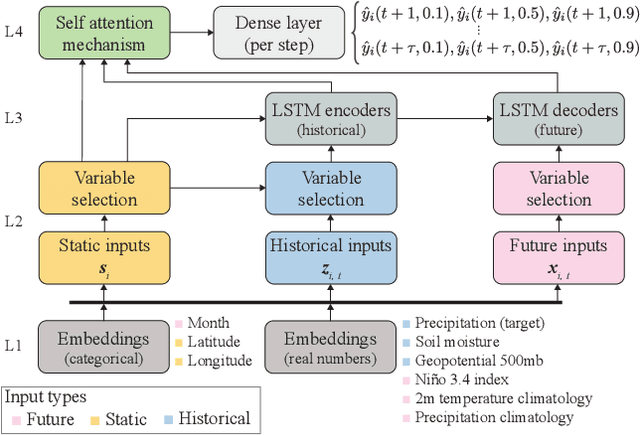
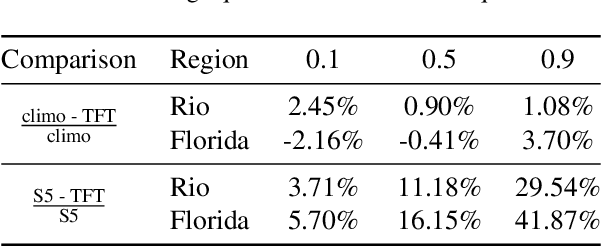
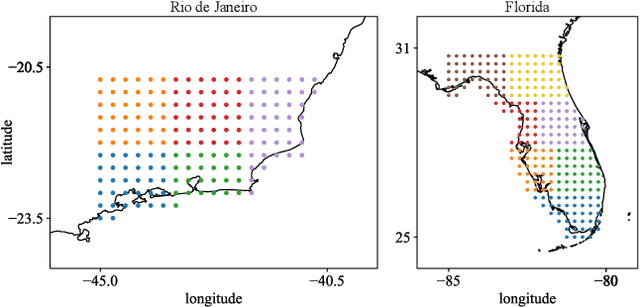
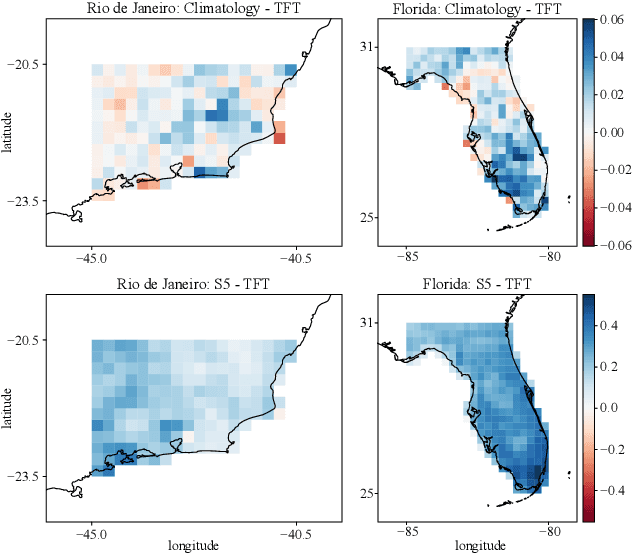
An impact of climate change is the increase in frequency and intensity of extreme precipitation events. However, confidently predicting the likelihood of extreme precipitation at seasonal scales remains an outstanding challenge. Here, we present an approach to forecasting the quantiles of the maximum daily precipitation in each week up to six months ahead using the temporal fusion transformer (TFT) model. Through experiments in two regions, we compare TFT predictions with those of two baselines: climatology and a calibrated ECMWF SEAS5 ensemble forecast (S5). Our results show that, in terms of quantile risk at six month lead time, the TFT predictions significantly outperform those from S5 and show an overall small improvement compared to climatology. The TFT also responds positively to departures from normal that climatology cannot.