 Add to Chrome
 Add to Firefox
 Add to Edge
FinRank: An Evidence-Grounded Benchmark for Financial Question Answering and Retrieval over SEC Filings
Aug 07, 2026
Financial question answering is typically evaluated by answer correctness, yet in SEC filings a plausible and even numerically correct answer can be grounded in the wrong evidence. Similar facts and disclosures recur across sections of a filing, across reporting periods of the same firm, and across comparable firms. FinRank targets this provenance-sensitive retrieval problem by requiring systems to identify evidence for the intended entity, reporting period, and disclosure context. The benchmark contains 1185 manually authored question-answer records over the 10-K and 10-Q filings of 22 companies. Each record includes a reference answer, gold supporting passages, and hand-curated hard negatives drawn from confusable passages within filings, across reporting periods, and across comparable firms. FinRank evaluates passage retrieval, reranking, and hard-negative discrimination as separately measured tasks. Baseline results demonstrate the difficulty of this setting: among the evaluated systems, even a 7B instruction-tuned embedder reaches only 44.8% Recall@10 on the pooled evidence corpus; sub-billion-parameter encoders gain at most 3.5 points over BM25, a finance-adapted embedder trails BM25 by 9.7 points, and pairwise accuracy falls by 13.0-20.5 percentage points when random negatives are replaced with the curated hard negatives. FinRank provides an evidence-first benchmark for developing financial question answering systems that are not only accurate but also grounded in the correct disclosure.

CUIfy the XR: An Open-Source Package to Embed LLM-powered Conversational Agents in XR
Nov 07, 2024
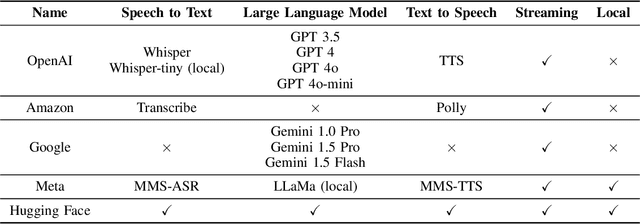
Recent developments in computer graphics, machine learning, and sensor technologies enable numerous opportunities for extended reality (XR) setups for everyday life, from skills training to entertainment. With large corporations offering consumer-grade head-mounted displays (HMDs) in an affordable way, it is likely that XR will become pervasive, and HMDs will develop as personal devices like smartphones and tablets. However, having intelligent spaces and naturalistic interactions in XR is as important as technological advances so that users grow their engagement in virtual and augmented spaces. To this end, large language model (LLM)--powered non-player characters (NPCs) with speech-to-text (STT) and text-to-speech (TTS) models bring significant advantages over conventional or pre-scripted NPCs for facilitating more natural conversational user interfaces (CUIs) in XR. In this paper, we provide the community with an open-source, customizable, extensible, and privacy-aware Unity package, CUIfy, that facilitates speech-based NPC-user interaction with various LLMs, STT, and TTS models. Our package also supports multiple LLM-powered NPCs per environment and minimizes the latency between different computational models through streaming to achieve usable interactions between users and NPCs. We publish our source code in the following repository: https://gitlab.lrz.de/hctl/cuify