 Add to Chrome
 Add to Firefox
 Add to Edge
Evaluation of Conversational Agents: Understanding Culture, Context and Environment in Emotion Detection
May 28, 2026
Valuable decisions and highly prioritized analysis now depend on applications such as facial biometrics, social media photo tagging, and human robots interactions. However, the ability to successfully deploy such applications is based on their efficiencies on tested use cases taking into consideration possible edge cases. Over the years, lots of generalized solutions have been implemented to mimic human emotions including sarcasm. However, factors such as geographical location or cultural difference have not been explored fully amidst its relevance in resolving ethical issues and improving conversational AI (Artificial Intelligence). In this paper, we seek to address the potential challenges in the usage of conversational AI within Black African society. We develop an emotion prediction model with accuracies ranging between 85% and 96%. Our model combines both speech and image data to detect the seven basic emotions with a focus on also identifying sarcasm. It uses 3-layers of the Convolutional Neural Network in addition to a new Audio-Frame Mean Expression (AFME) algorithm and focuses on model pre-processing and post-processing stages. In the end, our proposed solution contributes to maintaining the credibility of an emotion recognition system in conversational AIs.
* IEEE paper on arxiv

CUIfy the XR: An Open-Source Package to Embed LLM-powered Conversational Agents in XR
Nov 07, 2024
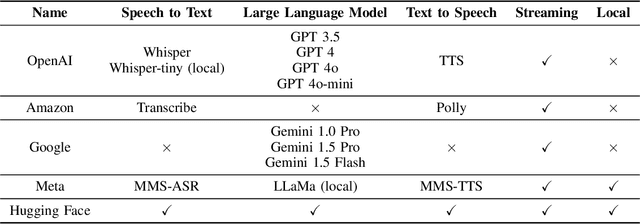
Recent developments in computer graphics, machine learning, and sensor technologies enable numerous opportunities for extended reality (XR) setups for everyday life, from skills training to entertainment. With large corporations offering consumer-grade head-mounted displays (HMDs) in an affordable way, it is likely that XR will become pervasive, and HMDs will develop as personal devices like smartphones and tablets. However, having intelligent spaces and naturalistic interactions in XR is as important as technological advances so that users grow their engagement in virtual and augmented spaces. To this end, large language model (LLM)--powered non-player characters (NPCs) with speech-to-text (STT) and text-to-speech (TTS) models bring significant advantages over conventional or pre-scripted NPCs for facilitating more natural conversational user interfaces (CUIs) in XR. In this paper, we provide the community with an open-source, customizable, extensible, and privacy-aware Unity package, CUIfy, that facilitates speech-based NPC-user interaction with various LLMs, STT, and TTS models. Our package also supports multiple LLM-powered NPCs per environment and minimizes the latency between different computational models through streaming to achieve usable interactions between users and NPCs. We publish our source code in the following repository: https://gitlab.lrz.de/hctl/cuify