 Add to Chrome
 Add to Firefox
 Add to Edge
Can Tabular In-Context Learners Generalize to Biomolecular Property Prediction?
Jun 30, 2026
Predicting biomolecular properties from limited labeled data is a central bottleneck in protein engineering and small-molecule design. As strong pretrained encoders now supply rich fixed-length representations, the difficulty has shifted from representation learning to building a data-efficient predictor for the few-shot regime. Tabular foundation models such as TabPFN3 and TabICL are unlikely candidates for this role: they are in-context learners pretrained on synthetic tables drawn from random causal graphs, a generative prior with no obvious correspondence to the processes that produce protein sequences or molecular graphs. That this tabular, causal inductive bias should transfer to biomolecular data at all is unintuitive, yet we find it does. Treating each method as a predictor-representation pair, we evaluate across two domains. Over a fixed ESMC representation, tabular in-context learning is consistently competitive for protein fitness regression on ProteinGym and a diverse esterase dataset. For small-molecule classification with ECFP/RDKit descriptors, no single pairing dominates across TDC ADMET, MoleculeNet, FS-Mol, and DrugOOD; representation choice becomes a primary determinant, as expected when the predictor's own prior is indifferent to molecular structure. We conclude that tabular foundation models are strong performers on biomolecular prediction tasks, but that their performance depends strongly on the sequence or molecular representation used.

Active Flow Matching
Mar 01, 2026Discrete diffusion and flow matching models capture complex, non-additive and non-autoregressive structure in high-dimensional objective landscapes through parallel, iterative refinement. However, their implicit generative nature precludes direct integration with principled variational frameworks for online black-box optimisation, such as variational search distributions (VSD) and conditioning by adaptive sampling (CbAS). We introduce Active Flow Matching (AFM), which reformulates variational objectives to operate on conditional endpoint distributions along the flow, enabling gradient-based steering of flow models toward high-fitness regions while preserving the rigour of VSD and CbAS. We derive forward and reverse Kullback-Leibler (KL) variants using self-normalised importance sampling. Across a suite of online protein and small molecule design tasks, forward-KL AFM consistently performs competitively compared to state-of-the-art baselines, demonstrating effective exploration-exploitation under tight experimental budgets.
Flowette: Flow Matching with Graphette Priors for Graph Generation
Feb 27, 2026We study generative modeling of graphs with recurring subgraph motifs. We propose Flowette, a continuous flow matching framework, that employs a graph neural network based transformer to learn a velocity field defined over graph representations with node and edge attributes. Our model preserves topology through optimal transport based coupling, and long-range structural dependencies through regularisation. To incorporate domain driven structural priors, we introduce graphettes, a new probabilistic family of graph structure models that generalize graphons via controlled structural edits for motifs like rings, stars and trees. We theoretically analyze the coupling, invariance, and structural properties of the proposed framework, and empirically evaluate it on synthetic and small-molecule graph generation tasks. Flowette demonstrates consistent improvements, highlighting the effectiveness of combining structural priors with flow-based training for modeling complex graph distributions.
Causal Preference Elicitation
Feb 01, 2026We propose causal preference elicitation, a Bayesian framework for expert-in-the-loop causal discovery that actively queries local edge relations to concentrate a posterior over directed acyclic graphs (DAGs). From any black-box observational posterior, we model noisy expert judgments with a three-way likelihood over edge existence and direction. Posterior inference uses a flexible particle approximation, and queries are selected by an efficient expected information gain criterion on the expert's categorical response. Experiments on synthetic graphs, protein signaling data, and a human gene perturbation benchmark show faster posterior concentration and improved recovery of directed effects under tight query budgets.
Variational Search Distributions
Sep 10, 2024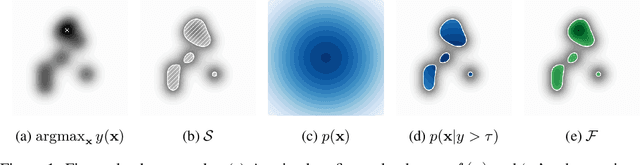
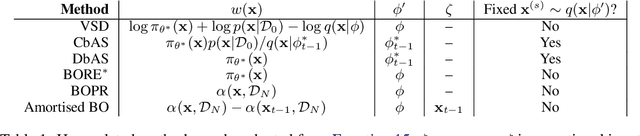
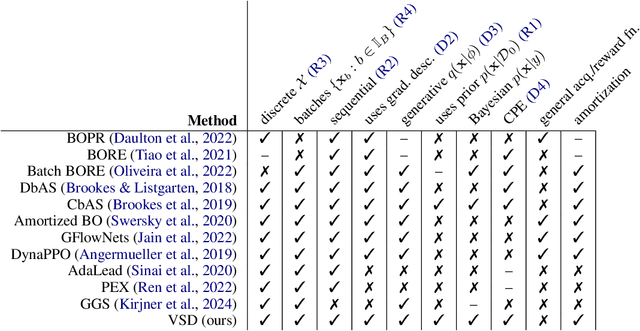
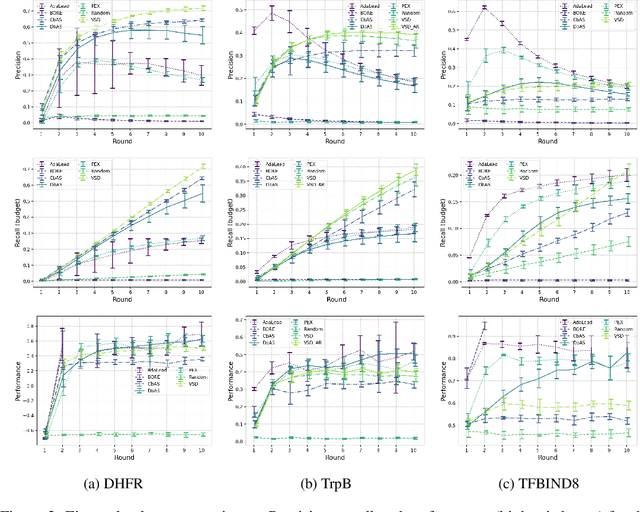
We develop variational search distributions (VSD), a method for finding discrete, combinatorial designs of a rare desired class in a batch sequential manner with a fixed experimental budget. We formalize the requirements and desiderata for this problem and formulate a solution via variational inference that fulfill these. In particular, VSD uses off-the-shelf gradient based optimization routines, and can take advantage of scalable predictive models. We show that VSD can outperform existing baseline methods on a set of real sequence-design problems in various biological systems.