 Add to Chrome
 Add to Firefox
 Add to Edge
Fully Automatic Trace Gas Plume Detection
May 05, 2026
Future imaging spectrometers will increase data volumes by orders of magnitude, requiring automated detection of trace gas point sources. We present a fully automated framework that combines machine learning-based morphological analysis with physics-based spectroscopic fitting to detect plumes without human participation. Applied to EMIT imaging spectrometer data, the system operates in two modes: "daily digest" that runs automatically on all downlinked data, flagging the largest events for immediate response, and a retrospective analysis that identifies plumes missed by prior human review. The daily digest demonstrates that a significant fraction of the largest plumes can be detected automatically with negligible false positives, while retrospective analysis suggests at least 25% of plumes may have been overlooked. In addition to the previously observed methane point sources, we extend detection to three understudied trace gases: NH3, NO2 and the first observations of carbon monoxide (CO) plume in EMIT imagery.

Impact of Scene-Specific Enhancement Spectra on Matched Filter Greenhouse Gas Retrievals from Imaging Spectroscopy
Jun 25, 2021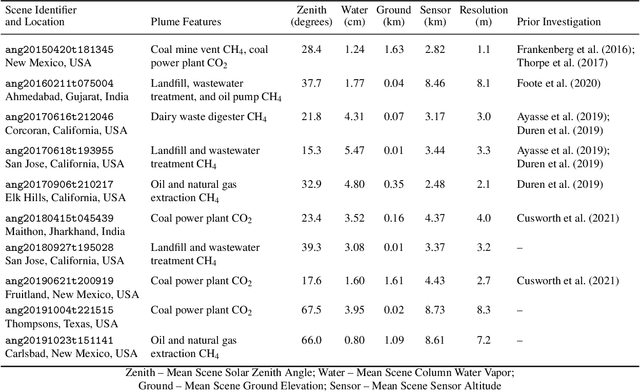
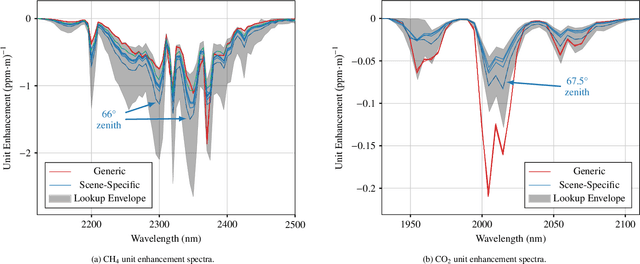
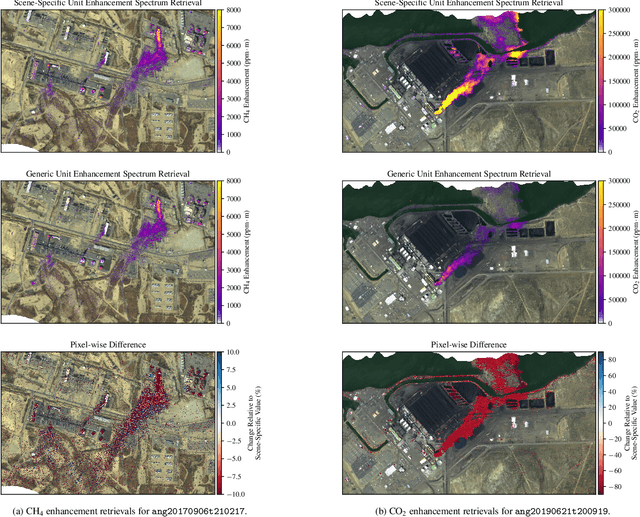
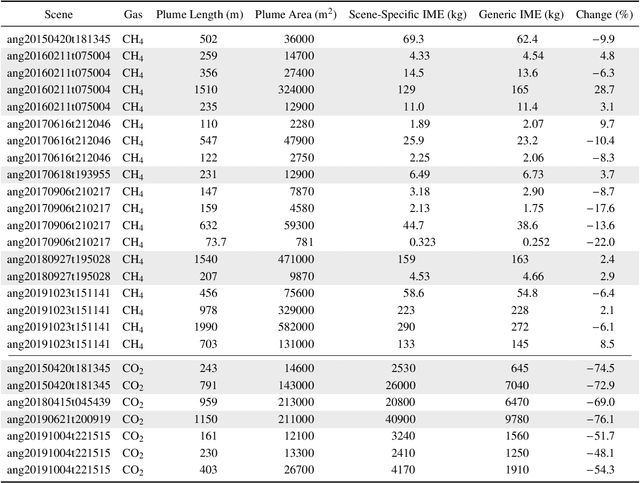
Matched filter (MF) techniques have been widely used for retrieval of greenhouse gas enhancements (enh.) from imaging spectroscopy datasets. While multiple algorithmic techniques and refinements have been proposed, the greenhouse gas target spectrum used for concentration enh. estimation has remained largely unaltered since the introduction of quantitative MF retrievals. The magnitude of retrieved methane and carbon dioxide enh., and thereby integrated mass enh. (IME) and estimated flux of point-source emitters, is heavily dependent on this target spectrum. Current standard use of molecular absorption coefficients to create unit enh. target spectra does not account for absorption by background concentrations of greenhouse gases, solar and sensor geometry, or atmospheric water vapor absorption. We introduce geometric and atmospheric parameters into the generation of scene-specific (SS) unit enh. spectra to provide target spectra that are compatible with all greenhouse gas retrieval MF techniques. For methane plumes, IME resulting from use of standard, generic enh. spectra varied from -22 to +28.7% compared to SS enh. spectra. Due to differences in spectral shape between the generic and SS enh. spectra, differences in methane plume IME were linked to surface spectral characteristics in addition to geometric and atmospheric parameters. IME differences for carbon dioxide plumes, with generic enh. spectra producing integrated mass enh. -76.1 to -48.1% compared to SS enh. spectra. Fluxes calculated from these integrated enh. would vary by the same %s, assuming equivalent wind conditions. Methane and carbon dioxide IME were most sensitive to changes in solar zenith angle and ground elevation. SS target spectra can improve confidence in greenhouse gas retrievals and flux estimates across collections of scenes with diverse geometric and atmospheric conditions.