 Add to Chrome
 Add to Firefox
 Add to Edge
Global monitoring of methane point sources using deep learning on hyperspectral radiance measurements from EMIT
Apr 11, 2026
Anthropogenic methane (CH4) point sources drive near-term climate forcing, safety hazards, and system inefficiencies. Space-based imaging spectroscopy is emerging as a tool for identifying emissions globally, but existing approaches largely rely on manual plume identification. Here we present the Methane Analysis and Plume Localization with EMIT (MAPL-EMIT) model, an end-to-end vision transformer framework that leverages the complete radiance spectrum from the Earth Surface Mineral Dust Source Investigation (EMIT) instrument to jointly retrieve methane enhancements across all pixels within a scene. This approach brings together spectral and spatial context to significantly lower detection limits. MAPL-EMIT simultaneously supports enhancement quantification, plume delineation, and source localization, even for multiple overlapping plumes. The model was trained on 3.6 million physics-based synthetic plumes injected into global EMIT radiance data. Synthetic evaluation confirms the model's ability to identify plumes with high recall and precision and to capture weaker plumes relative to existing matched-filter approaches. On real-world benchmarks, MAPL-EMIT captures 79% of known hand-annotated NASA L2B plume complexes across a test set of 1084 EMIT granules, while capturing twice as many plausible plumes than identified by human analysts. Further validation against coincident airborne data, top-emitting landfills, and controlled release experiments confirms the model's ability to identify previously uncaptured sources. By incorporating model-generated metrics such as spectral fit scores and estimated noise levels, the framework can further limit false-positive rates. Overall, MAPL-EMIT enables high-throughput implementation on the full EMIT catalog, shifting methane monitoring from labor-intensive workflows to a rapid, scalable paradigm for global plume mapping at the facility scale.

Towards Operational Automated Greenhouse Gas Plume Detection
May 27, 2025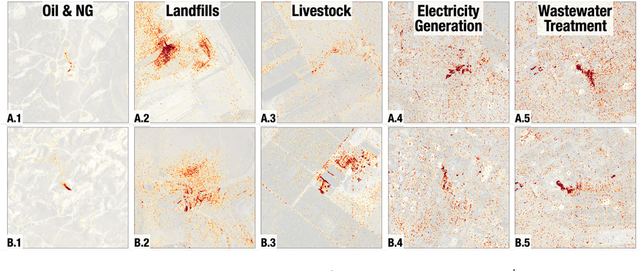
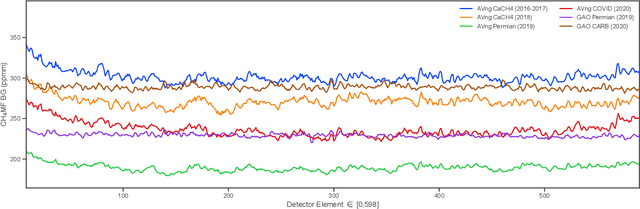
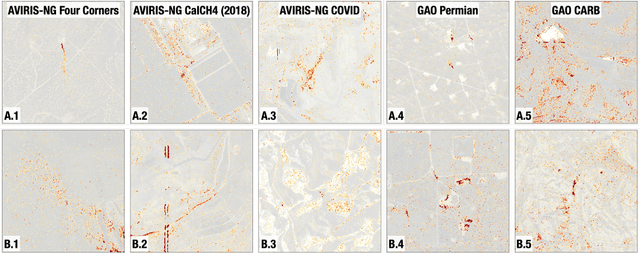
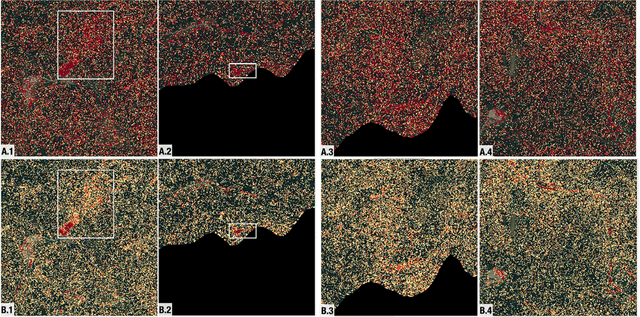
Operational deployment of a fully automated greenhouse gas (GHG) plume detection system remains an elusive goal for imaging spectroscopy missions, despite recent advances in deep learning approaches. With the dramatic increase in data availability, however, automation continues to increase in importance for natural and anthropogenic emissions monitoring. This work reviews and addresses several key obstacles in the field: data and label quality control, prevention of spatiotemporal biases, and correctly aligned modeling objectives. We demonstrate through rigorous experiments using multicampaign data from airborne and spaceborne instruments that convolutional neural networks (CNNs) are able to achieve operational detection performance when these obstacles are alleviated. We demonstrate that a multitask model that learns both instance detection and pixelwise segmentation simultaneously can successfully lead towards an operational pathway. We evaluate the model's plume detectability across emission source types and regions, identifying thresholds for operational deployment. Finally, we provide analysis-ready data, models, and source code for reproducibility, and work to define a set of best practices and validation standards to facilitate future contributions to the field.
Impact of Scene-Specific Enhancement Spectra on Matched Filter Greenhouse Gas Retrievals from Imaging Spectroscopy
Jun 25, 2021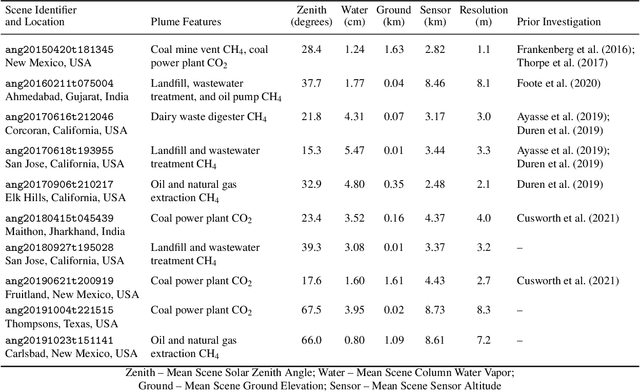
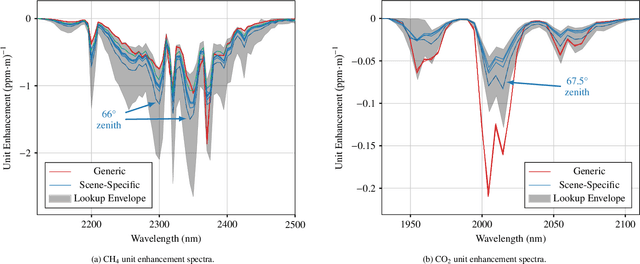
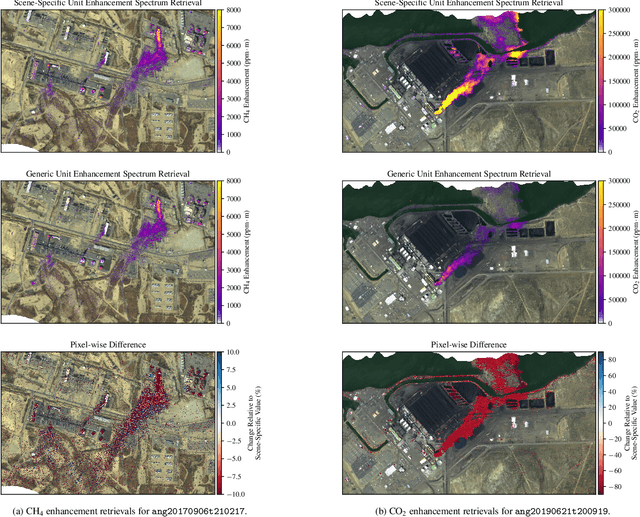
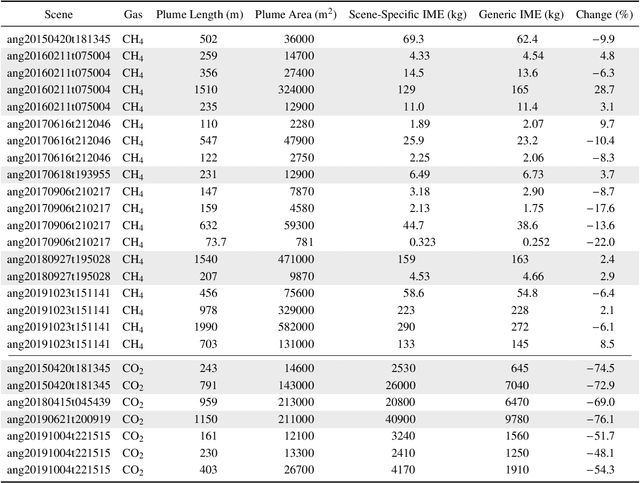
Matched filter (MF) techniques have been widely used for retrieval of greenhouse gas enhancements (enh.) from imaging spectroscopy datasets. While multiple algorithmic techniques and refinements have been proposed, the greenhouse gas target spectrum used for concentration enh. estimation has remained largely unaltered since the introduction of quantitative MF retrievals. The magnitude of retrieved methane and carbon dioxide enh., and thereby integrated mass enh. (IME) and estimated flux of point-source emitters, is heavily dependent on this target spectrum. Current standard use of molecular absorption coefficients to create unit enh. target spectra does not account for absorption by background concentrations of greenhouse gases, solar and sensor geometry, or atmospheric water vapor absorption. We introduce geometric and atmospheric parameters into the generation of scene-specific (SS) unit enh. spectra to provide target spectra that are compatible with all greenhouse gas retrieval MF techniques. For methane plumes, IME resulting from use of standard, generic enh. spectra varied from -22 to +28.7% compared to SS enh. spectra. Due to differences in spectral shape between the generic and SS enh. spectra, differences in methane plume IME were linked to surface spectral characteristics in addition to geometric and atmospheric parameters. IME differences for carbon dioxide plumes, with generic enh. spectra producing integrated mass enh. -76.1 to -48.1% compared to SS enh. spectra. Fluxes calculated from these integrated enh. would vary by the same %s, assuming equivalent wind conditions. Methane and carbon dioxide IME were most sensitive to changes in solar zenith angle and ground elevation. SS target spectra can improve confidence in greenhouse gas retrievals and flux estimates across collections of scenes with diverse geometric and atmospheric conditions.