 Add to Chrome
 Add to Firefox
 Add to Edge
EXIM: A Hybrid Explicit-Implicit Representation for Text-Guided 3D Shape Generation
Nov 03, 2023
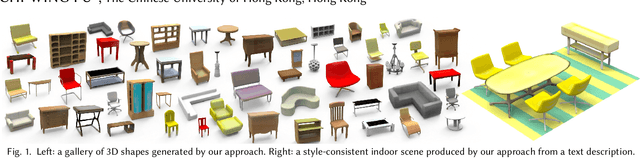
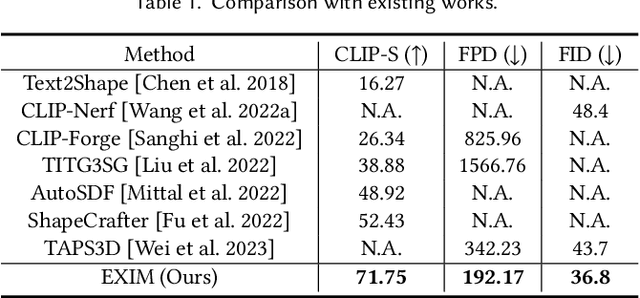
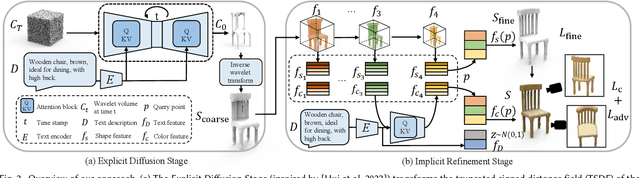
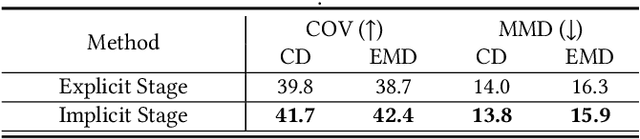
This paper presents a new text-guided technique for generating 3D shapes. The technique leverages a hybrid 3D shape representation, namely EXIM, combining the strengths of explicit and implicit representations. Specifically, the explicit stage controls the topology of the generated 3D shapes and enables local modifications, whereas the implicit stage refines the shape and paints it with plausible colors. Also, the hybrid approach separates the shape and color and generates color conditioned on shape to ensure shape-color consistency. Unlike the existing state-of-the-art methods, we achieve high-fidelity shape generation from natural-language descriptions without the need for time-consuming per-shape optimization or reliance on human-annotated texts during training or test-time optimization. Further, we demonstrate the applicability of our approach to generate indoor scenes with consistent styles using text-induced 3D shapes. Through extensive experiments, we demonstrate the compelling quality of our results and the high coherency of our generated shapes with the input texts, surpassing the performance of existing methods by a significant margin. Codes and models are released at https://github.com/liuzhengzhe/EXIM.

Noise-Free Score Distillation
Oct 26, 2023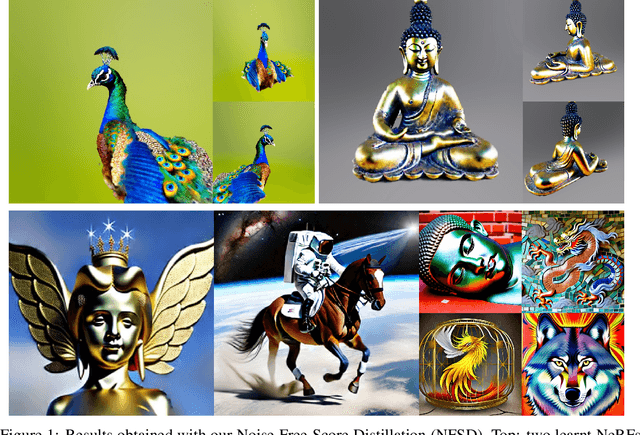
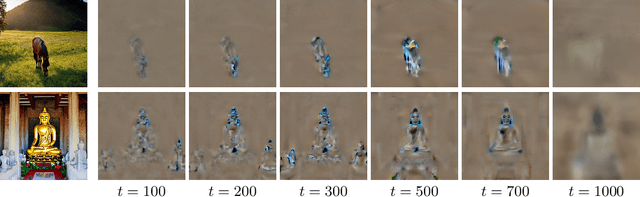
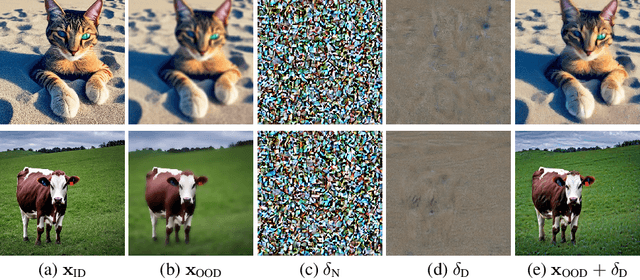
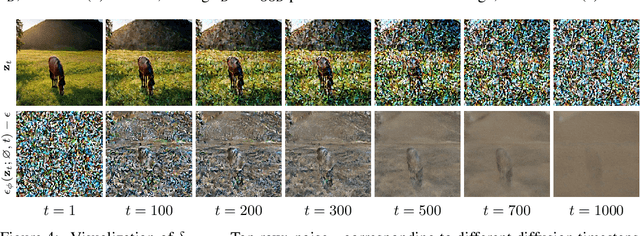
Score Distillation Sampling (SDS) has emerged as the de facto approach for text-to-content generation in non-image domains. In this paper, we reexamine the SDS process and introduce a straightforward interpretation that demystifies the necessity for large Classifier-Free Guidance (CFG) scales, rooted in the distillation of an undesired noise term. Building upon our interpretation, we propose a novel Noise-Free Score Distillation (NFSD) process, which requires minimal modifications to the original SDS framework. Through this streamlined design, we achieve more effective distillation of pre-trained text-to-image diffusion models while using a nominal CFG scale. This strategic choice allows us to prevent the over-smoothing of results, ensuring that the generated data is both realistic and complies with the desired prompt. To demonstrate the efficacy of NFSD, we provide qualitative examples that compare NFSD and SDS, as well as several other methods.
MAS: Multi-view Ancestral Sampling for 3D motion generation using 2D diffusion
Oct 23, 2023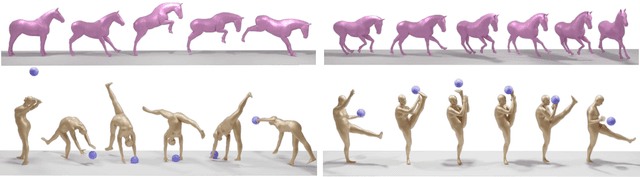

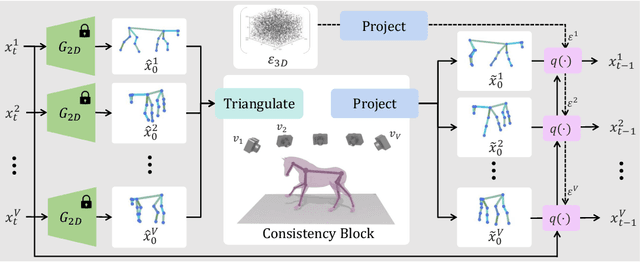
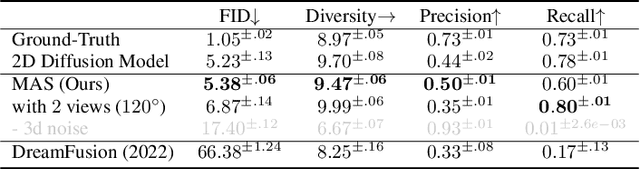
We introduce Multi-view Ancestral Sampling (MAS), a method for generating consistent multi-view 2D samples of a motion sequence, enabling the creation of its 3D counterpart. MAS leverages a diffusion model trained solely on 2D data, opening opportunities to exciting and diverse fields of motion previously under-explored as 3D data is scarce and hard to collect. MAS works by simultaneously denoising multiple 2D motion sequences representing the same motion from different angles. Our consistency block ensures consistency across all views at each diffusion step by combining the individual generations into a unified 3D sequence, and projecting it back to the original views for the next iteration. We demonstrate MAS on 2D pose data acquired from videos depicting professional basketball maneuvers, rhythmic gymnastic performances featuring a ball apparatus, and horse obstacle course races. In each of these domains, 3D motion capture is arduous, and yet, MAS generates diverse and realistic 3D sequences without textual conditioning. As we demonstrate, our ancestral sampling-based approach offers a more natural integration with the diffusion framework compared to popular denoising optimization-based approaches, and avoids common issues such as out-of-domain sampling, lack of details and mode-collapse. https://guytevet.github.io/mas-page/
ConceptLab: Creative Generation using Diffusion Prior Constraints
Aug 03, 2023Recent text-to-image generative models have enabled us to transform our words into vibrant, captivating imagery. The surge of personalization techniques that has followed has also allowed us to imagine unique concepts in new scenes. However, an intriguing question remains: How can we generate a new, imaginary concept that has never been seen before? In this paper, we present the task of creative text-to-image generation, where we seek to generate new members of a broad category (e.g., generating a pet that differs from all existing pets). We leverage the under-studied Diffusion Prior models and show that the creative generation problem can be formulated as an optimization process over the output space of the diffusion prior, resulting in a set of "prior constraints". To keep our generated concept from converging into existing members, we incorporate a question-answering model that adaptively adds new constraints to the optimization problem, encouraging the model to discover increasingly more unique creations. Finally, we show that our prior constraints can also serve as a strong mixing mechanism allowing us to create hybrids between generated concepts, introducing even more flexibility into the creative process.
EmoSet: A Large-scale Visual Emotion Dataset with Rich Attributes
Jul 28, 2023Visual Emotion Analysis (VEA) aims at predicting people's emotional responses to visual stimuli. This is a promising, yet challenging, task in affective computing, which has drawn increasing attention in recent years. Most of the existing work in this area focuses on feature design, while little attention has been paid to dataset construction. In this work, we introduce EmoSet, the first large-scale visual emotion dataset annotated with rich attributes, which is superior to existing datasets in four aspects: scale, annotation richness, diversity, and data balance. EmoSet comprises 3.3 million images in total, with 118,102 of these images carefully labeled by human annotators, making it five times larger than the largest existing dataset. EmoSet includes images from social networks, as well as artistic images, and it is well balanced between different emotion categories. Motivated by psychological studies, in addition to emotion category, each image is also annotated with a set of describable emotion attributes: brightness, colorfulness, scene type, object class, facial expression, and human action, which can help understand visual emotions in a precise and interpretable way. The relevance of these emotion attributes is validated by analyzing the correlations between them and visual emotion, as well as by designing an attribute module to help visual emotion recognition. We believe EmoSet will bring some key insights and encourage further research in visual emotion analysis and understanding. Project page: https://vcc.tech/EmoSet.
Domain-Agnostic Tuning-Encoder for Fast Personalization of Text-To-Image Models
Jul 13, 2023Text-to-image (T2I) personalization allows users to guide the creative image generation process by combining their own visual concepts in natural language prompts. Recently, encoder-based techniques have emerged as a new effective approach for T2I personalization, reducing the need for multiple images and long training times. However, most existing encoders are limited to a single-class domain, which hinders their ability to handle diverse concepts. In this work, we propose a domain-agnostic method that does not require any specialized dataset or prior information about the personalized concepts. We introduce a novel contrastive-based regularization technique to maintain high fidelity to the target concept characteristics while keeping the predicted embeddings close to editable regions of the latent space, by pushing the predicted tokens toward their nearest existing CLIP tokens. Our experimental results demonstrate the effectiveness of our approach and show how the learned tokens are more semantic than tokens predicted by unregularized models. This leads to a better representation that achieves state-of-the-art performance while being more flexible than previous methods.
Facial Reenactment Through a Personalized Generator
Jul 12, 2023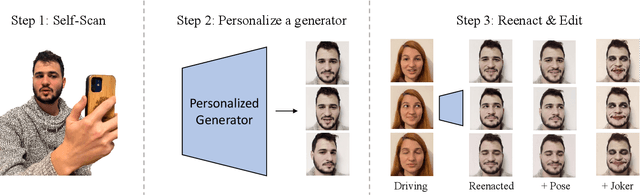
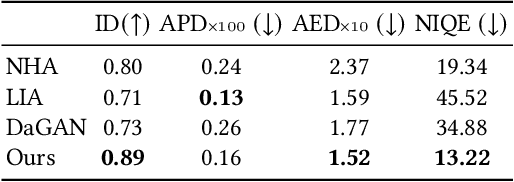
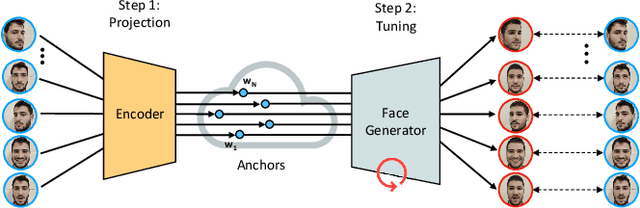
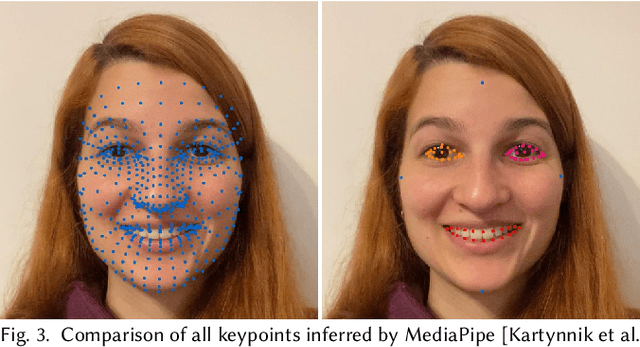
In recent years, the role of image generative models in facial reenactment has been steadily increasing. Such models are usually subject-agnostic and trained on domain-wide datasets. The appearance of the reenacted individual is learned from a single image, and hence, the entire breadth of the individual's appearance is not entirely captured, leading these methods to resort to unfaithful hallucination. Thanks to recent advancements, it is now possible to train a personalized generative model tailored specifically to a given individual. In this paper, we propose a novel method for facial reenactment using a personalized generator. We train the generator using frames from a short, yet varied, self-scan video captured using a simple commodity camera. Images synthesized by the personalized generator are guaranteed to preserve identity. The premise of our work is that the task of reenactment is thus reduced to accurately mimicking head poses and expressions. To this end, we locate the desired frames in the latent space of the personalized generator using carefully designed latent optimization. Through extensive evaluation, we demonstrate state-of-the-art performance for facial reenactment. Furthermore, we show that since our reenactment takes place in a semantic latent space, it can be semantically edited and stylized in post-processing.
SVNR: Spatially-variant Noise Removal with Denoising Diffusion
Jun 28, 2023Denoising diffusion models have recently shown impressive results in generative tasks. By learning powerful priors from huge collections of training images, such models are able to gradually modify complete noise to a clean natural image via a sequence of small denoising steps, seemingly making them well-suited for single image denoising. However, effectively applying denoising diffusion models to removal of realistic noise is more challenging than it may seem, since their formulation is based on additive white Gaussian noise, unlike noise in real-world images. In this work, we present SVNR, a novel formulation of denoising diffusion that assumes a more realistic, spatially-variant noise model. SVNR enables using the noisy input image as the starting point for the denoising diffusion process, in addition to conditioning the process on it. To this end, we adapt the diffusion process to allow each pixel to have its own time embedding, and propose training and inference schemes that support spatially-varying time maps. Our formulation also accounts for the correlation that exists between the condition image and the samples along the modified diffusion process. In our experiments we demonstrate the advantages of our approach over a strong diffusion model baseline, as well as over a state-of-the-art single image denoising method.
SENS: Sketch-based Implicit Neural Shape Modeling
Jun 09, 2023We present SENS, a novel method for generating and editing 3D models from hand-drawn sketches, including those of an abstract nature. Our method allows users to quickly and easily sketch a shape, and then maps the sketch into the latent space of a part-aware neural implicit shape architecture. SENS analyzes the sketch and encodes its parts into ViT patch encoding, then feeds them into a transformer decoder that converts them to shape embeddings, suitable for editing 3D neural implicit shapes. SENS not only provides intuitive sketch-based generation and editing, but also excels in capturing the intent of the user's sketch to generate a variety of novel and expressive 3D shapes, even from abstract sketches. We demonstrate the effectiveness of our model compared to the state-of-the-art using objective metric evaluation criteria and a decisive user study, both indicating strong performance on sketches with a medium level of abstraction. Furthermore, we showcase its intuitive sketch-based shape editing capabilities.
Concept Decomposition for Visual Exploration and Inspiration
May 31, 2023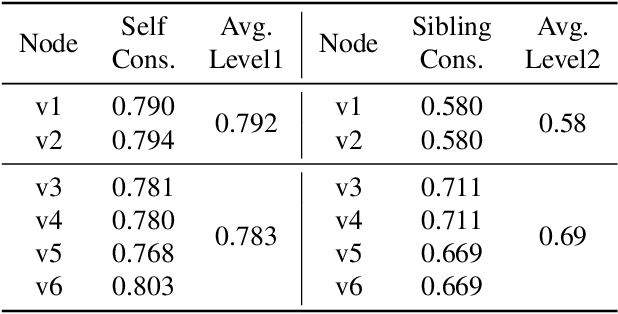
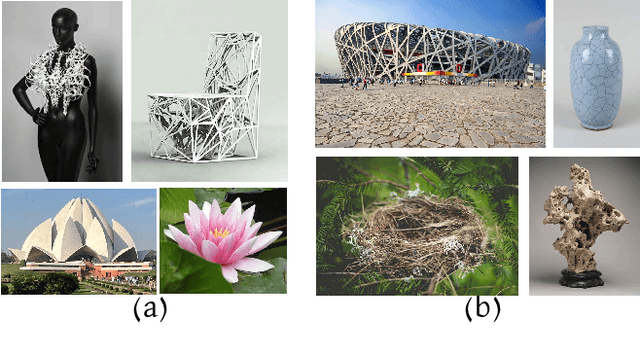
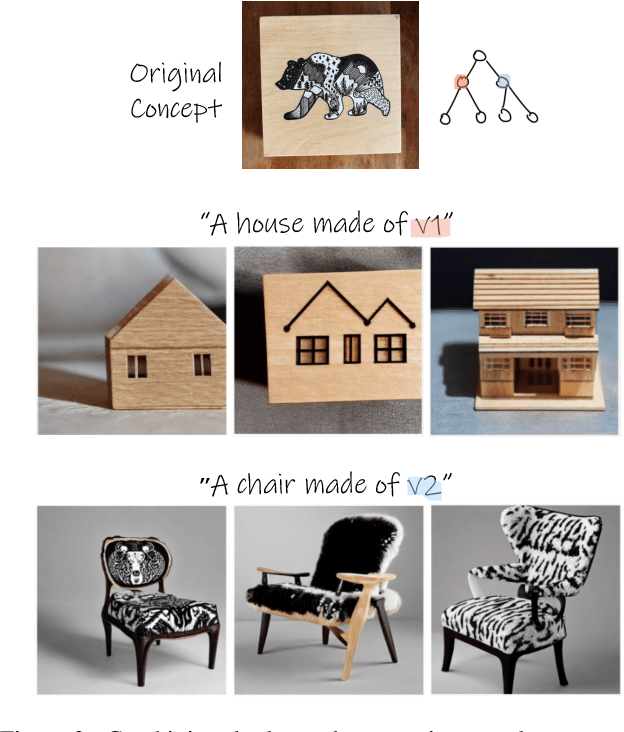
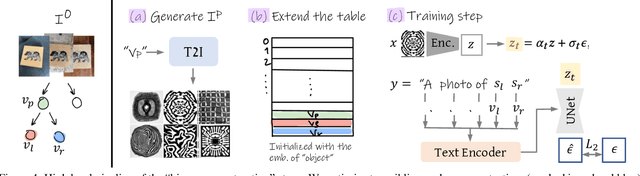
A creative idea is often born from transforming, combining, and modifying ideas from existing visual examples capturing various concepts. However, one cannot simply copy the concept as a whole, and inspiration is achieved by examining certain aspects of the concept. Hence, it is often necessary to separate a concept into different aspects to provide new perspectives. In this paper, we propose a method to decompose a visual concept, represented as a set of images, into different visual aspects encoded in a hierarchical tree structure. We utilize large vision-language models and their rich latent space for concept decomposition and generation. Each node in the tree represents a sub-concept using a learned vector embedding injected into the latent space of a pretrained text-to-image model. We use a set of regularizations to guide the optimization of the embedding vectors encoded in the nodes to follow the hierarchical structure of the tree. Our method allows to explore and discover new concepts derived from the original one. The tree provides the possibility of endless visual sampling at each node, allowing the user to explore the hidden sub-concepts of the object of interest. The learned aspects in each node can be combined within and across trees to create new visual ideas, and can be used in natural language sentences to apply such aspects to new designs.