 Add to Chrome
 Add to Firefox
 Add to Edge
JEPA-DNA: Grounding Genomic Foundation Models through Joint-Embedding Predictive Architectures
Feb 19, 2026
Genomic Foundation Models (GFMs) have largely relied on Masked Language Modeling (MLM) or Next Token Prediction (NTP) to learn the language of life. While these paradigms excel at capturing local genomic syntax and fine-grained motif patterns, they often fail to capture the broader functional context, resulting in representations that lack a global biological perspective. We introduce JEPA-DNA, a novel pre-training framework that integrates the Joint-Embedding Predictive Architecture (JEPA) with traditional generative objectives. JEPA-DNA introduces latent grounding by coupling token-level recovery with a predictive objective in the latent space by supervising a CLS token. This forces the model to predict the high-level functional embeddings of masked genomic segments rather than focusing solely on individual nucleotides. JEPA-DNA extends both NTP and MLM paradigms and can be deployed either as a standalone from-scratch objective or as a continual pre-training enhancement for existing GFMs. Our evaluations across a diverse suite of genomic benchmarks demonstrate that JEPA-DNA consistently yields superior performance in supervised and zero-shot tasks compared to generative-only baselines. By providing a more robust and biologically grounded representation, JEPA-DNA offers a scalable path toward foundation models that understand not only the genomic alphabet, but also the underlying functional logic of the sequence.

Cards Against AI: Predicting Humor in a Fill-in-the-blank Party Game
Oct 24, 2022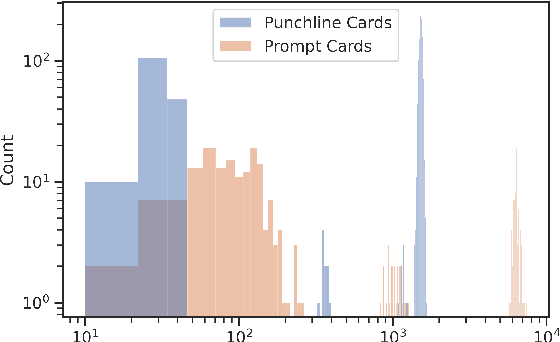
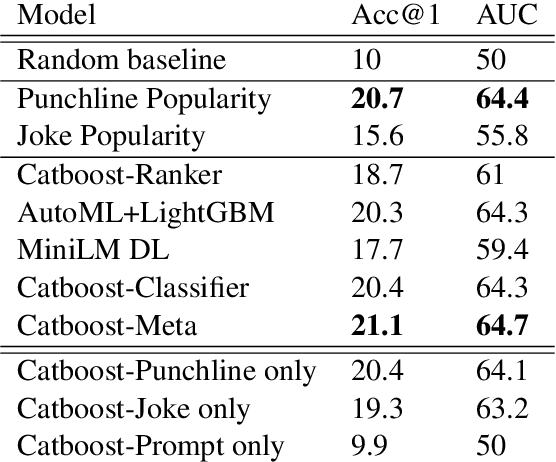
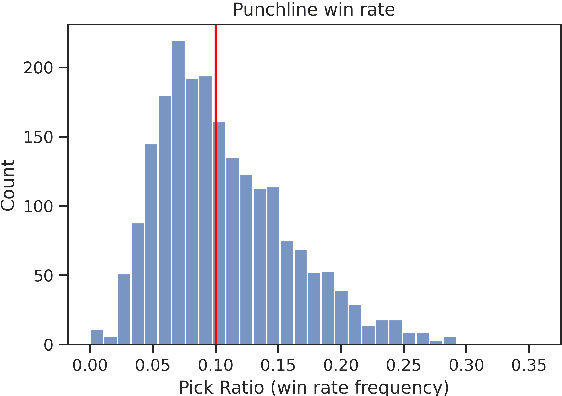
Humor is an inherently social phenomenon, with humorous utterances shaped by what is socially and culturally accepted. Understanding humor is an important NLP challenge, with many applications to human-computer interactions. In this work we explore humor in the context of Cards Against Humanity -- a party game where players complete fill-in-the-blank statements using cards that can be offensive or politically incorrect. We introduce a novel dataset of 300,000 online games of Cards Against Humanity, including 785K unique jokes, analyze it and provide insights. We trained machine learning models to predict the winning joke per game, achieving performance twice as good (20\%) as random, even without any user information. On the more difficult task of judging novel cards, we see the models' ability to generalize is moderate. Interestingly, we find that our models are primarily focused on punchline card, with the context having little impact. Analyzing feature importance, we observe that short, crude, juvenile punchlines tend to win.