 Add to Chrome
 Add to Firefox
 Add to Edge
From Optimizable to Interactable: Mixed Digital Twin-Empowered Testing of Vehicle-Infrastructure Cooperation Systems
Mar 19, 2026
Sufficient testing under corner cases is critical for the long-term operation of vehicle-infrastructure cooperation systems (VICS). However, existing corner-case generation methods are primarily AI-driven, and VICS testing under corner cases is typically limited to simulation. In this paper, we introduce an L5 ''Interactable'' level to the VICS digital twin (VICS-DT) taxonomy, extending beyond the conventional L4 ''Optimizable'' level. We further propose an L5-level VICS testing framework, IMPACT (Interactive Mixed-digital-twin Paradigm for Advanced Cooperative vehicle-infrastructure Testing). By enabling direct human interactions with VICS entities, IMPACT incorporates highly uncertain and unpredictable human behaviors into the testing loop, naturally generating high-quality corner cases that complement AI-based methods. Furthermore, the mixedDT-enabled ''Physical-Virtual Action Interaction'' facilitates safe VICS testing under corner cases, incorporating real-world environments and entities rather than purely in simulation. Finally, we implement IMPACT on the I-VIT (Interactive Vehicle-Infrastructure Testbed), and experiments demonstrate its effectiveness. The experimental videos are available at our project website: https://dongjh20.github.io/IMPACT.

Multi-Source Human-in-the-Loop Digital Twin Testbed for Connected and Autonomous Vehicles in Mixed Traffic Flow
Mar 18, 2026In the emerging mixed traffic environments, Connected and Autonomous Vehicles (CAVs) have to interact with surrounding human-driven vehicles (HDVs). This paper introduces MSH-MCCT (Multi-Source Human-in-the-Loop Mixed Cloud Control Testbed), a novel CAV testbed that captures complex interactions between various CAVs and HDVs. Utilizing the Mixed Digital Twin concept, which combines Mixed Reality with Digital Twin, MSH-MCCT integrates physical, virtual, and mixed platforms, along with multi-source control inputs. Bridged by the mixed platform, MSH-MCCT allows human drivers and CAV algorithms to operate both physical and virtual vehicles within multiple fields of view. Particularly, this testbed facilitates the coexistence and real-time interaction of physical and virtual CAVs \& HDVs, significantly enhancing the experimental flexibility and scalability. Experiments on vehicle platooning in mixed traffic showcase the potential of MSH-MCCT to conduct CAV testing with multi-source real human drivers in the loop through driving simulators of diverse fidelity. The videos for the experiments are available at our project website: https://dongjh20.github.io/MSH-MCCT.
Mixed Cloud Control Testbed: Validating Vehicle-Road-Cloud Integration via Mixed Digital Twin
Dec 05, 2022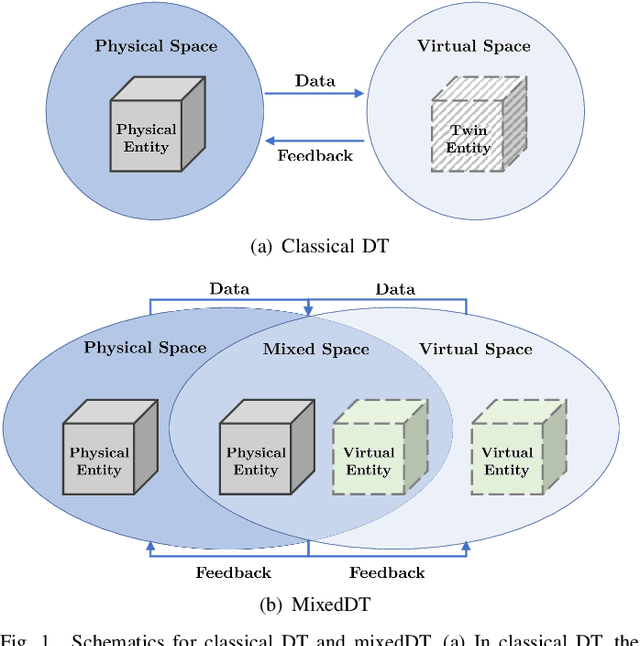
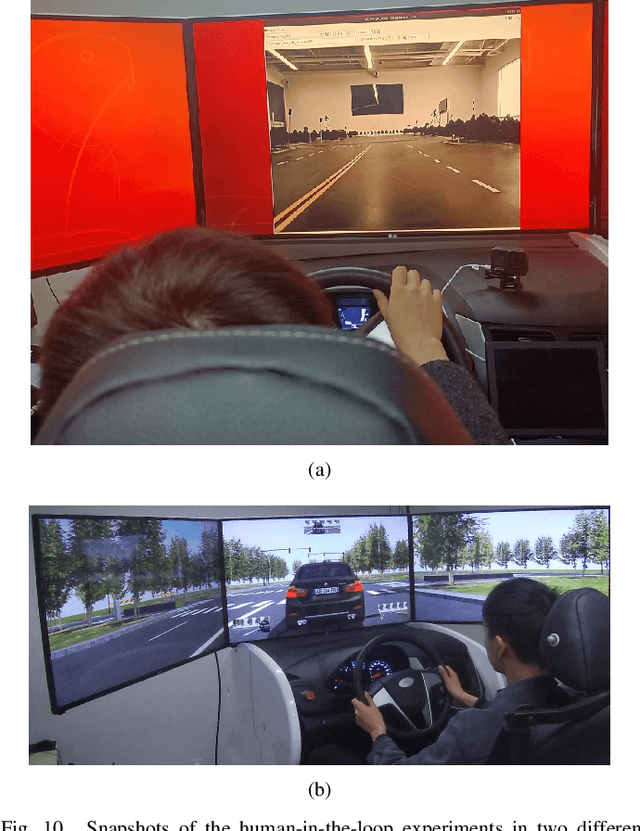
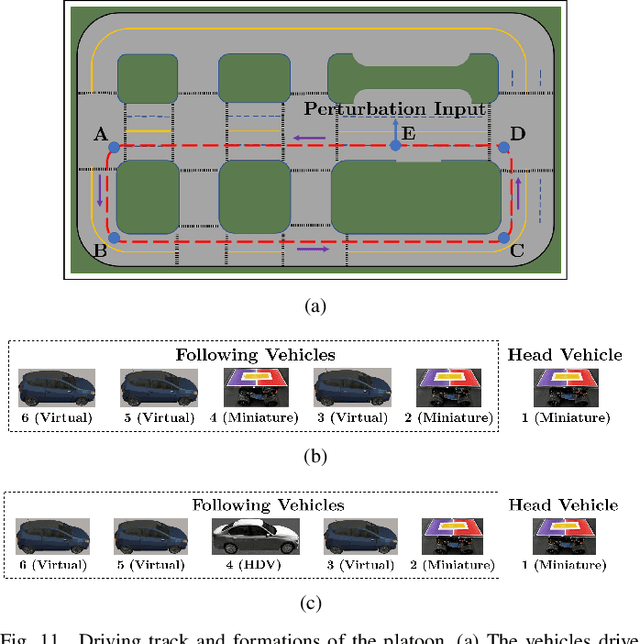

Reliable and efficient validation technologies are critical for the recent development of multi-vehicle cooperation and vehicle-road-cloud integration. In this paper, we introduce our miniature experimental platform, Mixed Cloud Control Testbed (MCCT), developed based on a new notion of Mixed Digital Twin (mixedDT). Combining Mixed Reality with Digital Twin, mixedDT integrates the virtual and physical spaces into a mixed one, where physical entities coexist and interact with virtual entities via their digital counterparts. Under the framework of mixedDT, MCCT contains three major experimental platforms in the physical, virtual and mixed spaces respectively, and provides a unified access for various human-machine interfaces and external devices such as driving simulators. A cloud unit, where the mixed experimental platform is deployed, is responsible for fusing multi-platform information and assigning control instructions, contributing to synchronous operation and real-time cross-platform interaction. Particularly, MCCT allows for multi-vehicle coordination composed of different multi-source vehicles (\eg, physical vehicles, virtual vehicles and human-driven vehicles). Validations on vehicle platooning demonstrate the flexibility and scalability of MCCT.