 Add to Chrome
 Add to Firefox
 Add to Edge
HiFA4: Training-Free 4-bit FlashAttention on Ascend HIF4 NPUs for LLM Inference
Jul 05, 2026
We present HiFA4, a post-training operator-level design that executes both QK^T and PV in FlashAttention as 4-bit HIF4 Cube GEMMs for LLM inference on Ascend NPUs, while maintaining the online softmax state in FP16. To our knowledge, HiFA4 is the first Ascend-HIF4-targeted design of this kind evaluated on standard NLP benchmarks. HiFA4 combines two mechanisms. Smooth-QK applies a calibration-static per-channel equivalent rescaling to Q and K after RoPE, transferring quantization difficulty from K to Q without per-tile online reduction at inference. P-Reordering accumulates the softmax normalizer from the same quantized attention weights P_hat used in the PV GEMM, rather than from a higher-precision reconstruction. We show that this inconsistent formulation introduces a coherent output-scaling error, and validate the effect on a Qwen3-8B Layer-0 MMLU trace, where all 3.6M measured attention tiles exhibit net probability-mass loss with median epsilon_bar = -0.064. P-Reordering also allows the normalizer to be fused into the PV Cube GEMM. Across five LLMs, HiFA4 reduces quantization-induced decision drift. On Qwen3-8B, it recovers 37.5% of the accuracy gap introduced by direct HIF4 quantization, narrows the sample-weighted accuracy loss from 1.12 pp to 0.70 pp, reduces BF16-inconsistent MMLU predictions from 16.3% to 8.2%, and cuts MMLU accuracy regressions by 57% (1071 to 465). On Gemma2-9B, mild smoothing keeps HiFA4 within 0.7 pp of BF16 while reducing MMLU regressions by 27%. On LLaMA3.1-8B, Mistral-7B, and Phi-4B, where Smooth-QK is disabled, P-Reordering with the adopted Q-Mean auxiliary still reduces full-set MMLU regressions by 41-52%. A preliminary instruction-scheduling analysis projects a 35.4% critical-path latency reduction relative to BF16 by fusing the softmax normalizer into the PV Cube GEMM; on-hardware validation is left to future work.

Training-free sparse attention based on cumulative energy filtering
Jun 15, 2026Sparse attention accelerates Diffusion Transformers (DiTs) for video generation by computing only the important tokens while skipping the rest. The token selection strategy is key to balancing sparsity and accuracy. We formulate the token filtering process as a dual-goal optimization problem: maximizing sparsity and minimizing accuracy degradation. Existing algorithms cannot fulfill both objectives simultaneously. For example, Top-p only considers the accuracy constraint, while Top-k maintains a fixed computational budget but loosens the accuracy constraint. This paper demonstrates that maintaining a fixed recall rate is sufficient for ensuring accuracy, whereas a fixed threshold is suboptimal for reducing computational cost. Therefore, we propose a dynamic thresholding scheme to improve sparsity while maintaining the same level of accuracy. Furthermore, our algorithm is deeply integrated with Flash Attention (FA), eliminating the need for any additional masking computation overhead. Experimental results on Wan 2.2 validate that, compared to the BLASST algorithm which is also integrated with FA, our dynamic thresholding strategy enhances sparsity from 61.42\% to 82\% with a VBench metric drop of less than 5\%. This results in an approximate 15\% in attention computation and a $1.61\times$ increase in computational efficiency, which is 1.18x higher than that of BLASST.
To fit or not to fit: Model-based Face Reconstruction and Occlusion Segmentation from Weak Supervision
Jun 17, 2021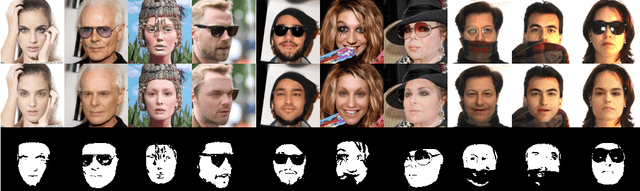


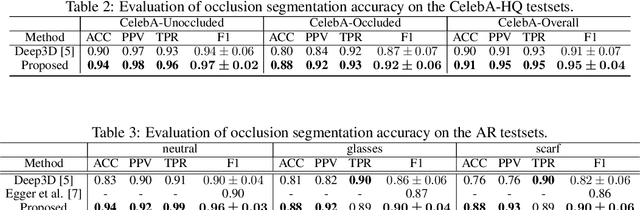
3D face reconstruction from a single image is challenging due to its ill-posed nature. Model-based face autoencoders address this issue effectively by fitting a face model to the target image in a weakly supervised manner. However, in unconstrained environments occlusions distort the face reconstruction because the model often erroneously tries to adapt to occluded face regions. Supervised occlusion segmentation is a viable solution to avoid the fitting of occluded face regions, but it requires a large amount of annotated training data. In this work, we enable model-based face autoencoders to segment occluders accurately without requiring any additional supervision during training, and this separates regions where the model will be fitted from those where it will not be fitted. To achieve this, we extend face autoencoders with a segmentation network. The segmentation network decides which regions the model should adapt to by reaching balances in a trade-off between including pixels and adapting the model to them, and excluding pixels so that the model fitting is not negatively affected and reaches higher overall reconstruction accuracy on pixels showing the face. This leads to a synergistic effect, in which the occlusion segmentation guides the training of the face autoencoder to constrain the fitting in the non-occluded regions, while the improved fitting enables the segmentation model to better predict the occluded face regions. Qualitative and quantitative experiments on the CelebA-HQ database and the AR database verify the effectiveness of our model in improving 3D face reconstruction under occlusions and in enabling accurate occlusion segmentation from weak supervision only. Code available at https://github.com/unibas-gravis/Occlusion-Robust-MoFA.