 Add to Chrome
 Add to Firefox
 Add to Edge
Prediction of Solar Flares Using Photospheric Magnetic Field Parameters with Deep Learning
Jun 20, 2026
Solar flares, particularly those of the M- and X-class, have a significant impact on human life because of their potential to disrupt critical infrastructure and communication systems on Earth. Accurate prediction of solar flares is crucial for mitigating these risks, but the black-box nature of conventional deep learning models used in flare prediction limits their trustworthiness and interpretability. In this paper, we propose a new approach to solar flare prediction using photospheric magnetic field parameters or features with deep learning. To improve model interpretability, we integrate explainable artificial intelligence (XAI) techniques, including SHapley Additive exPlanations (SHAP) and partial dependence plots (PDPs), into our prediction framework. XAI methods provide transparency by analyzing the importance and interactions of features used by our model. Specifically, SHAP values offer a global and local understanding of the features, while PDPs provide insights into feature-level trends. These techniques demonstrate the potential of XAI in deploying AI-driven solutions in high-impact applications such as solar flare prediction, paving the way for more informed decision-making in solar physics and space weather studies.

Deep Learning-Enabled Prediction of Geoeffective CMEs Using SOHO and SDO Observations
May 23, 2026Understanding and forecasting the geoeffectiveness of a coronal mass ejection (CME) is crucial for protecting infrastructure in the near-Earth space environment and on Earth. In this study, we present a novel fusion model to forecast the geoeffectiveness of CME events. Our model combines convolutional neural networks for feature learning and a prediction network for feature fusion and event classification. The model is trained by observations from instruments including the Large Angle Spectroscopic Coronagraph (LASCO) on board the Solar and Heliospheric Observatory (SOHO) and the Atmospheric Imaging Assembly (AIA) and Helioseismic and Magnetic Imager (HMI) on board the Solar Dynamics Observatory (SDO). The trained model is then used to predict whether an Earth-reaching CME will cause a geomagnetic storm and/or the probability that the CME will cause such a storm. Experimental results based on a five-fold cross validation scheme demonstrate the good performance of our fusion model, achieving a mean true skill statistic (TSS) score of 0.703 when the model is used as a deterministic prediction tool, and a mean Brier score of 0.095 when the model is used as a probabilistic forecasting tool, where a TSS score of 1 or a Brier score of 0 indicates perfect performance. This work contributes to forecasting the causal relationship between Earth-directed CMEs and geomagnetic storms in solar-terrestrial interactions.
TOM: An Open-Source Tongue Segmentation Method with Multi-Teacher Distillation and Task-Specific Data Augmentation
Aug 19, 2025Tongue imaging serves as a valuable diagnostic tool, particularly in Traditional Chinese Medicine (TCM). The quality of tongue surface segmentation significantly affects the accuracy of tongue image classification and subsequent diagnosis in intelligent tongue diagnosis systems. However, existing research on tongue image segmentation faces notable limitations, and there is a lack of robust and user-friendly segmentation tools. This paper proposes a tongue image segmentation model (TOM) based on multi-teacher knowledge distillation. By incorporating a novel diffusion-based data augmentation method, we enhanced the generalization ability of the segmentation model while reducing its parameter size. Notably, after reducing the parameter count by 96.6% compared to the teacher models, the student model still achieves an impressive segmentation performance of 95.22% mIoU. Furthermore, we packaged and deployed the trained model as both an online and offline segmentation tool (available at https://itongue.cn/), allowing TCM practitioners and researchers to use it without any programming experience. We also present a case study on TCM constitution classification using segmented tongue patches. Experimental results demonstrate that training with tongue patches yields higher classification performance and better interpretability than original tongue images. To our knowledge, this is the first open-source and freely available tongue image segmentation tool.
Improving the Temporal Resolution of SOHO/MDI Magnetograms of Solar Active Regions Using a Deep Generative Model
Mar 05, 2025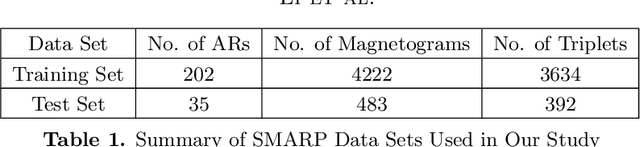
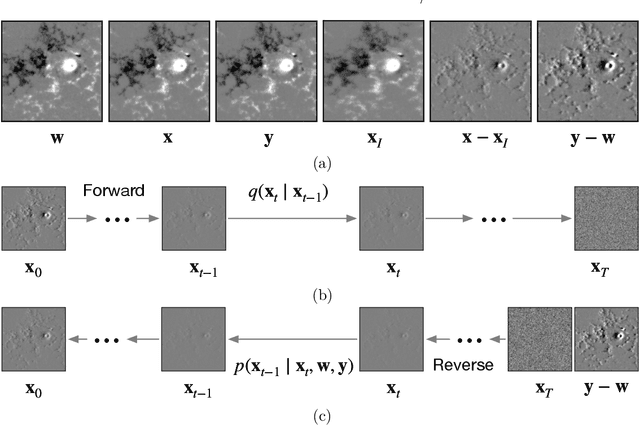

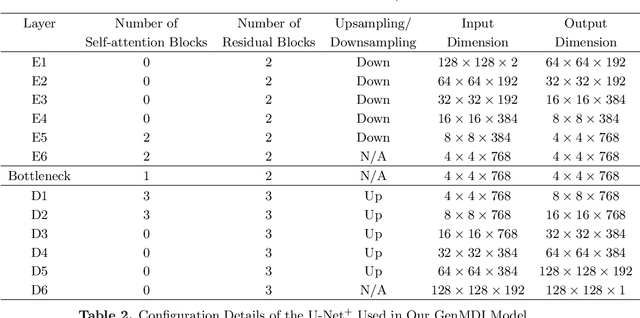
We present a novel deep generative model, named GenMDI, to improve the temporal resolution of line-of-sight (LOS) magnetograms of solar active regions (ARs) collected by the Michelson Doppler Imager (MDI) on board the Solar and Heliospheric Observatory (SOHO). Unlike previous studies that focus primarily on spatial super-resolution of MDI magnetograms, our approach can perform temporal super-resolution, which generates and inserts synthetic data between observed MDI magnetograms, thus providing finer temporal structure and enhanced details in the LOS data. The GenMDI model employs a conditional diffusion process, which synthesizes images by considering both preceding and subsequent magnetograms, ensuring that the generated images are not only of high-quality, but also temporally coherent with the surrounding data. Experimental results show that the GenMDI model performs better than the traditional linear interpolation method, especially in ARs with dynamic evolution in magnetic fields.
Super-Resolution of SOHO/MDI Magnetograms of Solar Active Regions Using SDO/HMI Data and an Attention-Aided Convolutional Neural Network
Mar 27, 2024Image super-resolution has been an important subject in image processing and recognition. Here, we present an attention-aided convolutional neural network (CNN) for solar image super-resolution. Our method, named SolarCNN, aims to enhance the quality of line-of-sight (LOS) magnetograms of solar active regions (ARs) collected by the Michelson Doppler Imager (MDI) on board the Solar and Heliospheric Observatory (SOHO). The ground-truth labels used for training SolarCNN are the LOS magnetograms collected by the Helioseismic and Magnetic Imager (HMI) on board the Solar Dynamics Observatory (SDO). Solar ARs consist of strong magnetic fields in which magnetic energy can suddenly be released to produce extreme space weather events, such as solar flares, coronal mass ejections, and solar energetic particles. SOHO/MDI covers Solar Cycle 23, which is stronger with more eruptive events than Cycle 24. Enhanced SOHO/MDI magnetograms allow for better understanding and forecasting of violent events of space weather. Experimental results show that SolarCNN improves the quality of SOHO/MDI magnetograms in terms of the structural similarity index measure (SSIM), Pearson's correlation coefficient (PCC), and the peak signal-to-noise ratio (PSNR).