 Add to Chrome
 Add to Firefox
 Add to Edge
Modeling and Mitigation of 7.125-7.40 GHz Terrestrial Network RFI on the Passive Earth Exploration Satellite Service in 6.725-7.125 GHz Band
May 03, 2026
The 7.125-7.4 GHz band is attractive for next generation Terrestrial Network (TN) deployments owing to the large bandwidths available and favorable propagation characteristics. Furthermore, recent U.S. Presidential actions have cleared the usage of this band for 6G by stipulating relocation of federal incumbents that share this band. However, this deployment can only be successful if we can also guarantee coexistence of these networks with existing incumbents operating in adjacent bands. This paper presents a comprehensive analysis of the Radio Frequency Interference (RFI) caused by the proposed TNs in the 7.125-7.4 GHz band at passive Earth Exploration Satellite Service (EESS) sensors that operate in the adjacent 6.725-7.125 GHz band. Using TN base stations (BSs) equipped with filtennas (filtering antennas) as well as transmit precoders for RFI mitigation, we carry out an RFI analysis that accounts for increasing BS deployments in the contiguous U.S. over a 10 year period from 2030 to 2040. We also characterize the size of the guard bands needed to protect the EESS sensors for different BS deployment densities. With appropriate filtenna and precoder design, our results reveal that a 100 Mbps increase in the rate requirements of the TN users results in an RFI increase of roughly 2.45 dB at the EESS sensors. For a 25 MHz Guard Band, simulations show that in 2030, there is no significant RFI for user rates upto 500 Mbps. However, the same systems in 2040 would cause RFI that is around 4 dB above the ITU mandated threshold for passive EESS sensors. This would need to be countered by (a) increasing Guard Band width to 35 MHz, or (b) by reducing the user data rate requirements to 300 Mbps.

In-Sensor Radio Frequency Computing for Energy-Efficient Intelligent Radar
Dec 16, 2023Radio Frequency Neural Networks (RFNNs) have demonstrated advantages in realizing intelligent applications across various domains. However, as the model size of deep neural networks rapidly increases, implementing large-scale RFNN in practice requires an extensive number of RF interferometers and consumes a substantial amount of energy. To address this challenge, we propose to utilize low-rank decomposition to transform a large-scale RFNN into a compact RFNN while almost preserving its accuracy. Specifically, we develop a Tensor-Train RFNN (TT-RFNN) where each layer comprises a sequence of low-rank third-order tensors, leading to a notable reduction in parameter count, thereby optimizing RF interferometer utilization in comparison to the original large-scale RFNN. Additionally, considering the inherent physical errors when mapping TT-RFNN to RF device parameters in real-world deployment, from a general perspective, we construct the Robust TT-RFNN (RTT-RFNN) by incorporating a robustness solver on TT-RFNN to enhance its robustness. To adapt the RTT-RFNN to varying requirements of reshaping operations, we further provide a reconfigurable reshaping solution employing RF switch matrices. Empirical evaluations conducted on MNIST and CIFAR-10 datasets show the effectiveness of our proposed method.
Temporal credit assignment for one-shot learning utilizing a phase transition material
Sep 29, 2023
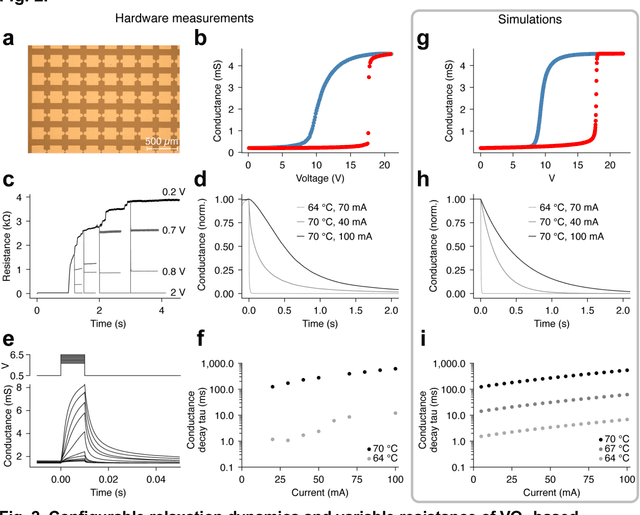
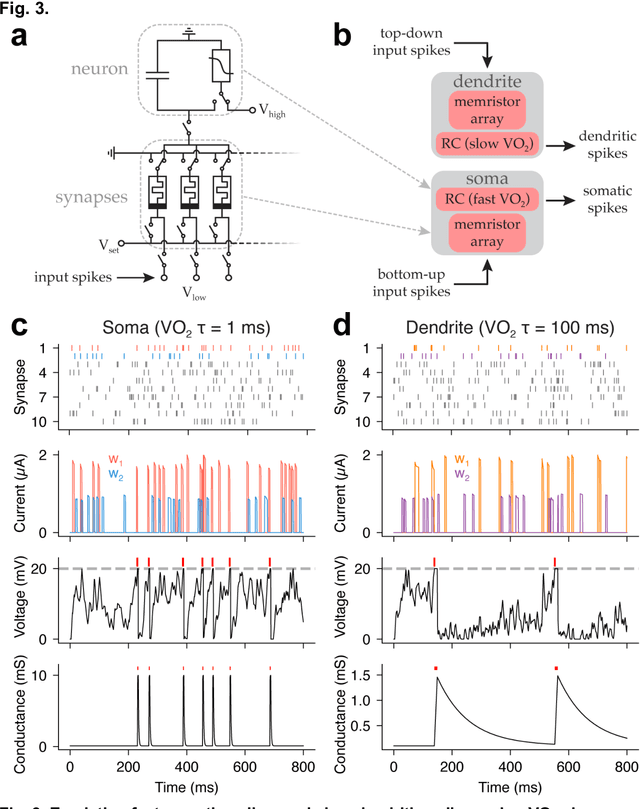

Design of hardware based on biological principles of neuronal computation and plasticity in the brain is a leading approach to realizing energy- and sample-efficient artificial intelligence and learning machines. An important factor in selection of the hardware building blocks is the identification of candidate materials with physical properties suitable to emulate the large dynamic ranges and varied timescales of neuronal signaling. Previous work has shown that the all-or-none spiking behavior of neurons can be mimicked by threshold switches utilizing phase transitions. Here we demonstrate that devices based on a prototypical metal-insulator-transition material, vanadium dioxide (VO2), can be dynamically controlled to access a continuum of intermediate resistance states. Furthermore, the timescale of their intrinsic relaxation can be configured to match a range of biologically-relevant timescales from milliseconds to seconds. We exploit these device properties to emulate three aspects of neuronal analog computation: fast (~1 ms) spiking in a neuronal soma compartment, slow (~100 ms) spiking in a dendritic compartment, and ultraslow (~1 s) biochemical signaling involved in temporal credit assignment for a recently discovered biological mechanism of one-shot learning. Simulations show that an artificial neural network using properties of VO2 devices to control an agent navigating a spatial environment can learn an efficient path to a reward in up to 4 fold fewer trials than standard methods. The phase relaxations described in our study may be engineered in a variety of materials, and can be controlled by thermal, electrical, or optical stimuli, suggesting further opportunities to emulate biological learning.
Space-Time Digitally-Coded Metamaterial Antenna Enabled Directional Modulation for Physical Layer Security
Nov 16, 2022Developing low-cost and scalable security solutions is vital to the advent of future large-scale wireless networks. Traditional cryptographic methods fail to meet the low-latency and scalability requirements of these networks due to their computational and key management complexity. On the other hand, physical layer (PHY) security has been put forth as a cost-effective alternative to cryptographic mechanisms that can circumvent the need for explicit key exchange between communication devices, owing to the fact that PHY security relies on the physics of the signal transmission for providing security. In this work, we propose a space-time-modulated digitally-coded metamaterial (MTM) leaky wave antenna (LWA) that can enable PHY security by achieving the functionalities of directional modulation (DM). From the theoretical perspective, we first show how the proposed space-time MTM antenna architecture can achieve DM through both the spatial and spectral manipulation of the orthogonal frequency division multiplexing (OFDM) signal received by a user equipment (UE). Simulation results are then provided as proof-of-principle, demonstrating the applicability of our approach for achieving DM in various communication settings. To further validate our simulation results, we realize a prototype of the proposed architecture controlled by a field-programmable gate array (FPGA), which achieves DM via an optimized coding sequence carried out by the branch-and-bound algorithm corresponding to the states of the MTM LWA's unit cells. Experimental results confirm the theory behind the space-time-modulated MTM LWA in achieving DM, which is observed via both the spectral harmonic patterns and bit error rate (BER) measurements.
Simultaneous Monitoring of Multiple People's Vital Sign Leveraging a Single Phased-MIMO Radar
Oct 15, 2021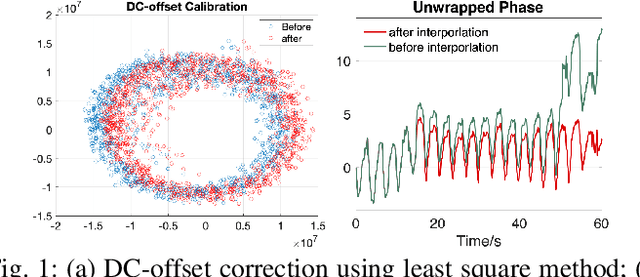
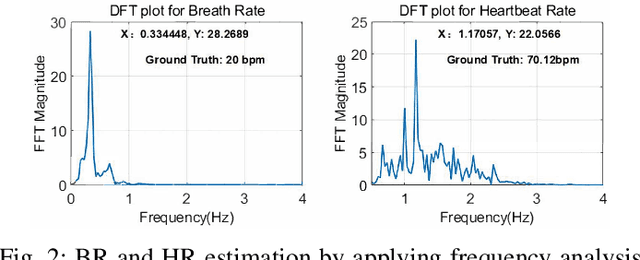
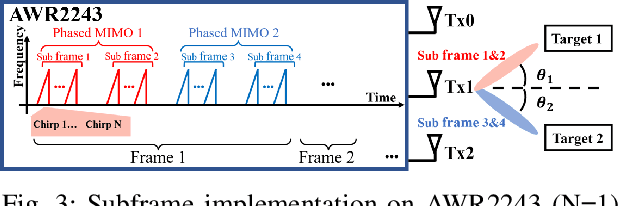
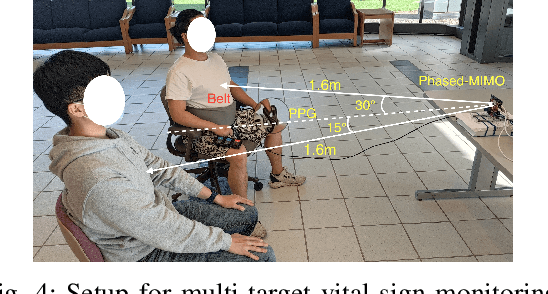
Vital sign monitoring plays a critical role in tracking the physiological state of people and enabling various health-related applications (e.g., recommending a change of lifestyle, examining the risk of diseases). Traditional approaches rely on hospitalization or body-attached instruments, which are costly and intrusive. Therefore, researchers have been exploring contact-less vital sign monitoring with radio frequency signals in recent years. Early studies with continuous wave radars/WiFi devices work on detecting vital signs of a single individual, but it still remains challenging to simultaneously monitor vital signs of multiple subjects, especially those who locate in proximity. In this paper, we design and implement a time-division multiplexing (TDM) phased-MIMO radar sensing scheme for high-precision vital sign monitoring of multiple people. Our phased-MIMO radar can steer the mmWave beam towards different directions with a micro-second delay, which enables capturing the vital signs of multiple individuals at the same radial distance to the radar. Furthermore, we develop a TDM-MIMO technique to fully utilize all transmitting antenna (TX)-receiving antenna (RX) pairs, thereby significantly boosting the signal-to-noise ratio. Based on the designed TDM phased-MIMO radar, we develop a system to automatically localize multiple human subjects and estimate their vital signs. Extensive evaluations show that under two-subject scenarios, our system can achieve an error of less than 1 beat per minute (BPM) and 3 BPM for breathing rate (BR) and heartbeat rate (HR) estimations, respectively, at a subject-to-radar distance of $1.6~m$. The minimal subject-to-subject angle separation is $40{\deg}$, corresponding to a close distance of $0.5~m$ between two subjects, which outperforms the state-of-the-art.